



A juice project usually reaches the aseptic question from the wrong direction. The plant has a product, a target shelf life and a bottle in mind, then asks suppliers for an "aseptic juice filling machine" price. Every quotation returns a different machine, scope and assumption about who validates the process, so the prices cannot be compared.
Filling is a process decision before it is an equipment decision. Two lines filling the same orange juice into the same 500 ml PET bottle can be quoted with different boundaries: one starts at treated product and ends at a capped bottle, the other includes product sterilization, package decontamination, a protected filling zone, sterile air, a sterilization sequence and a validation protocol. Until those boundaries are written down, "aseptic" stays a marketing category.
This guide covers the inputs a juice filling machine supplier needs before a quotation is technically meaningful. It follows the sequence that decides the line: product, process, package, boundary, then validation. It applies to still juice, juice drinks, tea and similar beverages. It does not decide the process for you, because that depends on your product and market requirement.
The product specification decides more of the juice filling machine configuration than any capacity figure. These inputs change equipment selection, and several of them eliminate whole process routes before a model is discussed.
pH and acidity. A high-acid product and a low-acid product carry different microbiological risk and usually different process routes. If the formulation is not final, state the intended range as provisional.
Pulp and particle content. Clear juice, cloudy juice and juice with visible pulp do not share filling valves, product lines or cleaning requirements.
Viscosity and solids. A thin juice drink and a concentrated base behave differently in the product circuit, filler bowl and transfer piping.
Preservation route. Heat treatment, a preservative system or a chilled distribution chain. The route determines whether the filling step carries the preservation duty or only protects an already-sterile product.
Target shelf life and distribution conditions. Ambient, chilled, or a mix. Shelf life is a project requirement, not a machine output.
Whether product sterilization is separate or integrated. Sterilization upstream of the filler and sterilization at the filler are different designs with different boundaries.
Conversion and future products. If the same line will run tea, a juice drink and a functional beverage, say so at the start.
Write these values into the RFQ as numbers or ranges, not adjectives. "Natural juice, high quality, long shelf life" cannot be engineered. "Apple juice, pH 3.5–3.7, no pulp, ambient distribution, 9-month target, no preservative" can.
The container and closure decide the treatment route and the filling environment. The same juice in a glass bottle, a PET bottle and a can requires different package preparation and different protection around the filler.
Container type and material: PET, glass, aluminium can, or a mixed format on one line.
Volume range and shape: the family of sizes the line must handle, not only the launch size. A 0.25–2.5 L range covers most PET juice projects, but the actual range must match your product plan.
Neck finish, cap type and cap material. The closure is part of the package treatment route and the capper configuration. Send the drawing or a physical sample.
Package treatment method for the aseptic or ultra-clean route, and whether it is applied to the preform or the formed container.
Container source: purchased bottles or in-house blowing. This changes line layout, compressed-air demand, transfer distances and where the protected zone begins.
Label and secondary packaging — sleeve, self-adhesive, wrap-around, tray, film or carton. These are downstream of the filler but they change line speed balance and accumulated buffer requirements.
Send samples or drawings. A verbal description of "a 500 ml round bottle" has produced more wrong moulds, change parts and capper settings than any other gap in juice filling machine projects.
Hot fill, ultra-clean and aseptic cold fill are three answers to the same question: how the product and package are protected between sterilization and the sealed bottle. They differ in product treatment, package treatment, filling temperature, filling environment, and cleaning and sterilization program.
Hot filling relies on the product's own heat, applied at filling, plus container and closure selection that tolerates it. Ultra-clean and aseptic routes separate product sterilization from filling and add package treatment and a controlled or sterile filling zone. Aseptic adds a defined sterile boundary, a sterilization sequence for the equipment inside that boundary, and validation evidence.
The route follows the product, the package, the required shelf life, the distribution chain and the market requirement. It is not decided by which machine a supplier prefers to sell, and not by choosing the most advanced option available. A route the plant cannot operate, monitor and recover after stoppages is worse than a simpler one it can run consistently.

Juice hot filling machine with the cap feeder and control panel. Machine model numbers and published output tables describe the base machine. They do not confirm that the same unit meets an aseptic specification for your product and package.
Buyers often treat the filling machine as the aseptic system. It is one part of it. The sterile or controlled boundary typically includes product treatment and transfer, the product circuit inside the boundary, package and closure treatment, the filling and capping enclosure, the air system serving it, cleaning and sterilization circuits, and the monitoring points that prove the condition.
That has a commercial consequence. A quotation for "the aseptic filler" and one for "the aseptic line" cover different equipment, utilities and responsibilities. Before comparing them, confirm:
Where the supplier's scope starts: raw material, prepared product, treated product, or the filler inlet.
Where it ends: capped bottles, labelled bottles, or packed pallets.
Which equipment inside the boundary is included, and which is excluded but still required.
Who supplies and installs the piping, valves, instruments and ducting between separately quoted skids.
How the boundary is established before production, monitored during production, and recovered after a stop.
Connecting two skids with pipe does not create a boundary. The interface has to be designed, installed and tested as part of the system.
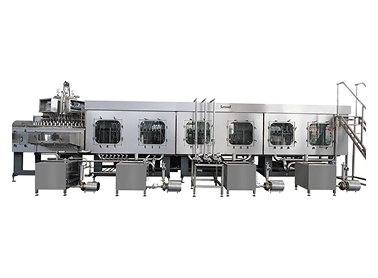
Ultra-clean and aseptic filling machine. The enclosure and glazed access doors form one part of the sterile boundary. Product and package treatment upstream of this unit carry the rest, which is why the quotation has to name where the supplier's scope starts.
Validation is where aseptic juice projects fail commercially rather than technically. The equipment may run, and the buyer may still be unable to release product, because no one agreed who defines the protocol, who executes it, who pays for it and what evidence closes it.
For each critical function — product sterilization, package and closure treatment, the filling environment, cleaning and sterilization, and recovery after a stop — record three names: who designs the function, who supplies or installs it, and who approves the evidence. Each role assumes another party holds it.
Factory acceptance testing confirms the machine's agreed functions and sequences. Site acceptance testing must account for your actual product, package, utilities and operating procedures. Where microbiological validation or product release testing is required, agree the protocol, sampling plan, acceptance criteria and testing owner as documents. Keep the phases separate.
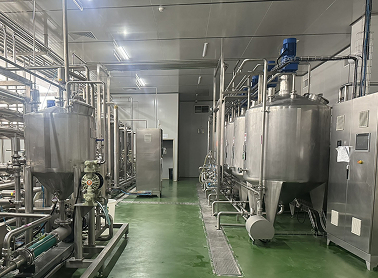
Product preparation and transfer inside a juice plant. Equipment on this side of the line is usually quoted on a separate skid, so the treatment conditions, sampling points and cleaning coverage at the connection have to be assigned to a named party.
| Project situation | Main process concern | Package concern | Inputs to confirm before quotation |
|---|---|---|---|
| Clear juice or juice drink, PET bottle, ambient distribution | Product treatment route and whether the filling step carries preservation duty | Bottle and closure tolerance for the selected filling temperature | pH, solids, target shelf life, bottle drawing, neck finish, cap sample, required net output at a named bottle size |
| Juice with pulp or particles | Filling valve design, product line sizing, cleaning effectiveness | Whether the pulp settles or bridges in the neck and cap area | Maximum particle size and content, viscosity or solids range, filling temperature, cleaning sequence, product samples |
| Tea or functional beverage on the same line | Changeover between recipes and the cleaning program between products | Shared bottle and cap family, or multiple formats | Full product list, changeover frequency, allergen or flavor segregation rules, format range |
| Glass bottle juice | Thermal shock tolerance and handling through filling, capping and cooling | Bottle weight, finish and closure type; breakage handling | Bottle drawing and sample, filling temperature, cooling method, required output, conveyor layout |
| Juice in cans | Filling and seaming interface, dissolved oxygen control if applicable to the product | Can diameter, height, lid specification, empty-can handling | Can and lid drawings, product carbonation state, required output, secondary packaging |
| Ultra-clean or aseptic route | Sterile boundary definition, sterilization sequence, recovery after stoppages | Package and closure treatment before entering the boundary | Process route and its basis, treatment method, boundary responsibility matrix, utility quality at point of use, validation protocol ownership, required evidence |
| Existing line expansion or filler replacement | Interface to preparation, cooling, CIP and downstream equipment | Reuse of existing bottle and cap formats | Existing equipment list with speed and conditions, available space, utilities, interfaces, buffer capacity, changeover plan |
Naming a process before defining the product. Requesting an aseptic line before the formulation, shelf life and distribution are fixed produces quotes for a system the project may not need, or one that cannot meet the actual requirement.
Quoting capacity in BPH without the bottle size. Output figures are meaningless without container volume and dimensions. State the reference bottle and the container range.
Leaving the container to "standard". Neck finish, cap material and bottle weight are project data, not supplier assumptions.
Omitting utilities and environment. Power, treated air, steam, chilled water, compressed air and drainage affect both machine selection and plant layout.
Ignoring the recovery case. A normal stop, a closure jam, an opened access door and a loss of controlled air have unequal consequences. The stop matrix belongs in the technical discussion, not in commissioning.
Treating sanitizing chemicals as a detail. The sterilization media, concentrations and handling procedures must match what the plant is licensed and equipped to store, prepare and use.
Asking for a price before the scope. A number without an equipment list, a boundary drawing and a responsibility matrix cannot be compared with another number.
Skipping waste and product loss planning. Start-up, changeover and sterilization cycles consume product, water and time, so they belong in the production plan.
Yaos Machinery supplies juice filling and bottling equipment and complete juice production lines for PET bottles, glass bottles and cans. The published juice line scope covers water treatment, syrup melting, juice mixing, sterilization, washing-filling-capping, pasteurization, filling, labeling, packing, palletizing and CIP modules, with filling systems described as hot fill, ultra-clean and aseptic. The published capacity range is 1,000 to 24,000 bottles per hour with PET bottle volumes from 0.25 L to 2.5 L, and the automatic filling machine is a three-in-one rinsing, filling and capping unit with PLC control and SUS304/SUS316 construction.
Those figures describe the standard equipment basis. They do not define an aseptic configuration, a sterile boundary, a package treatment method or a validation result for your product, so the configuration and verification package must be confirmed in a project-specific technical proposal.
Practical next step: send the product specification, the process route you are evaluating and its basis, container and closure drawings or samples, target net output at a named bottle size, the equipment you intend to keep, the factory layout and available utilities. Ask for a marked equipment list, a boundary and responsibility drawing, a utility schedule and a test plan with the quotation, so the technical proposal can be reviewed before the commercial comparison. Compare the juice filling machine configuration and the juice hot fill, ultra-clean and aseptic line scope against those documents, and treat any unconfirmed item as open rather than assumed.
No. Hot fill, ultra-clean and aseptic routes serve different product, package, shelf-life and distribution requirements. The route follows the product specification and the market requirement, not a preference for the most advanced equipment available.
Not as a rule. The filling temperature, package treatment, environmental protection and cleaning and sterilization programs differ, and they change the machine configuration. If a line must cover several routes, say so at the start so the changeover, zoning and cleaning limits can be assessed.
State the required net output at a named bottle size and the container range the line must cover. Name the basis for the figure — shift length, operating hours, efficiency assumption — so the supplier can confirm whether the proposed machine can meet the commercial production target.
An equipment list marked as included, optional or excluded; a boundary drawing showing where the supplier's scope starts and ends; a responsibility matrix for product, package, environment, cleaning and validation; a utility schedule with quality at point of use; and a test plan covering factory and site acceptance.
The project owner holds responsibility for product release. Suppliers, integrators and testing parties contribute protocol input, execution and evidence. Agree in writing which party designs, performs and approves each part before the order, not after installation.
Schedule depends on the process route, the quantity of custom equipment, the validation scope and the buyer's own civil, utility and recruitment work. Ask for a milestone schedule with buyer responsibilities listed, and treat any delivery date given before the technical scope is fixed as provisional.
Usually it needs assessment rather than an answer. Product conditions, flow rate, pressure, cleaning circuits, control interfaces and buffer capacity all affect the connection. Send the existing equipment list with operating conditions and speeds, and ask the supplier to state which interfaces are included.
Questions, not only a price. A supplier that returns a quotation without asking about product data, container drawings, utilities, existing equipment and the intended process route has quoted a different project from the one you are planning.
For a juice project, contact Yaos Machinery at tony@yaos.ltd or +86 18915689808. Send the product specification, container drawings or samples, target output, existing line details and factory layout, and state whether the project requires a hot fill, ultra-clean or aseptic process.


+86-512-58530618

Wukesong Road, Sanxing Town, Zhangjiagang City, Jiangsu Province, China


