



An RFQ that says “juice filler, 12,000 bottles per hour” leaves the supplier to assume the formula, preservation process and bottle. Those assumptions can change the filling configuration, product transfer, cleaning system and cooling requirements. They also make competing quotations difficult to compare.
For a useful juice filling equipment proposal, issue one controlled project brief with a row for each product and bottle combination. Record known values, mark provisional values and name the decisions still open. Ask every bidder to answer the same fields and return a list of deviations. The checklist below is designed for bottle-based juice projects, including approved hot-fill, ultra-clean or aseptic routes.
You can start a budget discussion with a short package: formula characteristics, intended process, bottle and cap details, and required output. A final machine selection needs more detail. Keep the RFQ revision number on the product sheet, drawings and supplier response so changes remain traceable.
| RFQ Area | Buyer Should Provide | Supplier Should Return |
|---|---|---|
| Product | Juice family, pH, Brix, viscosity at a stated temperature, pulp, foam and settling behavior | Proposed filling configuration, product limits and sample-test requirements |
| Process | Approved or proposed preservation route, filler inlet conditions and storage objective | Process boundary, temperature controls, return route and unresolved decisions |
| Package | Bottle and cap drawings, material, fill quantity, samples and revision | Handling range, closure configuration, format parts and compatibility checks |
| Capacity | Net accepted output for each SKU, shift plan and changeover frequency | Reference speed, net-output basis, line constraints and test conditions |
Yaoshi's juice filling equipment range is a starting point for the machine discussion. The RFQ should connect the selected equipment to an identified recipe, process and package.
Describe whether the product is clear juice, cloudy juice, nectar, concentrate-based drink or another formula. State the available pH, soluble solids in degrees Brix, density and viscosity data, including temperature and measurement method. If laboratory values are unavailable, mark them pending and arrange representative samples.
A product's behavior at the filler inlet matters for selection. Describe foaming, settling, sensitivity to air pickup, and any limits on agitation or repeated circulation. Give the supplier the expected range across batches, not only one ideal sample. If disclosure of a full recipe is restricted, begin with the engineering properties needed for selection and agree how confidential information will be shared.
“Contains pulp” is incomplete. Record pulp or fiber type, concentration, minimum and maximum dimensions, hardness and settling behavior. Ask how the supplier will maintain distribution from the holding tank through transfer and filling, whether separate dosing is proposed, and what trials support the decision. Do not assume every product called juice can pass through the same valves.
Request a trial plan that names sample quantity, conditioning temperature, test duration and checks for fill consistency, particle distribution and product damage. These are fields for confirmation rather than universal limits.

Juice preparation and transfer conditions belong in the RFQ before the filling configuration is finalized.
State whether the route is approved or still being evaluated. Include the intended preservation objective, storage and distribution conditions, product temperature at the filler, permitted operating range, upstream flow and available pressure. The RFQ should identify who supplies the process design and who approves its validation.
For hot-fill, request the operating sequence covering product treatment, transfer, filling, immediate closure and any approved post-fill package treatment or cooling. Ask what happens when the product falls outside its approved inlet conditions or the line stops. Any product return, recovery or disposal route needs an owner.
For ultra-clean or aseptic filling, define the relevant product, package and closure treatment, controlled filling environment, cleaning or sterilization circuits, monitoring and restart requirements. A hot-fill temperature or UHT unit alone does not define an aseptic system. Yaoshi's juice hot-fill, ultra-clean and aseptic solutions describe different project routes; the proposal must state which one it covers.
Upstream preparation should also be explicit. If blending, filtration, homogenization, treatment or holding is needed, identify each duty and its inlet and outlet conditions. Use the beverage pretreatment equipment range to discuss the modules, then mark the agreed equipment as included, optional or buyer supplied.
For each bottle, provide material, nominal and target fill quantity, overall dimensions, neck finish, drawing tolerances and sample revision. Add cap dimensions, material, seal or liner, closure method and the required closure checks. Photographs help identify the format but cannot replace dimensioned drawings.
For PET hot-fill projects, ask the bottle and cap suppliers to confirm suitability for the entire filling, closing and cooling cycle. For glass, provide handling and thermal limits relevant to the approved process. The filler supplier should return a matrix listing accepted formats, change parts, adjustments and restrictions.
Include labels and final packs early enough to define the downstream handoff. Specify bottle condition at label application, coding position, bottle count per pack and film or carton design. These inputs help determine where the filling supplier's responsibility ends.
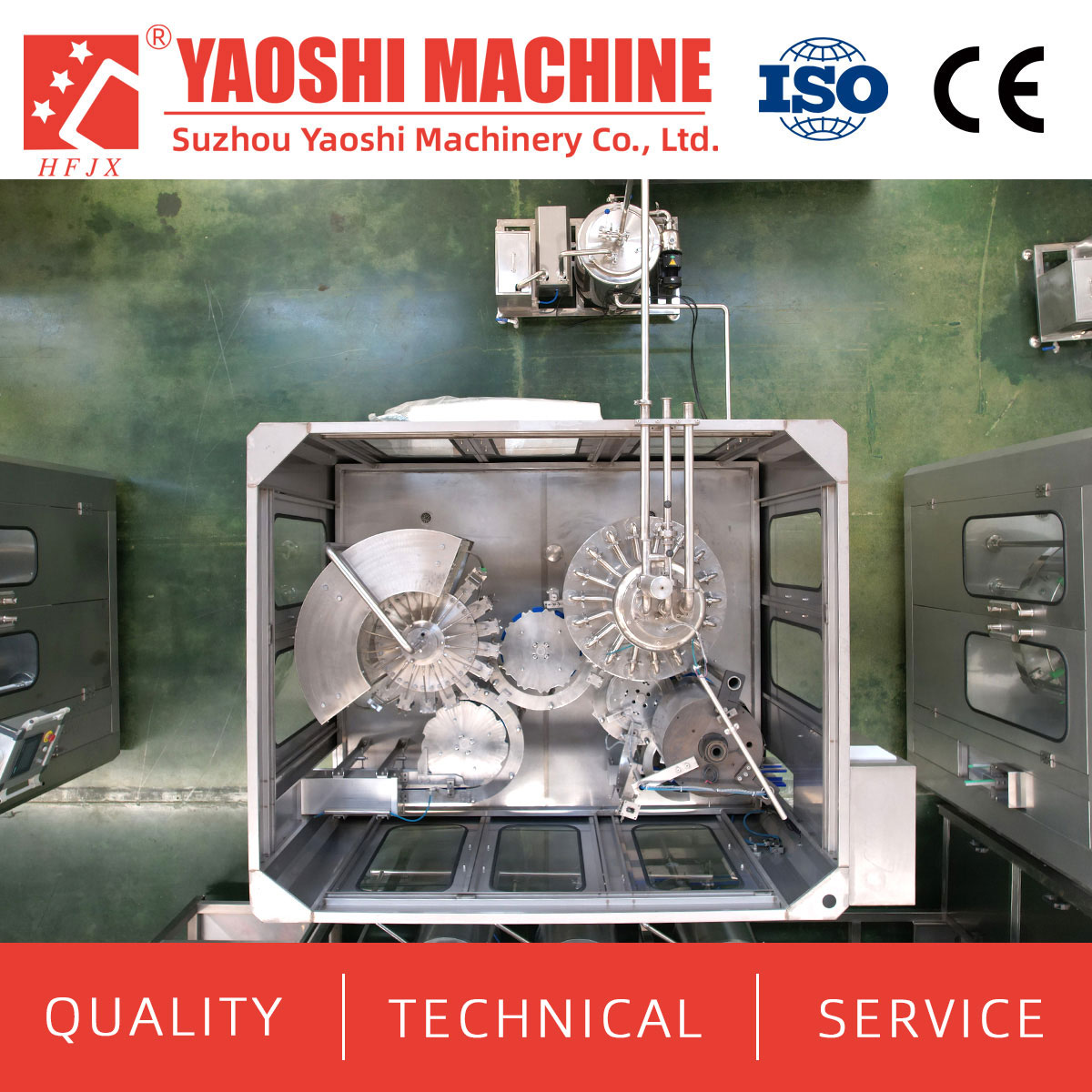
Official equipment illustration. The model and configuration in a quotation should be identified independently of the photograph.
List required accepted bottles per hour for every launch SKU. A small bottle of clear drink and a larger bottle of pulpy nectar need separate output entries. State the shift length, batch volume, product changes and bottle-format changes. Mark future formats as options so they can be evaluated separately.
| Field for Each SKU | Entry to Make | Quotation Check |
|---|---|---|
| Product and process | Recipe code, key properties, approved filling condition | Does the proposed duty cover that product? |
| Bottle and closure | Drawing revision, fill quantity, cap code | Are samples, parts and format limits identified? |
| Required output | Accepted bottles/hour at a named count point | Is rated speed distinguished from accepted line output? |
| Production schedule | Batch sizes, shifts, cleaning and change sequence | Are changeovers and process supply reflected in daily output? |
| Final pack | Label, code, bottles/pack and pack style | Can downstream equipment sustain the same bottle flow? |
Use fill volume to cross-check product demand. For example, 12,000 accepted bottles per hour at 500 ml contain 6,000 litres per hour. That arithmetic excludes process losses, return flow and cleaning demand. Ask the supplier to size the complete product-water and juice flow balance rather than treating that number as the full utility requirement.
The following figures come from Yaoshi's “Juice beverage hot filling machine” product table. They are preliminary catalogue references for the named RCGF models. They do not specify validated thermal settings, particle limits or aseptic performance.
| Model in Hot-Fill Table | Capacity Stated in That Table | Listed Power | Dimensions (mm) | RFQ Follow-Up |
|---|---|---|---|---|
| RCGF18-18-6 | 8,000 BPH | 4.4 kW | 2800 × 2150 × 2500 | Confirm bottle size, juice properties and test basis |
| RCGF24-24-8 | 12,000 BPH; the separate solution table states 8,000–10,000 BPH at 500 ml | 5.2 kW in hot-fill table | 3100 × 2500 × 2500 in hot-fill table | Reconcile the two public ratings in the signed datasheet |
| RCGF40-40-12 | 24,000 BPH | 7.8 kW | 4500 × 3300 × 2600 | Confirm sustained output and utility scope for the offered build |
The hot-fill model table also lists bottle diameter 50–115 mm, height 160–330 mm and 200–2000 ml, while another table on the page starts at 100 ml. Ask for one reconciled, model-specific datasheet covering the exact bottle. A public range should not be treated as automatic compatibility.
Record the SKU sequence, pulp deposits, cleaning expectations, allergens if present and limits on product carryover. Request a CIP circuit matrix covering supplied tanks, transfer pipes, filler and return loops. Identify manual cleaning tasks, isolated sections, drainage and the party responsible for establishing and verifying the cleaning procedure.
Attach a scaled layout and utility information: voltage, phase, frequency, available electrical load, compressed-air quality and flow, process water, heating and cooling services, and drainage. Include access for installation, maintenance and materials. In an existing plant, give connection elevations, pipe sizes, conveyor direction, control signals and capacities for retained machines.
The secondary packaging equipment should receive the agreed bottle condition and support the required pack rate. Name the integration owner for each upstream and downstream interface in the supplier response.
Ask the supplier to return a compliance table using four statuses: included, optional, excluded or subject to trial. Every open item should have an owner and a closure method. The quotation should identify the proposed model, configuration, product-contact path, format parts, utilities, documents and scope boundaries.
Before ordering, agree the factory acceptance test (FAT): product and package materials, conditioning, run duration, accepted output, fill checks, pulp distribution where relevant, cap checks, stops and changeovers. Allocate who provides samples, measuring instruments and test materials. Define which tests are repeated at site acceptance (SAT) and which process-validation work is performed separately.
Request the final layout, electrical drawings, process diagrams as applicable, manuals, parts list, settings or software backups as agreed, training scope and test records. Return all suppliers' offers to the same RFQ revision before comparing prices.
Yes. Mark unknown fields and request written assumptions. Replace consequential assumptions with measurements, drawings or trials before approving the final configuration.
Start with the properties required for selection. Agree a confidentiality process if a complete formulation is needed for technical review or validation.
State the measurement temperature and the expected filler inlet temperature. If they differ, provide data that represent actual filling conditions.
It requires confirmation. Ask for accepted product limits, passage and dosing design, cleaning changes and trials using representative recipes.
No. Request a separate configuration and performance basis for the proposed process, package treatment and operating boundary.
Record both versions and request a corrected datasheet tied to the quoted machine. Confirm the reference bottle, product, speed and utilities in writing.
Send one product-and-package matrix and require the same compliance, scope, utility and test schedules from every supplier.
For a new juice line, product extension or filler replacement, send Yaoshi Machinery the formula characteristics, intended process, bottle and cap drawings, and target output for each SKU. Add existing interfaces and factory information where available. Request a marked equipment configuration, deviation list and trial plan. Contact tony@yaos.ltd or +86 18915689808.
<!--!doctype-->


+86-512-58530618

Wukesong Road, Sanxing Town, Zhangjiagang City, Jiangsu Province, China


