



A request for “one tea filling machine” leaves the main engineering decision unresolved. Ready-to-drink black tea, reconstituted instant tea, milk tea, tea with fruit pieces and carbonated tea do not arrive at the filler under the same conditions. Their recipes affect extraction, filtration, thermal treatment, oxygen control, cleaning and package selection.
Equipment planning should begin after the tea product and preservation process have been confirmed by the producer's product team and process authority. The supplier can then match the product-delivery system, filler, closure equipment, cooling section and downstream packaging to those approved conditions.
The commercial name does not define how the product behaves in a machine. Prepare a separate line in the project specification for every tea SKU and identify its product family:
tea extracted from leaves, herbs or botanicals at the factory;
tea prepared from a liquid concentrate or instant powder;
sweetened or flavored still tea;
tea blended with juice, pulp, seeds or other visible inclusions;
milk tea or a formula containing protein, fat or emulsified ingredients; or
carbonated tea requiring pressure-controlled product handling.
These categories may share some packaging equipment, but they do not automatically share the same preparation or filling route. A still, filtered tea can be evaluated for a hot-fill line when the approved process and package support it. Carbonated tea needs pressure and temperature control associated with carbonated filling. Milk tea and other low-acid or protein-containing formulas require a preservation and hygiene review specific to the finished product.
Give the equipment supplier measured product data at the intended process and filling conditions. Useful inputs include:
ingredient list and recipe status;
pH or acidity, soluble solids, density and viscosity;
tea solids, fibres, fruit pulp, seeds or other particles;
maximum particle dimensions, concentration and settling behaviour;
protein, fat, stabilizer or emulsifier where present;
foaming, air pickup and oxygen sensitivity;
heat sensitivity, color change and aroma-loss concerns;
allergen and recipe-change requirements; and
target shelf-life and distribution conditions validated by the producer.
Viscosity should be recorded at the temperature seen by the pumps and filler. Particle information should describe the largest inclusion and fibre length, not an average value. A product sample is useful when the formula contains suspended material or has unusual foaming and flow behaviour.
A tea beverage production line may start with treated water and dry tea, or it may receive a prepared concentrate. This difference changes the equipment boundary. On-site extraction can involve tea feeding, controlled contact with water, separation of spent material, filtration and extract storage. Concentrate or powder routes may instead require controlled dissolution, mixing and filtration.
The producer should establish extraction time, temperature, tea-to-water ratio and quality targets through product development. The equipment supplier then designs tanks, filters, heat exchangers, pumps and controls for those confirmed requirements. Generic extraction settings should not be copied from another tea because they can change taste, color, haze and solids load.
Filtration needs a defined purpose. It may remove leaf fragments, control fine solids or prepare the product for a particular heat exchanger and filling valve. Excessive filtration can alter the intended product. Insufficient separation can load narrow passages and create deposits. State the required product condition after filtration and the acceptable loss or recovery method.
Yaos Machinery's beverage pretreatment systems cover equipment used before filling. For a tea project, the quotation should identify which preparation functions are included, the product-contact materials, tank working volumes, instrumentation and connection points.
Hot filling is one possible route for suitable still tea beverages. Other products may use a separately confirmed ultra-clean, aseptic, chilled or in-container process. The correct choice depends on the final recipe, microbiological risk, desired shelf life, package and distribution conditions.
The product developer or process authority should approve the preservation method and operating limits. The machine supplier should not promise shelf life from filler type alone. Once the process is approved, the line specification must define:
product condition at the thermal-process inlet;
approved treatment and holding requirements;
temperature, pressure and flow delivered to the filler;
the hygienic boundary after treatment;
recirculation, diversion and product disposition during stops;
restart conditions and responsibility for release; and
the required treatment of bottles, caps or cans.
This interface links product safety work to equipment design. It also prevents the thermal skid and filler from being quoted as unrelated machines.

Thermal treatment and the filler need a shared flow, temperature, stop and cleaning specification.
For a still tea using an approved hot-fill process, the filler must maintain the stated product condition through filling and closing. The product path, valves, seals and controls must suit the recipe, temperature and cleaning program. A tea with particles may require larger passages, controlled agitation or a separate dosing arrangement. These features should be selected from the real particle specification rather than added as a generic option.
A carbonated tea follows a pressure-controlled filling route. A milk tea or formula with proteins and fats may change the hygienic design, thermal process and cleaning strategy. These products should not be placed on a standard still-tea filler until the supplier has reviewed the full formula and preservation plan.
The Yaos Machinery tea filling machine page presents a rinse-fill-cap arrangement for high-temperature juice and tea applications. Its suitability for a specific tea still depends on the confirmed product, bottle, cap, process conditions and required output.
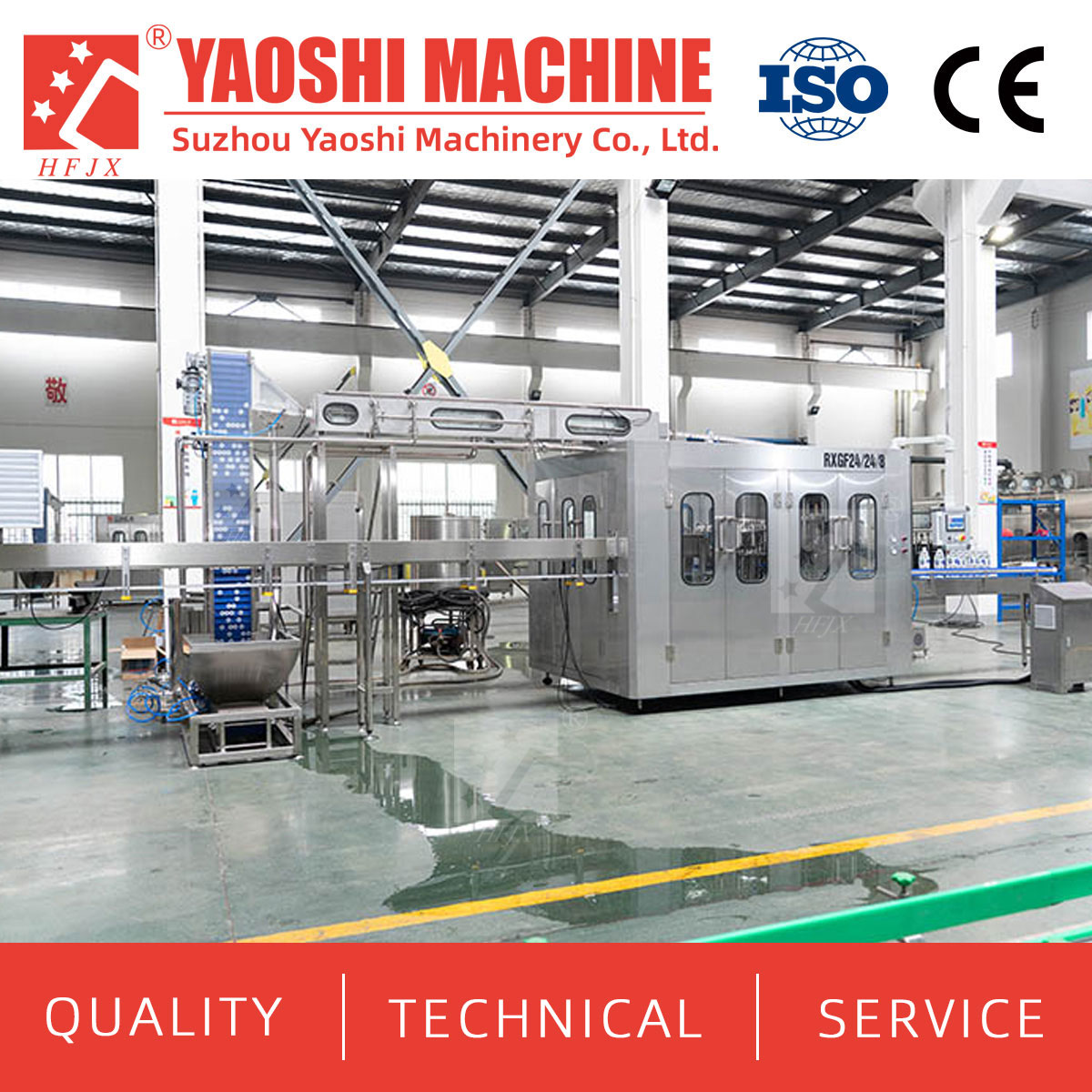
A tea filler should be specified with the incoming product, container and closure as one operating system.
Send drawings and physical samples for each bottle, cap or can. For PET hot fill, the bottle supplier must confirm that the bottle and neck finish suit the approved filling and cooling cycle. For glass, the project must address container handling and allowable thermal shock. For cans, filling and seaming conditions, lid specification and seam inspection need their own scope.
The package data should include container material, volume, dimensions, neck finish, empty weight, closure and liner, target fill level or quantity, headspace, label area and final pack format. If one line will run several formats, identify every planned SKU and the expected changeover frequency.
Package selection cannot be postponed until the filler has been ordered. Filling temperature, closure application, container inversion where approved, cooling and downstream handling can all change with the bottle or can.
When the confirmed process includes hot filling, the cooling section moves the closed container to a condition suitable for the product, package and downstream equipment. The required profile depends on the inlet condition, container material and geometry, closure, volume, line speed and available cooling water.
State the cooler inlet and outlet conditions, zone-control basis, residence-time requirement, water supply, drainage and stop response. Then check the requirements of the labeling machine and coder. A bottle that is too warm, wet or distorted at cooler discharge can produce poor label placement and unstable conveying even when the filler is running correctly.
Tea solids, sugar, milk ingredients, stabilizers and fruit components can produce different deposits. The hardest SKU and the most demanding product transition should set the cleaning basis. A clear unsweetened tea may not represent the cleaning time needed after milk tea or a product containing pulp.
Request a CIP flow diagram that marks supply and return circuits, drain points, valve states, removable parts and manually cleaned areas. Confirm how extraction vessels, filters, blend tanks, heat treatment, buffer tanks, filler and product-return lines are included. Cleaning chemistry, concentration, temperature and contact time should be validated for the recipe, materials and plant hygiene plan rather than taken from a universal schedule.
Where allergens are present, document the changeover sequence and verification method. The quotation should distinguish automated CIP, operator tasks and any parts that require disassembly.
Nominal bottles per hour should always refer to a stated bottle, product and filling condition. The required output for a 300 ml clear tea may not represent a larger bottle or a product with particles. Ask the supplier to state rated output for the main commercial SKUs and to identify the condition used for acceptance testing.
Compare liters per hour through preparation and thermal processing with bottles per hour at the filler and packs per minute downstream. Include batch preparation, filter service, product transitions, CIP and package changeovers in the production schedule.
The secondary packaging equipment must sustain the selected bottle and pack format. Conveyors and accumulation should absorb defined short interruptions, but they cannot compensate for an undersized thermal process, cooler or packer.
| Area | Buyer input | Supplier response |
|---|---|---|
| Tea product | Recipe family, source of tea solids, pH, soluble solids, density, viscosity, foam and oxygen sensitivity | Suitable product path, limitations and required product tests |
| Particles | Type, maximum size, fibre length, concentration and settling behaviour | Minimum passage, feed method, agitation or separate dosing proposal |
| Preparation | Extraction or reconstitution route, filtration target, batch size and product outlet condition | Included tanks, filters, pumps, instruments and battery limits |
| Preservation | Process approved by the process authority and required hygiene level | Thermal and filler interfaces, stop logic and container-treatment scope |
| Package | Bottle, cap or can drawings and samples; fill target; label and pack format | Handling method, change parts, closure system and package limits |
| Cooling | Approved thermal cycle, required outlet condition and site water data | Cooling basis, utilities, control zones and downstream interface |
| Cleaning | Soil load, allergens, SKU sequence and sanitation standard | CIP circuits, manual tasks, cleaning boundary and validation support |
| Capacity | Stable output by SKU, shifts, batch plan and changeover frequency | Rated output, line balance, test condition, assumptions and exclusions |
A water test can confirm basic mechanical operation but cannot reproduce tea foam, color, deposits, viscosity or suspended ingredients. Agree on a representative test product and package before the order. If the commercial formula cannot be supplied for FAT, define an approved test medium and record what the test does and does not prove.
The acceptance plan should cover stable output, fill control, closure application, package condition, rejects, stop and restart logic, changeover tasks and cleaning sequence. SAT should verify the installed tea beverage filling machine with site utilities, upstream product preparation and downstream packaging.
Selecting a hot-fill machine before the preservation process is approved.
Describing the product only as green tea, black tea or milk tea.
Ignoring tea solids, haze, fibres or fruit inclusions at the filler inlet.
Using room-temperature viscosity for a product filled at another temperature.
Finalizing the bottle after thermal treatment and cooling have been specified.
Leaving extraction, filtration, buffer and CIP boundaries outside the quotation.
Comparing filler BPH without checking cooler and packer capacity.
No. Suitability depends on the complete recipe, approved preservation process, target shelf life, package and distribution conditions. Milk-containing, carbonated or otherwise sensitive products require a separate review.
Only if the product passages, filling method, feed system and cleaning arrangement cover both products. Maximum particle dimensions and concentration must be confirmed before selection.
Not automatically. Extraction, filtration, blending, heat treatment and CIP may be separate modules. The contract should mark every included, optional and excluded section.
They normally require different container handling, closure and sometimes filling arrangements. Do not assume that format flexibility across these package types is a standard changeover.
The basis includes container and product inlet conditions, required outlet condition, approved thermal profile, bottle volume, line speed and site cooling-water data.
Provide the SKU matrix, recipe and particle data, approved process conditions, package drawings and samples, output by SKU, cleaning requirements, utility data, layout and preferred project scope.
Yaos Machinery lists preparation, thermal treatment, filling, cooling, labeling and packing equipment within its hot-fill, ultra-clean and aseptic beverage solutions. The final tea line should be configured from the confirmed recipe and process rather than copied from a standard juice layout.
Send the tea type, complete formula category, particle data, approved preservation route, filling condition, bottle or can drawings, required output and factory layout through the contact page. Ask for a proposal that identifies the filling method, preparation and CIP boundaries, cooling requirements, utilities, test conditions and commercial exclusions.


+86-512-58530618

Wukesong Road, Sanxing Town, Zhangjiagang City, Jiangsu Province, China


