



A carbonated filler cannot be selected from bottle volume and bottles per hour alone. The same 500 ml PET bottle can behave differently when the beverage has another carbonation target, enters the filler at a higher temperature, contains foam-active ingredients or uses a different cap.
A useful CSD filling machine specification connects the product from the carbonator to the closed package. The buyer should define carbonation, temperature, pressure, bottle and closure conditions at the same time. The supplier should then explain how the proposed filler maintains those conditions during steady production, short stops and restarts.
Carbon dioxide remains dissolved more readily when the beverage is colder and kept under sufficient pressure. A temperature increase or sudden pressure drop can release gas from solution. At the filler this appears as foam, unstable fill levels, product loss and reduced carbonation in the closed bottle.
Counter-pressure or isobaric filling reduces that disturbance by bringing the container and product system to controlled pressure conditions before liquid enters. Filling is followed by controlled pressure release and prompt closure. The complete cycle matters; “isobaric” on a machine datasheet does not confirm performance for every recipe and package.
The filler supplier needs the product condition at the machine inlet, not only the target printed on the label. Carbonator performance, transfer piping, buffer arrangement, filler bowl control, filling valves, venting and capper timing form one pressure-managed section.
State the target and permitted range using an agreed unit, such as grams per liter or volumes of carbon dioxide. Identify where the sample is taken, the product temperature at measurement and the test method used by the plant. Without this basis, two parties can report different results for the same beverage.
Provide data for every SKU. Cola, sparkling water, tonic and a carbonated energy drink may have different carbonation and foaming behaviour. The specification should also identify whether the filler must run products with different gas targets during the same production week and how recipe changeovers are handled.
Ask the supplier to state the supported product range and the conditions used to select operating pressure. Do not use one generic pressure value for all beverages. Carbonation target, product temperature, elevation, product composition and equipment pressure limits must be considered together.
A low and stable product temperature can reduce carbon dioxide breakout, but the required value is product- and process-specific. Record the design range at the carbonator outlet, filler inlet and filler bowl. Include the permitted variation during normal production and the expected change after a short stop.
Temperature control depends on more than a chiller nameplate. The quotation should identify heat-exchanger duty, coolant conditions, insulated or uninsulated product lines, transfer distance, ambient design conditions and the heat gained through pumps and recirculation. The product should arrive at the filler within the agreed range at the required flow.
If an existing plant is replacing only the filler, measure the actual product temperature throughout a production day. A new machine cannot correct an upstream carbonator or cooling system that delivers an unstable condition.
The CSD mixer or carbonator should deliver a stable beverage flow, carbonation level, temperature and pressure. The filler should return clear operating requests and stop signals. Both suppliers need one interface schedule covering:
normal and maximum product flow;
temperature and pressure at the agreed connection point;
carbonation target and test location;
pipe size, length, elevation and pressure rating;
buffer volume and level-control strategy;
product recirculation or disposition during a stop;
start permission, ready, fault and speed signals; and
responsibility for instruments, valves and interconnecting pipework.
Yaos Machinery includes a CO2 beverage mixer within its carbonated soft drink production-line solution. For a project quotation, the mixer and filler should be sized against the same product data and operating sequence.
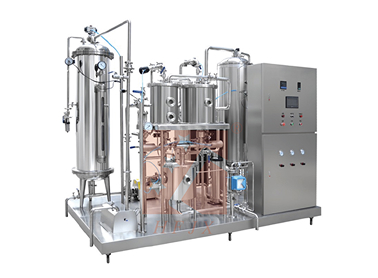
The mixer, carbonator and filler need a common temperature, pressure, flow and stop-control specification.
Foam is affected by carbonation, temperature and pressure release, but the recipe also matters. Sweeteners, juice content, proteins, stabilizers and other ingredients can change bubble formation and collapse. Air pickup or poor deaeration upstream can add another source of instability.
Give the supplier a representative finished product, not only carbonated water, when foam behaviour is a selection risk. During trials, record product temperature, carbonation, supply pressure, bowl condition, valve settings, filling time, pressure-release sequence, foam height, fill result and time to closure.
Do not solve foam only by slowing the filler. Review cooling, carbonation, product transfer, pre-pressurization, filling profile and controlled venting first. The agreed solution should retain the required product condition while meeting output and package-quality criteria.
Send dimensioned drawings and samples for every bottle and closure. For PET, confirm the bottle supplier's approved internal-pressure performance, neck finish, base design, empty-bottle stability and dimensional tolerances. For glass, confirm pressure rating, inspection requirements and allowable handling conditions. Cans require a filling-and-seaming arrangement and should not be treated as a bottle-format change.
The package specification should include:
container material, volume, diameter, height and empty weight;
neck finish or can-and-end specification;
closure material, dimensions, liner and application method;
target fill quantity or level, tolerance and headspace;
approved package pressure and temperature limits;
cap application and seal-inspection requirements;
label and coding area; and
secondary-pack and pallet format.
The time between controlled pressure release and closure can influence foam and product loss. The filler and capper therefore need coordinated speeds, transfers and fault logic. A cap supply interruption should trigger a controlled response rather than allowing filled bottles to remain open.
Yaos Machinery presents isobaric bottle-filling equipment for soda, sparkling water and other carbonated soft drinks in its CSD filling machine category. Model selection should use the required stable output for a stated product, bottle, cap, carbonation level and inlet temperature.
A rinse-fill-cap monoblock can reduce open transfers between these operations, but it does not define the upstream carbonator, cooling system, cap handling, downstream warming or final pack. Buyers should request a boundary drawing and utility list rather than assume those modules are included.

The selected filler must be evaluated at the agreed product temperature, carbonation, package and sustained output.
Normal production is only one operating mode. Short downstream stops can warm product in the filler, change foam behaviour and interrupt the supply from the carbonator. Longer stops may require recirculation, product diversion, depressurization or cleaning according to the approved plant procedure.
Write a functional description that covers start-up, container starvation, cap shortage, downstream blockage, carbonator fault, filler stop, emergency stop and restart. Assign control ownership at each interface. The document should also define how pressure is released safely and how the line prevents an uncontrolled restart.
The site safety review should cover carbon dioxide storage and supply, ventilation, gas monitoring where required, pressure relief and vent discharge. Final provisions must follow the applicable site and local safety requirements.
A cold-filled bottle may collect condensation when it enters a warmer production room. That moisture can affect coding, label adhesion, inspection and case or film performance. Review ambient temperature and humidity, filled-product temperature and downstream surface requirements.
Where warming or drying is required, define the outlet condition needed by the labeling machine and coder. The treatment must also remain within the package and product limits.
The secondary packaging machine should be specified by bottle format, pack pattern, film or carton, packs per minute and required pallet presentation. Its sustainable output and short-stop pattern belong in the complete line balance.
Syrup, colors, flavors, juice components and other ingredients can change cleaning difficulty. Define the hardest SKU, production sequence, allergen status where applicable and acceptable product carryover. Ask the supplier to mark CIP circuits, return paths, drain points, manually cleaned areas and removable parts.
Cleaning must cover the carbonator-to-filler product path and any recirculation loop, not only the filler bowl. Chemical concentration, temperature, flow and contact time should be validated for the product soil, equipment materials and plant sanitation plan. The quotation should state which CIP equipment and connections are included.
State required saleable output for each main product-and-package combination. A maximum speed achieved with one bottle and a lightly carbonated test liquid does not establish output for a different bottle or high-foam recipe.
Ask the supplier to distinguish mechanical design speed, rated production output and acceptance-test output. Include carbonation and cooling capacity, container supply, capper, bottle treatment, labeler and packer in the calculation. Add planned changeovers, CIP and production schedule to determine daily saleable volume.
For a replacement project, document existing conveyor heights, air-conveyor interface, filler inlet connection, product-return arrangement, cap supply, electrical and control platform, utilities, floor loading and shutdown window. The automatic carbonated soft drink filling machine or another model should be selected only after those interfaces are checked.
| Area | Buyer input | Supplier response |
|---|---|---|
| Product | Recipe family, density, viscosity, foam behaviour, solids, acidity and oxygen requirements | Product limitations, wetted-path proposal and test requirements |
| Carbonation | Target and range, unit, sample point, temperature and test method | Supported range, operating basis and measurement points |
| Temperature | Carbonator outlet, filler inlet and permitted operating range | Cooling duty, heat-gain assumptions and filler requirements |
| Pressure | Product-supply condition, line rating and site elevation | Tank, bowl, pre-pressure, filling and controlled-release sequence |
| Bottle and cap | Drawings, samples, pressure limits, fill target and seal requirements | Handling method, change parts, filling cycle and closure system |
| Output | Stable BPH by SKU, shifts, changeovers and downstream pack formats | Rated output, line balance, assumptions and acceptance condition |
| Cleaning | SKU sequence, soil load, sanitation standard and available CIP | CIP boundary, circuits, manual tasks and product-change time basis |
| Site | Layout, utilities, ambient conditions and existing interfaces | Battery limits, utility loads, installation scope and exclusions |
Water does not reproduce carbonation retention or foam. Agree on a representative beverage and approved package for factory testing. If the commercial product cannot be supplied, define a test medium and record the limits of the test.
The acceptance plan should state test duration, stable output, product temperature, carbonation before and after filling, fill result, foam or overflow criteria, closure condition, rejects, stops and restarts. SAT should repeat the agreed checks with site utilities, the installed carbonator, production bottles and downstream equipment.
Requesting a machine with only bottle size and BPH.
Providing a carbonation target without its unit, temperature or test method.
Assuming the filler can correct unstable carbonator temperature and pressure.
Testing with still water when foam is a main project risk.
Choosing a PET bottle without confirmed pressure performance.
Reviewing filling and capping as separate operating cycles.
Ignoring condensation before labeling and packing.
Replacing a filler without surveying existing product and control interfaces.
It controls the pressure difference between the product system and container during filling, helping limit carbon dioxide breakout and foam. The complete result also depends on product temperature, carbonation, pressure release and closure timing.
Provide the target and allowable range, unit of measurement, sample point, product temperature and plant test method for every SKU.
No. Temperature is one factor. Product composition, carbonation, transfer pressure, filling profile, venting and closure timing must be reviewed together.
Only if the machine and change parts are designed for both packages and their handling, pressure and closure requirements. The supplier must review drawings and samples before confirming compatibility.
A gravity water filler is not automatically suitable for pressure-controlled carbonated filling. Review pressure rating, tank, valves, gas handling, controls, capping and product supply before considering any conversion.
Provide the product and package data plus verified site dimensions, elevations, pipe connections, pressure ratings, cap feed, controls, utilities, downstream capacity and available shutdown period.
Send Yaos Machinery the product matrix, carbonation specification, filler-inlet temperature and pressure, bottle and cap drawings, required output by SKU, factory layout and existing-line interfaces through the contact page. Ask for the proposed filling cycle, supported operating window, carbonator interface, cleaning scope, utility basis and acceptance conditions.


+86-512-58530618

Wukesong Road, Sanxing Town, Zhangjiagang City, Jiangsu Province, China


