



A request for “one liquid filler at 10,000 bottles per hour” is not enough to select equipment. That output could refer to still water in 500 ml PET bottles, carbonated soda in pressure-resistant bottles, or hot-filled juice in heat-resistant containers. The nominal speed may be similar, but the product path, filling valve, tank conditions, container handling and downstream interfaces are different.
The practical way to compare types of liquid filling equipment is to start with the product at the filling point. Then confirm the container and closure, required output, cleaning method and connection to the rest of the line. This guide explains the main filling approaches used in beverage projects and the information a supplier needs before recommending a configuration.
A beverage name does not fully describe how it must be filled. The supplier needs the liquid condition when it reaches the filler. Water is normally still and free-flowing. A carbonated soft drink must retain dissolved gas while foam is controlled. Juice or tea may be filled hot, but only when the approved preservation process calls for hot filling. Products with pulp, fibers or suspended ingredients require a product path and valve design that can pass those particles and still be cleaned effectively.
Record the following before comparing filling methods:
These inputs narrow the possible methods before speed or automation is discussed. They also prevent a buyer from treating water, juice and carbonated drinks as interchangeable applications.
Gravity filling uses the liquid head above the filling valve to move a free-flowing product into the container. It is commonly considered for still, low-viscosity beverages when the product does not require pressure control. The engineering review should cover liquid level stability, valve flow, dripping, bottle-neck geometry and the required fill result.
For bottled-water projects, the filler may be combined with rinsing and capping in a monoblock. The machine still has to be specified against the bottle material, volume, neck finish and cap. Review the available water filling machine configurations only after these package details are fixed.
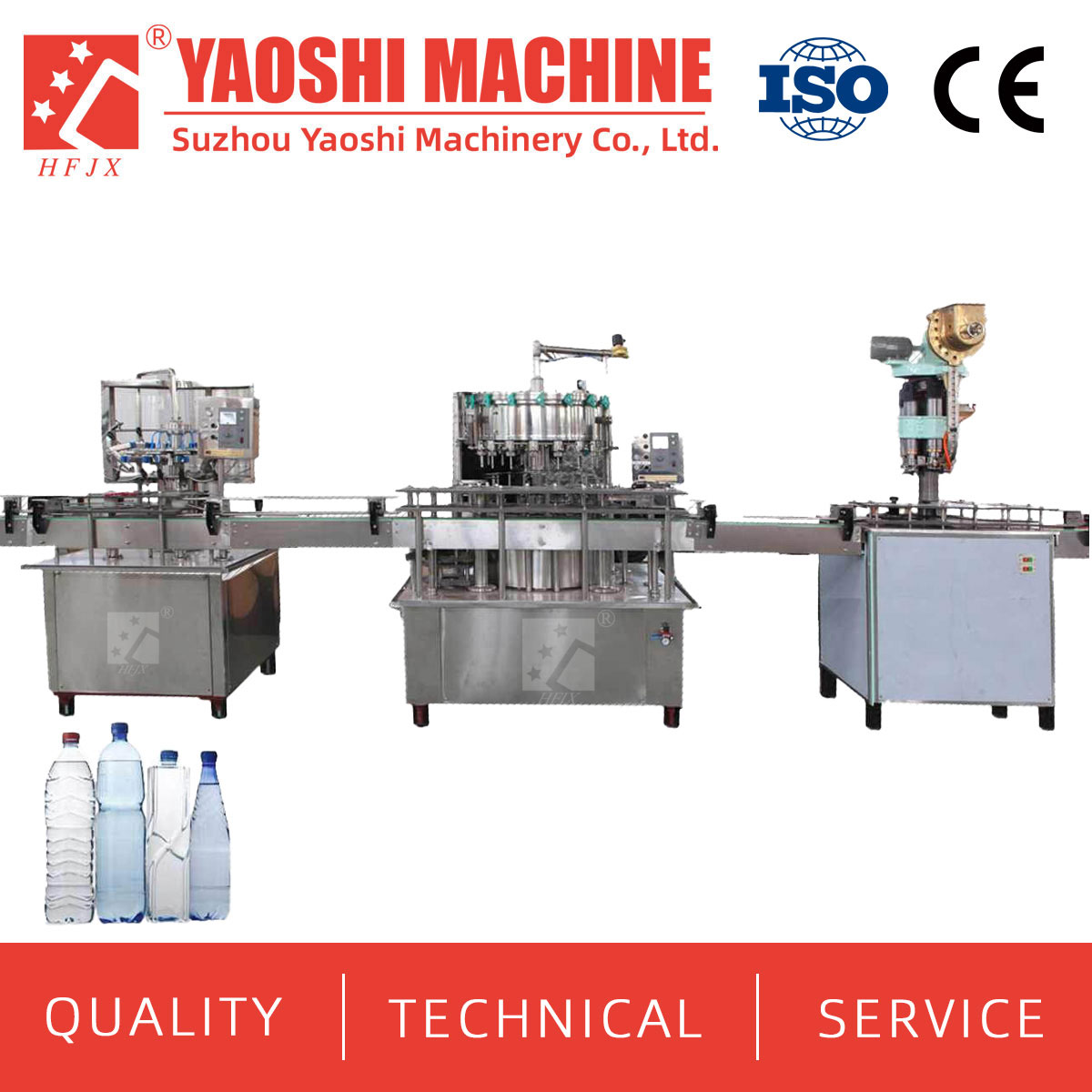
Gravity filling should not be selected from viscosity alone. A still product can still create foam, contain particles or require a controlled hygienic process. Those conditions may change the valve, product tank, return path and cleaning design.
Some applications need more control than an open gravity system provides. A pressure-gravity arrangement can use controlled tank pressure to support product flow while filling still or lightly behaving liquids, where applicable. The supplier should state the required inlet pressure, tank condition and valve sequence instead of describing the machine only as a “pressure filler.”
This category must not be confused with isobaric filling for carbonated products. The pressure conditions, gas handling and purpose of the two approaches are different.
Carbonated beverages require a filling process that manages product temperature, pressure and foam. In an isobaric or counter-pressure process, the container and product tank are brought to controlled pressure conditions before liquid enters the container. The purpose is to reduce uncontrolled gas release during filling and support stable closure afterward.
The machine cannot compensate for warm, unstable or incorrectly carbonated product arriving from upstream processing. Before selecting a CSD filling machine, provide the target carbonation condition, product temperature at the filler, bottle or can specification, closure type and required output for that exact package.

The quotation should also identify the upstream product supply conditions and the timing between filling and capping or sealing. A PET bottle, glass bottle and can may contain the same drink but need different handling and closure equipment.
Volumetric equipment meters a defined quantity rather than filling only to a visible level. Depending on the application, the measured quantity may be controlled by a piston, flow meter or another dosing arrangement. Volumetric filling can be relevant when the declared amount is the main acceptance criterion or when the container geometry makes level-based filling less suitable.
The product must still match the measuring method. Conductivity, density variation, viscosity, particles, temperature and entrained gas can affect whether a particular measuring principle is appropriate. Ask the supplier to identify the measurement method, product limitations, calibration procedure and acceptance test rather than relying on the word “volumetric.”
Piston or pump-based filling is often discussed for liquids that do not flow predictably by gravity. It may suit higher-viscosity products or applications that require controlled displacement, but the pump or piston type must match the recipe. Particle size, shear sensitivity, temperature, seal compatibility and cleaning access all matter.
For beverage products with pulp or fibers, submit samples and a written particle specification. A general statement such as “juice with pulp” does not define the largest particle, concentration or distribution. The supplier should confirm the minimum product-path opening, valve arrangement and cleaning method before offering the machine.
Net-weight filling measures the product by mass while it enters the container. It may be evaluated for larger packages, products whose value makes overfill important, or applications where mass is the required control basis. The trade-off can include a different machine structure and cycle than high-speed rotary beverage filling.
If this method is considered, define whether the commercial requirement is net mass, nominal volume or visual level. Density at the filling temperature must also be known when the declared package quantity is expressed as volume but the machine controls mass.
Hot filling describes the temperature and preservation conditions under which a product and package are filled. It does not, by itself, define how the liquid is metered. A hot-fill project also needs an approved product treatment, a container that tolerates the specified temperature, a suitable cap and closure process, controlled product return or circulation where required, and the correct cooling sequence.
For juice and tea projects, review the juice filling machine range against the actual recipe and preservation process. Do not assume that every juice requires hot filling, or that a standard water filler becomes suitable by increasing the product temperature.

| Product or control condition | Filling approach to evaluate | Information required before selection | Main mismatch risk |
|---|---|---|---|
| Still, free-flowing beverage | Gravity or normal-pressure filling | Flow behavior, fill target, bottle neck, dripping and foam | Unstable level, product loss or unsuitable bottle handling |
| Still product requiring controlled flow | Pressure-gravity or another controlled-pressure arrangement, where applicable | Tank pressure, inlet condition, valve sequence and package | Using a vague “pressure” label without defined operating conditions |
| Carbonated beverage | Isobaric or counter-pressure filling | Carbonation, product temperature, pressure, foam, container and closure | CO2 loss, foaming and unstable filling |
| Product controlled by measured quantity | Volumetric filling | Target volume, product properties, measurement method and calibration | Metering principle does not match the liquid |
| Viscous or particle-containing liquid | Piston or suitable pump-based filling | Viscosity at temperature, particles, shear sensitivity, seals and cleaning | Blocked product path, product damage or difficult cleaning |
| Package controlled by mass | Net-weight filling | Target mass, density, package size, speed and weighing acceptance method | Mass and declared volume are not reconciled |
This table is a screening tool, not a final machine specification. Product trials or sample testing may still be required when the recipe foams, changes viscosity with temperature, contains solids or uses an unusual package.
After the filling principle is selected, the project must define how the machine fits the plant. A linear filler can be relevant for lower output, more frequent format changes or a constrained project scope. A rotary system can support continuous higher-output operation, but it must be sized for one confirmed product and container combination. Neither layout is automatically better for every plant.
The buyer must also decide whether the project needs a standalone filler, a rinsing-filling-capping monoblock or a wider line. The beverage filling equipment range should be reviewed together with the required upstream and downstream interfaces.
A replacement machine must match more than the available floor area. Submit the existing conveyor height and direction, line speed, accumulation conditions, product inlet point, cap or lid feeding arrangement, electrical standard and control handshakes. Drawings should show maintenance access and the position of columns, drains, walls and utility drops.
Ask the supplier to return an interface list with the quotation. It should identify which conveyors, sensors, cables, piping, change parts and modifications are included, optional or excluded. This prevents a standalone machine price from being mistaken for a complete installed scope.
No. The requested output has no engineering meaning without the product, container volume, container dimensions and closure. A capacity stated for 500 ml still water cannot be applied directly to a larger bottle, carbonated beverage or hot-filled product.
Only when every SKU has compatible product and package conditions, which must be confirmed technically. Still water, carbonated soda and hot-filled juice impose different requirements for pressure, temperature, foam control, valves and container handling.
No. Hot filling belongs to an approved preservation process. The product treatment, filling temperature, bottle heat resistance, closure and cooling steps must work together. Changing the valve alone does not convert a standard line into a complete hot-fill system.
Provide the particle type, maximum dimensions, concentration and distribution, together with product samples where possible. These details affect the minimum product-path opening, valve arrangement, blockage risk and cleaning procedure.
Not necessarily. Stable output can be limited by container supply, capping, conveying, labeling, packing, changeovers and short production stops. Compare the complete line at the confirmed bottle or container size rather than relying on the filler nameplate alone.
Confirm them before the quotation is finalized. Mechanical elevations, conveyor direction, product piping, electrical supply, controls and upstream or downstream handshakes should be included in the technical review and written scope boundary.
To compare types of liquid filling equipment on a technical basis, send one project data set for every product-and-package combination:
Yaos Machinery can use these inputs to review the filling method, machine layout and line boundary. Send the product data, container drawing or sample, target output and existing-line interface information to tony@yaos.ltd or WhatsApp +86 18915689808. Request an equipment list, layout proposal and written scope boundary so the technical and commercial comparison covers the same project.


+86-512-58530618

Wukesong Road, Sanxing Town, Zhangjiagang City, Jiangsu Province, China


