



Two suppliers can both quote a “turnkey” project while offering different equipment, services and handover points. One proposal may begin with treated beverage and purchased bottles. Another may include raw-water treatment, beverage processing, bottle blowing, filling, secondary packaging and installation. The headline description does not make the prices comparable.
Before comparing a turnkey bottling line quotation, define the technical boundary, commercial boundary and final acceptance condition. Every scope item should be marked as included, optional, excluded, supplied by the buyer or still requiring confirmation.
Turnkey should not be treated as shorthand for “everything required to open a beverage factory.” A supplier may integrate all equipment within a defined production line while the investor remains responsible for the building, laboratory, utility generation, warehouse, permits and local installation work.
The contract should state where supplier responsibility starts and ends. Examples include raw water entering the treatment section, prepared beverage arriving at a product tank, empty bottles reaching an air conveyor, or packaged products leaving the packer. The handover boundary may be filled bottles, retail packs or completed pallets. There is no universally correct boundary, but there must be one documented boundary.
| Status | Meaning in the quotation | Required commercial treatment |
|---|---|---|
| Included | Part of the supplier’s contracted equipment or service scope | Price, quantity, specification and deliverable should be identifiable |
| Optional | Available from the supplier but not in the base price | Show separate price, technical effect and decision deadline |
| Excluded | Not supplied or performed under the offer | Name the party expected to provide it and any required interface |
| By buyer | Necessary project input or work assigned to the customer | State required condition, location and completion date |
| Assumed | Used for design or price because confirmed data is unavailable | Record the assumption and the effect if actual conditions differ |
| To be confirmed | Open technical or commercial decision | Assign an owner and closure date before contract or design release |
Do not let blank cells mean “not applicable.” A blank item can later become a dispute about whether the equipment was included. Require a response for every line in the scope schedule.
All quotations should respond to the same production requirement. The basis of design should list beverages, formulations relevant to processing and filling, container materials and sizes, closures, labels, secondary packs, target good-output rate, operating hours, changeover plan and destination requirements.
Define output at a named point. Filler speed, closed-container output and saleable packs leaving the end of the line are different measures. For a complete filling and packaging line, the contract should identify the product, container and pack format used for the guaranteed or acceptance rate.
| Production block | Items that may be included | Questions that must be closed |
|---|---|---|
| Water treatment | Raw-water tank, filtration, membranes where required, disinfection, treated-water storage, pumps and controls | Raw-water analysis, treatment objective, tank responsibility, waste or reject-water route and laboratory verification |
| Beverage processing | Mixing, sugar preparation, filtration, heat treatment, carbonation, product tanks, CIP and process pipework | Recipe, batch size, temperatures, product characteristics, process validation and product-to-filler boundary |
| Container supply | Bottle blowing, molds, chiller, high-pressure air, bottle feeding, unscrambling, depalletizing or can handling | Purchased or produced containers, preform and bottle data, mold ownership and transfer method |
| Filling and closing | Rinsing, filling, capping or sealing, closure feeding, basic inspection and change parts | Product condition, container and closure tolerances, fill-quality basis, hygiene level and included formats |
| Labeling and coding | Labeler, date or batch coder, label inspection, reject station and format parts | Label material, artwork position, code content, consumables and reject verification |
| Secondary packaging | Film wrapping, tray packing, carton forming and sealing, case coding and pack inspection | Pack pattern, film or carton specification, handle or tray requirement and accepted pack quality |
| End of line | Case conveying, palletizing, pallet supply, wrapping and finished-pallet discharge | Pallet pattern, pallet specification, warehouse boundary and forklift or conveyor interface |
| Line integration | Air and floor conveyors, accumulation, line controls, safety integration and production data | Overall controls owner, speed logic, buffer basis, emergency-stop zones and third-party interfaces |
A water treatment system cannot be defined from filling capacity alone. The quotation basis should include raw-water analysis, source variability, required treated-water condition, available feed pressure, recovery assumptions where relevant, storage requirements and the route for backwash or reject streams.

Water-treatment scope should identify the inlet condition, treated-water boundary, tanks, pumps and discharge responsibilities.
For juice, carbonated drinks or other formulated beverages, processing may be a separate contract from packaging. Confirm whether the quotation includes recipe-specific mixing, heat treatment, carbonation, CIP, product tanks, interconnecting pipework and process control. If the buyer supplies prepared product, specify its condition at the agreed connection point.
The filling equipment section should state the included rinsing, filling and closing functions, closure feeding, conveyors at the machine boundary, change parts, product connections, drains, machine controls and inspection devices.
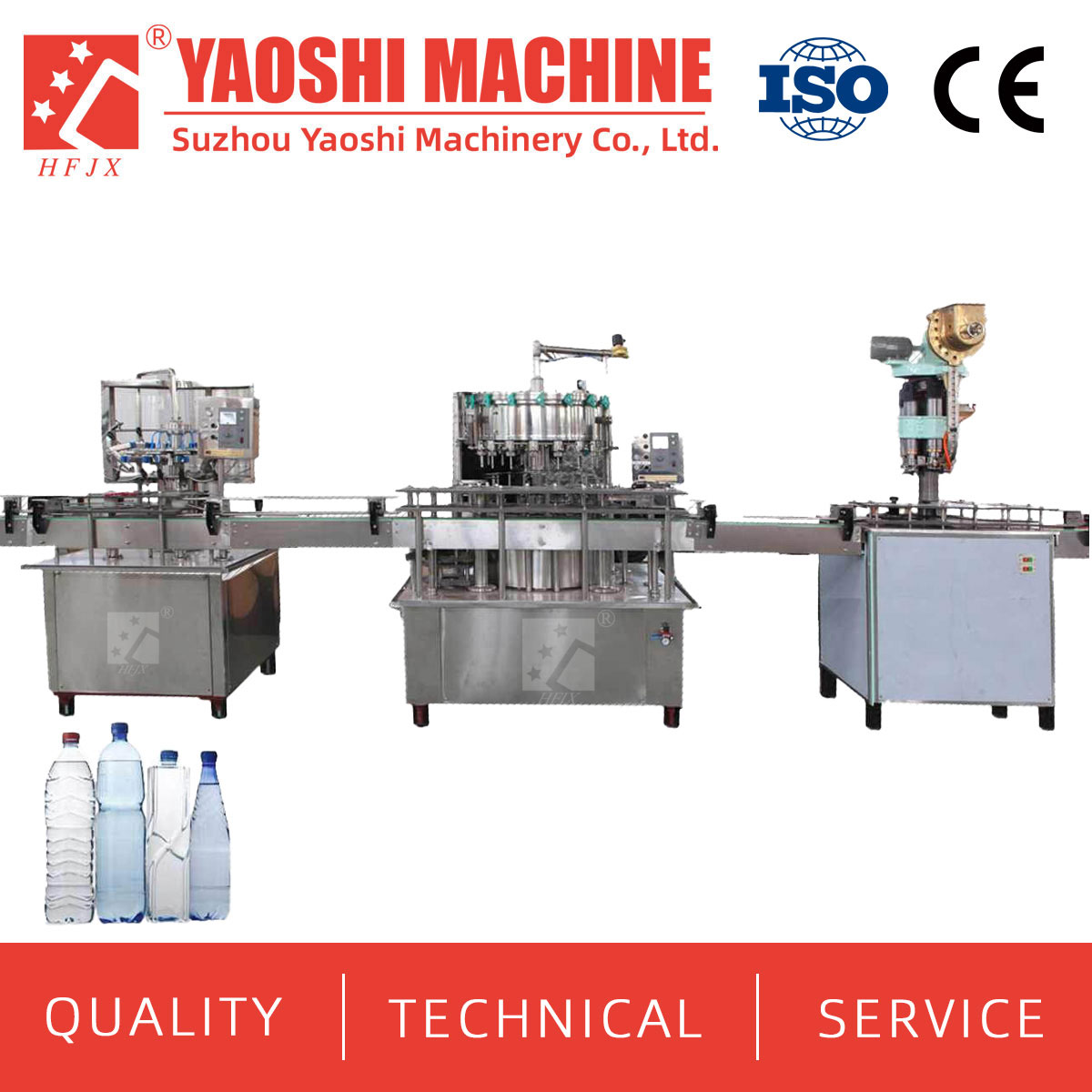
The quotation should distinguish the filling-machine supply from the surrounding process, conveying and inspection scope.
Ask whether output is stated at nominal machine speed or as stable good containers under defined production conditions. List every product and format included in the price. Extra star wheels, guides, recipes, molds or closure-handling parts should not remain hidden under the phrase “change parts as required.”
A complete bottling line may end after labeling, after secondary packaging or after palletizing. Specify which packaging equipment is included and define its materials and finished-pack requirements.

Film, tray and carton formats affect packer configuration, conveyor accumulation and the end-of-line boundary.
Consumables used for design and testing also need ownership. The buyer may need to provide commercial labels, closures, film, cartons, preforms or bottles before FAT. Record quantities, delivery dates, approved specifications and responsibility for material that cannot be sourced near the equipment factory.
“Utilities by buyer” is too broad, while “utilities included” can also be misleading. Divide utilities into generation, distribution and final connection.
Generation may include compressors, chillers, boilers, cooling equipment or electrical transformation.
Distribution includes plant pipework, cables, trays, headers, valves and drains.
Final connection covers the last pipe or cable section at the machine boundary.
The supplier should provide a utility schedule showing required quality, pressure, temperature, peak demand, normal demand and connection point. The buyer should confirm what the site can deliver. State who sizes and supplies backup capacity, water storage, ventilation, wastewater handling and utility-room equipment.
Machine quotations commonly exclude foundations, floor finishes, drainage channels, wall openings, platforms, pipe supports, fire protection, lighting, ventilation, laboratory areas and warehouse systems. These exclusions may be reasonable, but they belong in the total project budget and schedule.
The approved layout should show equipment access, maintenance clearance, operating aisles, material routes, columns, ceiling height, floor loading, drains and future expansion space. Name the party responsible for construction drawings and for checking the final equipment layout against the building.
| Service | Points to define |
|---|---|
| Supervision | Number of specialists, working days, daily hours, extension rates and buyer-provided labor |
| Mechanical installation | Positioning, leveling, anchoring, conveyors, guards, pipework and supplied tools |
| Electrical installation | Panels, field cabling, cable trays, terminations, networks and safety circuits |
| Commissioning | Dry tests, water tests, product trials, format setup, performance run and correction period |
| Training | Operators, maintenance staff, language, duration, materials and attendance records |
| Travel costs | Flights, visas, accommodation, local transport, meals and taxes |
Also assign unloading, customs clearance, inland transport, cranes, forklifts, lifting tools, scaffolding, welding services, consumables and waste removal. A quotation can include commissioning while excluding the labor and materials required to make the site ready for it.
The commercial schedule should correspond to verifiable deliverables such as design approval, equipment readiness, FAT completion, shipment documents, installation progress or SAT. Define what evidence is required for each milestone and how unresolved punch-list items affect approval.
Confirm packing method, shipping terms, insurance, customs documents, duties, taxes, storage risk and the point at which title and risk transfer. Delivery time should distinguish drawing approval, manufacturing, FAT preparation, shipment and site work rather than presenting one undivided period.
FAT should confirm the supplied equipment, agreed formats, control functions, safety checks, documentation and performance under the available factory conditions. The protocol should name the test materials, run duration, output measurement, quality checks, witnesses and treatment of open items.
SAT should confirm installation, utilities, interfaces and connected-line performance at the buyer’s site. Define whether acceptance is measured at the filler, after labeling, after packing or at the pallet boundary. Site conditions that prevent testing should be recorded separately from equipment nonconformities.
List required layouts, process diagrams, equipment drawings, electrical schematics, manuals, parts lists, certificates, software backups, parameter files and maintenance schedules. State language, file format, revision and delivery stage.
Separate commissioning consumables, startup spares, recommended operating spares and long-term spare parts. Warranty start date, exclusions, response process, remote-support conditions and responsibility for third-party equipment should be written into the offer.
Issue one basis of design and one scope schedule to every bidder.
Require every item to be marked included, optional, excluded, by buyer, assumed or open.
Compare the same product, format, output and acceptance boundary.
Add excluded equipment, local works, utilities, logistics, installation and testing to the project-cost comparison.
Record technical deviations and their effect on performance, schedule and buyer workload.
Close critical assumptions before contract signature and control later changes by revision.
The lowest equipment price is not necessarily the lowest installed project cost. A useful comparison shows what the investor must still purchase, coordinate and prove before commercial production can begin.
No. Water treatment may be included, optional or supplied under a separate process package. The raw-water inlet and treated-water outlet conditions must be defined.
They may be offered as utility equipment, but plant distribution and final connections can remain buyer responsibilities. Confirm each utility individually.
Supervision generally means supplier specialists direct or check work performed by others. Full installation assigns defined mechanical and electrical work to the supplier. The quotation must describe labor and cost boundaries.
Not automatically. Foundations, floors, drains, openings and building services should be listed even when they are excluded and completed locally.
Apply the same design basis, scope-status definitions, output boundary and acceptance conditions. Then add all buyer-side equipment, services and local costs to the comparison.
Yaos Machinery supplies beverage treatment, filling and packaging equipment for complete-line projects. Send the beverage and package matrix, raw-material information, target output, site layout, utility conditions, required project boundary and service expectations through the contact page. Request an itemized response showing inclusions, options, exclusions, buyer responsibilities, assumptions and acceptance conditions.


+86-512-58530618

Wukesong Road, Sanxing Town, Zhangjiagang City, Jiangsu Province, China


