A request for “bottled water equipment” rarely defines a complete project. It may refer only to the filler, or it may include raw-water treatment, PET bottle production, labeling, packing and line controls. If those boundaries are unclear, two quotations can carry the same line-speed headline while covering very different equipment.
This checklist is for a new PET bottled-water line or a capacity-expansion project. It organizes the equipment by function and identifies the information a supplier needs before selecting models. It does not prescribe one fixed line because raw-water quality, bottle format, sales pack and factory conditions change the required scope.
Define the saleable product before discussing individual machines. State whether the product is purified water, mineral water or another drinking-water specification. Submit a recent raw-water analysis and the required finished-water standard. Also identify every bottle volume, bottle drawing, neck finish, cap specification, label format and secondary pack.
Output should be stated for each bottle size. A request for 12,000 bottles per hour is incomplete if the supplier does not know whether it applies to 330 ml, 500 ml, 1.5 L or several formats. The quotation should also distinguish nominal machine speed from the required stable output of packed products.
| Process stage | Equipment to evaluate | Buyer information required | Scope point to confirm |
|---|---|---|---|
| Raw-water intake | Raw-water tank, feed pump and inlet instruments | Water source, analysis, supply pressure and daily availability | Tank, pump, instruments and connecting pipework |
| Water treatment | Media filtration, activated carbon, softening when required, precision filtration, RO and selected disinfection equipment | Raw-water report, finished-water target and required treated-water flow | Treatment process, recovery basis, cleaning provisions and waste-water interface |
| Treated-water transfer | Finished-water tank, sanitary pump and product-water piping | Buffer time, filling demand and sanitation procedure | Tank capacity, level control and pipework boundary |
| Bottle supply | PET blow molding machine or bottle unscrambler, bottle conveyor and preform handling where applicable | Bottle drawing, preform specification, bottle weight and purchased-bottle or in-house-blowing plan | Blower, molds, compressors, chiller, air recovery and bottle transfer |
| Rinsing, filling and capping | 3-in-1 monoblock, cap elevator or sorter and cap feeding | Bottle and cap drawings, output by format and treated-water condition | Change parts, cap handling, product connections and discharge conveyor |
| Inspection and identification | Light inspection, bottle dryer and date or batch coder | Inspection points, code content and code position | Included devices, reject method and controls interface |
| Labeling | Labeling machine selected for the confirmed label and bottle | Label material, drawing, application position and bottle surface | Labeler type, consumables, change parts and inspection |
| Final packing | Shrink wrapper or carton packing equipment, conveyors and optional pallet handling | Pack pattern, film or carton specification, pack size and required packed output | Grouping, film or carton handling, tunnel, coding and palletizing boundary |
| Line integration | Conveyors, sensors, buffers, controls and safety interfaces | Factory layout, line direction, elevations and operating plan | Mechanical, electrical and software responsibility at every interface |
Water treatment is specified from water analysis, not from filler speed alone. The treatment train may include a raw-water tank and pump, multi-media filtration, activated carbon, water softening, precision filtration, reverse osmosis, ozone treatment, ultraviolet treatment and a finished-water tank. The required sequence depends on the source and the finished-water specification.
Yaos lists these modules within its water treatment systems. Its published product information gives a broad processing range of 0.5–150 tons per hour. That range is not a substitute for a treatment calculation. The supplier still needs source-water chemistry, peak filling demand, operating hours, expected treatment recovery and the required cleaning arrangement.

Water-treatment equipment should be selected from the raw-water report and required finished-water output.
A plant that buys empty bottles needs bottle storage, an unscrambler where applicable and a stable transfer method to the rinser. A plant that makes PET bottles in-house adds preform handling, a PET blow molding machine, molds, high- and low-pressure air, cooling and a connection to the filling area.
The bottle drawing controls more than the mold. Diameter, height, neck finish, base geometry and bottle stiffness affect guides, transfer parts, air conveyors, label application and pack stability. Provide the drawing and representative samples before the line layout is frozen. If several SKUs will run on one line, list the expected production share and changeover sequence for each bottle.
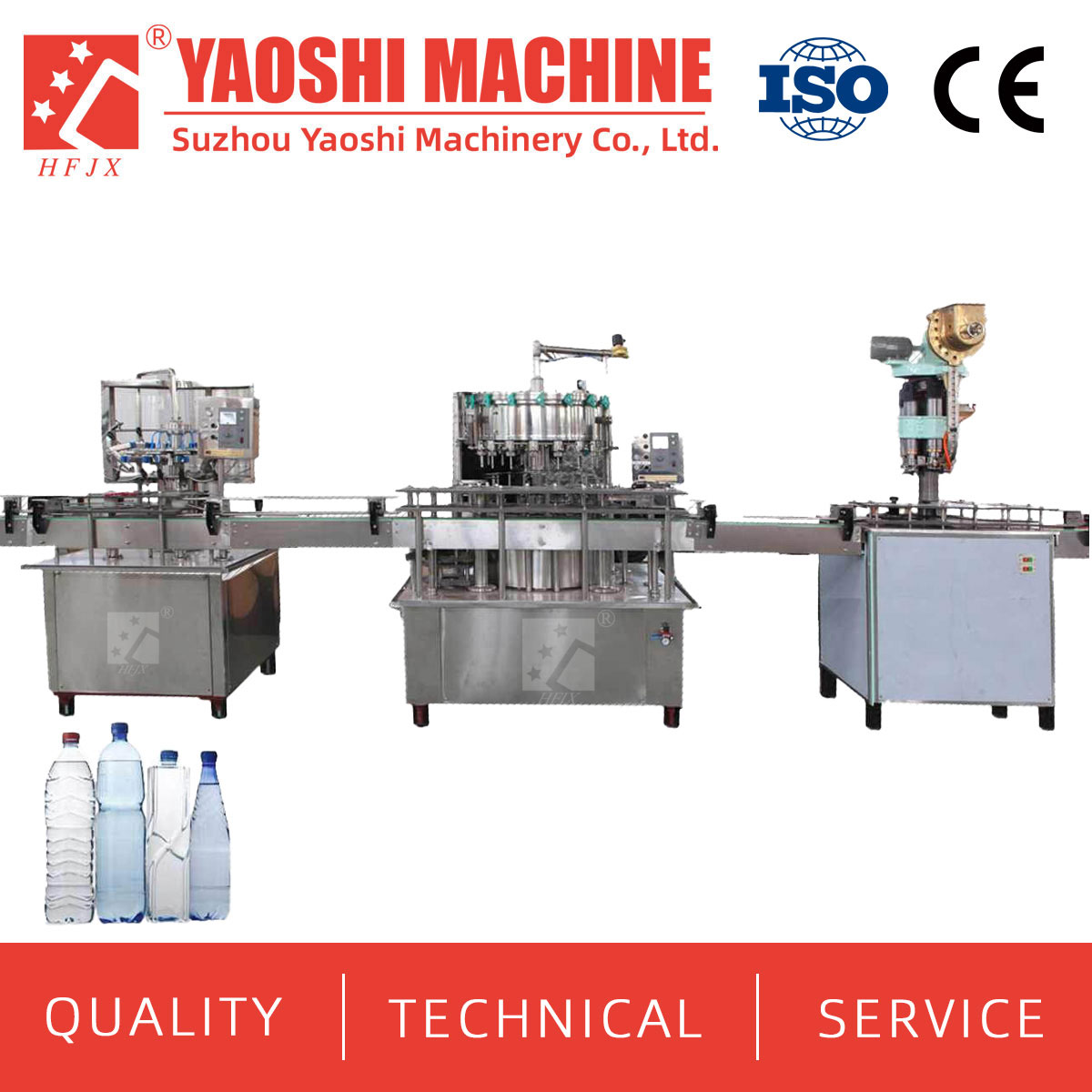
For regular PET bottled-water projects, the main block commonly combines bottle rinsing, filling and capping. The selection starts with the confirmed bottle and cap, treated-water supply and output by format. Cap sorting and feeding, change parts, product-water connections, cleaning provisions and discharge conditions must appear in the quotation rather than being assumed.
The Yaos water filling machine range includes CXGF 3-in-1 configurations for PET bottled purified and mineral water. Published specifications show that different models have different head counts, output ranges, installed power and machine dimensions. These values describe the listed monoblock models, not the output of a complete packed line.

A 3-in-1 water filler combines rinsing, filling and capping in one machine block.
The area after the capper should be defined as carefully as the filler. The equipment list may include visual or automated inspection, a bottle dryer before labeling or coding, a date or batch coder and a labeler. State the inspection objective and reject method. For coding, provide the required text, code position and substrate.
Label selection requires the bottle and label drawings. A shrink sleeve, self-adhesive label and other label formats use different application and handling equipment. Confirm the label material, roll or magazine specification, application height, registration requirement and acceptable bottle-surface condition before selecting the labeler.
Final packing converts filled bottles into the unit that leaves the production area. The choice may be unsupported film wrapping, tray-supported film wrapping or carton packing. The supplier needs the bottle count and arrangement, pack dimensions, film or carton specification, opening direction and required packs per minute.
Review the packaging machine scope together with the filler and conveyor plan. If the filler can produce faster than the packer can accept bottles, accumulation and line controls must protect the line from repeated stops. Palletizing and finished-pack conveyors should be marked as included, optional or supplied by others.

Final packing capacity must be checked against the chosen bottle count and pack pattern.
The following values come from specific Yaos product entries and are suitable for early screening. A quotation should reconfirm them against the current technical offer, bottle drawings and required line output.
| Equipment or model | Published output | Published format or size data | Published power or utility data | Use in the checklist |
|---|---|---|---|---|
| Purified/mineral water treatment system | 0.5–150 tons/hour | Process modules listed by project; no single standard vessel-size table is provided | Not stated in the product list | Request a process flow, equipment schedule and utility list based on the raw-water report |
| CXGF8-8-3 | 2,000 BPH | Bottle diameter 50–115 mm; bottle height 160–320 mm; 8 rinsing, 8 filling and 3 capping heads | Total power 3.8 kW; compressed-air pressure 0.3–0.7 MPa | Confirm the actual bottle, cap and stable line-output requirement |
| CXGF24-24-8 | 8,000–12,000 BPH | Bottle diameter 50–115 mm; bottle height 160–320 mm; 24 rinsing, 24 filling and 8 capping heads | Total power 5.2 kW; compressed-air pressure 0.3–0.7 MPa | Check downstream capacity and the bottle size used for the requested output |
| CXGF40-40-10 | 18,000–24,000 BPH | Bottle diameter 50–115 mm; bottle height 160–320 mm; 40 rinsing, 40 filling and 10 capping heads | Total power 9.6 kW; compressed-air pressure 0.3–0.7 MPa | Confirm line accumulation, cap supply and packed-product output |
| WP-350A linear shrink wrapper | 16–20 bags/minute | Maximum package size L2400 × W650 × H450 mm; PE film, 0.03–0.15 mm | Equipment power 30 kW; air pressure 0.6–0.8 MPa | Check the pack pattern, pack dimensions and required packs per minute |
Prepare a utility schedule for every included machine. The project may require raw and treated water, electricity, high- and low-pressure compressed air, cooling water, drainage and ventilation. The blower and shrink tunnel can change the utility load materially, so a utility total should not be estimated from the filler alone.
Send a dimensioned factory drawing with columns, doors, floor levels, drains, existing utilities and the intended material flow. Mark whether operators, preforms, caps, labels, film, cartons, pallets and finished packs can move through the proposed area. Leave access for maintenance and change parts. For an expansion project, provide the elevation, speed, controls and direction of every existing-machine interface.
Ask each bidder to return the same equipment schedule. For every line item, record the supplier, model, quantity, rated basis, included accessories, change parts, utilities, drawings, tests and interface responsibility. Mark each module as included, optional or excluded. This makes price differences traceable and prevents a low initial total from hiding omitted conveyors, molds, coding, compressors or packing equipment.
Confirm the output basis for every bottle and pack format.
Separate machine capacity from stable packed-line output.
List bottle, cap, label, film and carton samples required for testing.
Define who supplies tanks, pumps, piping, cables, air lines and installation materials.
Agree on the test products, test duration, acceptance measurements and documentation.
Identify spare parts, change parts, manuals and training in the commercial scope.
No. The quotation must state whether raw-water storage, filtration, reverse osmosis, disinfection, finished-water storage and pipework are included. The process cannot be finalized without a raw-water analysis and finished-water target.
The requested output should be defined at a stated bottle size and at a stated point, such as filled bottles or finished packs. Allowance for stops, format changes and downstream constraints should be addressed in the line-balance proposal.
It is required only when the project scope includes producing PET bottles from preforms. Plants that buy finished bottles need a different bottle-storage and feeding arrangement. Compare bottle logistics, utilities, labor and available space before fixing the scope.
Provide bottle material, volume, drawing, height, diameter, neck finish, weight and samples where available. The supplier also needs the cap drawing and the list of all formats planned for the line.
A multi-format proposal requires every bottle and cap specification. The supplier should identify change parts, adjustment points, changeover procedure and the output expected for each format.
State the bottle count and arrangement, film or carton type, package dimensions, required packs per minute, coding needs and whether palletizing is included. Samples or confirmed packaging drawings improve the equipment selection.
Send the raw-water report, product specification, bottle and closure drawings, target output by SKU, label and pack specifications, factory layout, utility conditions, existing-line interfaces and the required project boundary.
For a new bottled-water plant or capacity expansion, send Yaos Machinery your raw-water analysis, finished-water target, bottle and cap drawings, output by bottle size, label and final-pack specification, factory layout and available utilities. Request an itemized equipment list that separates included, optional and excluded scope. Email tony@yaos.ltd or call/WhatsApp +86 18915689808.


+86-512-58530618

Wukesong Road, Sanxing Town, Zhangjiagang City, Jiangsu Province, China