A small commercial water project can become oversized before production starts. A buyer asks for 2,000 bottles per hour, then adds in-house bottle blowing, several bottle sizes, automatic labeling and shrink wrapping without checking labor, utilities or local demand. The opposite problem is also common: the filler is purchased first, while water treatment, cap handling and final packing remain undefined.
This guide covers commercial bottled-water production, not household water dispensers or domestic filtration appliances. It explains how to specify a small water filling machine project using bottle size, required saleable output, available labor and a staged expansion plan.
“Small” should describe the project duty rather than one universal speed. A compact line may serve a new local water brand, a regional distributor, a hotel or institutional supply business, or an established producer testing a new bottle format. The line still needs a defined product-water standard, controlled bottle handling, filling, capping, identification and packing.
Yaos lists a ZPC12 linear filling machine with a published capacity of 1,000–2,000 bottles per hour for 500 ml bottles. This provides a useful reference point for a small line, but it does not automatically define the output for other bottle sizes or the number of finished packs produced during a shift. Those figures must be calculated from the actual SKU and operating plan.
Start with the number of saleable bottles needed per day, the production days per month and the effective filling hours per shift. Effective hours exclude sanitation, startup, product-water preparation, format changes, material replenishment and routine stops. If demand is seasonal, state normal and peak requirements separately.
BPH must always be tied to bottle volume. At the same bottle count, a larger bottle requires more treated water per hour and changes product transfer, accumulation and packing conditions.
| Bottle size | At 1,000 bottles/hour | At 2,000 bottles/hour | Why it matters |
|---|---|---|---|
| 330 ml | 330 liters/hour | 660 liters/hour | Higher bottle and cap consumption for each liter sold |
| 500 ml | 500 liters/hour | 1,000 liters/hour | Published ZPC12 capacity is stated on this bottle-volume basis |
| 1 liter | 1,000 liters/hour | 2,000 liters/hour | Treated-water delivery must support the increased volume |
| 1.5 liters | 1,500 liters/hour | 3,000 liters/hour | Bottle stability, conveyor handling and pack weight also change |
These are simple volume calculations, not promised line outputs. The final specification should state the required stable output at the end of the line for every bottle and pack format.
A small line does not have to automate every function on day one. The first-stage scope should remove the handling steps that limit hygiene, consistency or output while keeping later expansion practical.
| Project approach | Typical scope | Suitable situation | Main limitation to check |
|---|---|---|---|
| Purchased bottles with compact filling | Bottle feeding, rinsing, filling, capping, basic coding and manual or compact packing | New producer with reliable local bottle supply | Empty-bottle storage, contamination control and manual handling |
| Semi-automatic bottle making plus filling | Preform heating and blowing, bottle transfer, filling and capping | Project that needs control of bottle supply but can support more operator handling | Blower output, compressor duty, cooling and bottle accumulation |
| Compact integrated line | Treatment, bottle supply, filling, labeling, packing and connected conveyors | Plant with stable demand and enough space and utilities for continuous production | Higher initial scope and a need to balance every machine |
The filler requires a stable supply of finished water. Send a recent raw-water analysis and the required finished-water specification before requesting the treatment equipment list. Depending on the source, the process may include raw-water storage, media filtration, activated carbon, softening, precision filtration, reverse osmosis and selected disinfection equipment.
Yaos publishes a broad 0.5–150 tons/hour range for its water treatment systems. A small-line quotation should narrow that range to the required flow, operating hours, treatment recovery, sanitation method and buffer capacity. It should also state whether tanks, pumps, instruments, connecting pipework and waste-water connections are included.

Raw-water analysis and finished-water requirements determine the treatment process.
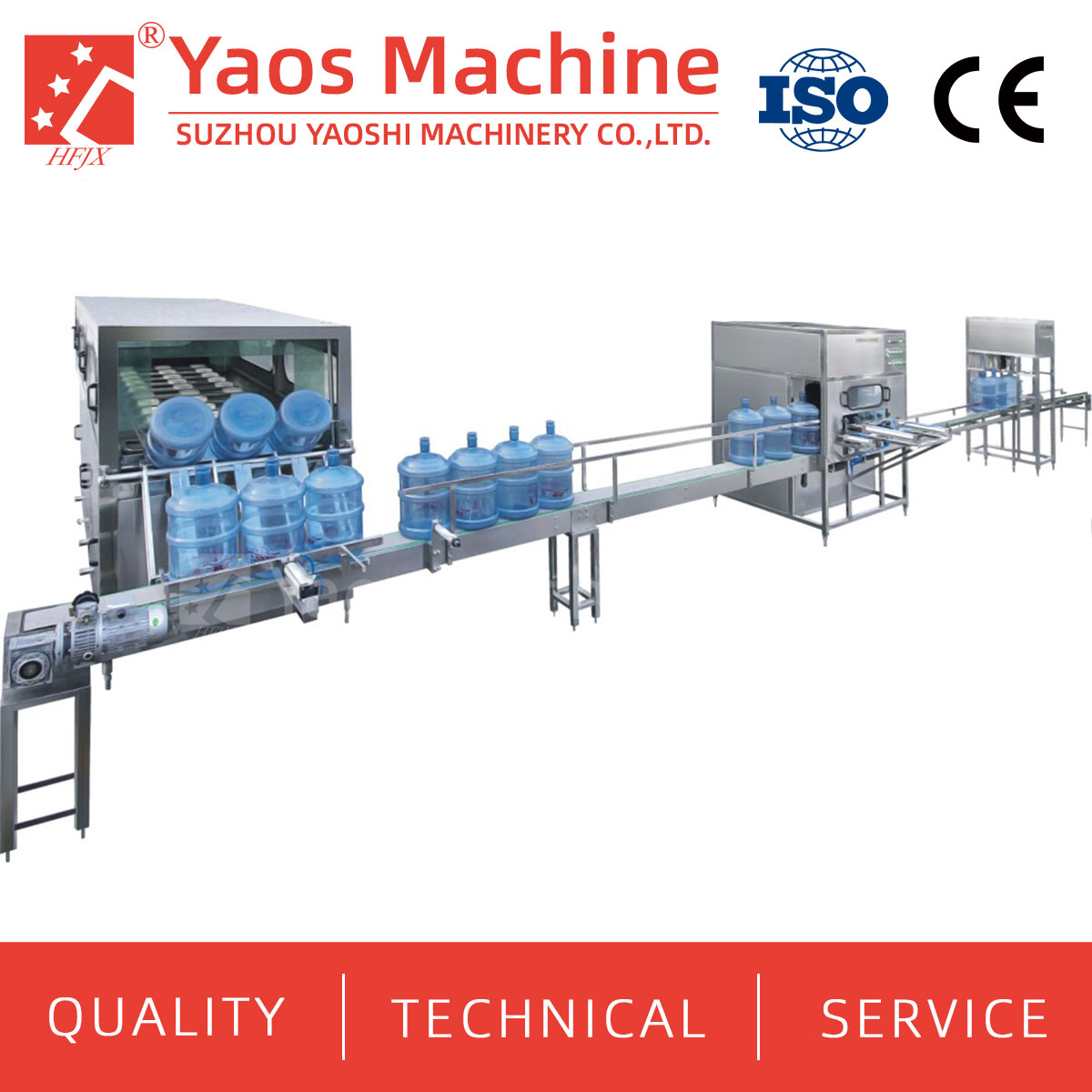
A linear machine can suit a low-output project because the equipment arrangement is accessible and the initial line scope can remain compact. The published ZPC12 unit is described as a linear rinsing, filling and capping line. Its listed bottle range covers round or square PET bottles within the stated dimensions.
The model should be checked against the actual bottle drawing, neck finish and cap. If the plant will introduce larger bottles or raise output later, the buyer should ask whether the first-stage filler remains usable, whether more heads can be added, or whether a future rotary machine will replace it. The water filling machine range provides the commercial page for comparing compact and higher-capacity options.

A linear filling arrangement can support a compact commercial water project when bottle and output requirements match.
Buying finished bottles reduces the first equipment scope, but it requires storage space and dependable supply. In-house blowing reduces empty-bottle transport and gives the plant more control over bottle production, while adding preform handling, molds, compressed air, cooling, maintenance and operator tasks.
Yaos lists a semi-automatic PET blower for 0.1–2 liter containers with a published theoretical output of 1,200–1,600 pieces per hour. That output may sit below a filler rated at 2,000 BPH, so the project would need a bottle buffer, additional blowing time or another bottle-supply plan. Review the available PET blow molding equipment against the required bottle output instead of matching machines by headline speed alone.

Semi-automatic bottle production adds air, cooling, molds and operator handling to the project.
The table below uses published data from specific Yaos product pages. It is an initial screening reference. Values should be reconfirmed in the technical quotation, and no single-machine rating should be treated as guaranteed packed-line output.
| Parameter | ZPC12 linear filling line | Semi-automatic PET bottle blower | Buyer confirmation required |
|---|---|---|---|
| Published capacity | 1,000–2,000 BPH for 500 ml | 1,200–1,600 pieces/hour theoretical output | Required stable output by bottle size and shift |
| Container | Round or square PET bottle | PET, 0.1–2 liters | Bottle and preform drawings, weight, neck finish and samples |
| Published dimensions | Bottle diameter 50–115 mm; height 150–320 mm | Preform length 15–350 mm; inner diameter 5–38 mm | Compatibility of every planned SKU |
| Published machine power | 3.2 kW total power | 17.5 kW | Local voltage, frequency, installed load and startup conditions |
| Additional utilities | Not fully defined in the published table | Compressed-air and drying/filtering equipment are required | Supplier utility schedule with pressure, flow and connection points |
Labor demand depends on what remains manual. Map the work at each operating point before assigning a shift headcount:
Monitor raw-water intake, treatment conditions and finished-water storage.
Load preforms or manage purchased empty bottles.
Supply caps and check the rinser, filler and capper.
Load labels, coding consumables, film or cartons.
Inspect bottles and remove nonconforming products.
Pack, stack and move finished products.
Clean equipment and record production and sanitation results.
Automation can move labor from repetitive bottle handling to supervision and material replenishment, but it does not remove water-treatment checks, quality control, cleaning or maintenance. Ask the supplier to mark every manual loading, transfer and inspection point on the proposed layout.
A practical expansion plan identifies what will be retained and what will be replaced. Water treatment, tanks and utilities can be sized with a defined expansion allowance if the future target is credible. Conveyors can reserve connection points, and the layout can leave space for an automatic labeler, packaging machine or a higher-capacity filler.
Do not oversize every first-stage machine without checking the consequence. A larger treatment system may cycle inefficiently at low demand, while a fast filler can spend most of the shift waiting for bottles or packing. Request two equipment schedules when expansion is likely: the first-stage operating scope and the planned future scope. Each schedule should identify retained equipment, new equipment and required modifications.
Raw-water source, recent analysis and required finished-water standard.
Bottle material, volume, drawing, neck finish, cap drawing and samples.
Required bottles per hour and saleable bottles per shift for each SKU.
Purchased-bottle or in-house-blowing plan.
Label type, code content and final pack pattern.
Available operators and the handling steps the buyer wants to automate.
Factory drawing, available floor space and preferred line direction.
Electricity, compressed air, water, drainage and cooling conditions.
First-stage scope, expected expansion date and future output target.
The supplier should return an itemized equipment list, layout, utility schedule, interface list and capacity basis. Every module should be marked as included, optional or supplied by the buyer.
This article covers commercial bottled-water production. Household dispensers and domestic filtration appliances have a different purpose and are outside this project scope.
Compare the required saleable bottles per shift with effective operating hours, seasonal demand and pack output. The answer changes with bottle size, working days and the time needed for sanitation and material handling.
The published page lists round or square PET bottles with a diameter of 50–115 mm and a height of 150–320 mm. Each proposed bottle and cap still requires a compatibility check, including change parts and the expected output for that format.
Not always. Compare local bottle supply, empty-bottle storage, preform logistics, labor, compressor and cooling requirements. A semi-automatic blower is practical only when its output and operating pattern support the filling schedule.
The equipment scope does not support one universal answer. Count the tasks that remain manual, including treatment monitoring, bottle or preform loading, cap and label supply, inspection, packing, material movement and cleaning.
Some projects can first automate labeling or packing while retaining the filler. A larger capacity increase may require a new filling block. Ask the supplier to define the maximum practical duty of the first-stage machine and the interfaces reserved for later equipment.
Compare the bottle-size basis, stable line-output definition, included machines, manual operations, utilities, change parts, tests, documentation and future expansion provisions. A lower total is not comparable if key modules or interfaces are excluded.
For a small commercial bottled-water line, send Yaos Machinery your raw-water analysis, bottle and cap drawings, target output by bottle size, available labor, final pack specification, factory layout and utility conditions. State the first-stage budget boundary and the expected upgrade target so the quotation can separate immediate equipment from future additions. Email tony@yaos.ltd or call/WhatsApp +86 18915689808.


+86-512-58530618

Wukesong Road, Sanxing Town, Zhangjiagang City, Jiangsu Province, China