An inquiry that says “500 ml PET bottle, 12,000 bottles per hour” does not contain enough information for a dependable filling-machine quotation. The supplier still has to assume the finished water condition, bottle and cap details, bottle-supply method, production schedule, line endpoint and available factory services. Different assumptions can produce quotations that look similar but cover different projects.
Prepare a water-specific project input package before asking for a drinking water filling machine. The package does not need to be a complete engineering design. It needs to identify the decisions that affect machine selection, line scope and interface responsibility. The supplier can then return a model proposal, equipment list, layout and list of open points that procurement can compare.
State what the new equipment must produce and where its responsibility begins and ends. Identify whether the request is for a filling monoblock, a connected bottling section or a wider line from raw-water treatment to packed bottles. If the plant already has equipment, name what will remain.
Finished product: purified drinking water, mineral water or another defined still-water product;
container: PET bottle with each required nominal volume;
closure: cap type, drawing and sample status;
target output for every important bottle format;
new factory, new line in an existing plant or replacement project;
required starting and ending points of the supplier’s scope;
destination, expected production start and document language;
buyer-supplied and retained equipment.
Do not use “complete line” as the only scope description. One supplier may include water treatment and bottle blowing, while another may begin at empty-bottle infeed. Put inclusions, options and exclusions into a line-item matrix.
The filling machine handles finished water, but the stability of the bottling project begins upstream. State whether the plant will use municipal water, well water or another source. Provide a current laboratory analysis from a representative sample and identify seasonal variation or more than one source where relevant. The required finished-water specification and applicable local requirements should be supplied separately.
| Water input | What the buyer should provide | What the supplier should return |
|---|---|---|
| Source conditions | Source type, available flow and pressure, normal temperature and known variation | Required feed conditions and any source-side assumptions |
| Water analysis | Recent test report with sampling date and source identification | Proposed treatment sequence and items requiring further testing |
| Finished water | Product specification and local or buyer requirements | Design basis, monitoring points and stated treatment boundary |
| Production demand | Required finished-water volume by shift or day | Net treatment output required to support filling and other defined uses |
| Cleaning and services | Known cleaning schedule and water users inside the requested scope | Process-water balance and excluded demands or assumptions |
Do not specify reverse osmosis only because it appears in another bottled-water project. Treatment selection should follow the raw-water analysis and finished-water target. Yaos Machinery lists relevant water treatment system equipment on its website, but the project configuration still requires water data and a confirmed scope.

Nominal bottle volume does not define the container. Two 500 ml bottles can have different heights, diameters, neck finishes, base designs and handling behavior. Send dimensioned drawings and physical samples when available. Mark preliminary drawings clearly so the supplier does not treat them as production-approved formats.
The bottle data package should include:
nominal and intended fill volume;
overall height and maximum body diameter;
neck-finish drawing and support-ring dimensions;
empty-bottle weight and material specification;
base and body geometry relevant to standing and conveying;
approved bottle sample or prototype status;
drawing number, revision and approval date;
all future formats that should be considered in the initial design.
Ask the supplier to return an approved format table. It should identify compatible bottles, required change parts, adjustment points and any formats that still need sample trials. Avoid a general statement such as “suitable for 200–2,000 ml bottles” when the project depends on specific bottle drawings.
The phrase “plastic screw cap” is also incomplete. Provide the cap drawing, material, outside dimensions, thread or closure details and representative samples. State whether caps arrive loose in cartons or through another supply arrangement. The supplier should identify cap feeding, orientation, application and replenishment scope.
Confirm whether every bottle uses the same neck and cap. If a future SKU needs another closure, request a separate compatibility statement rather than assuming that a bottle-format change automatically covers the cap system. Include any buyer inspection requirement in the project input register.
Bottles per hour must be tied to a defined bottle, fill volume and output-counting point. State whether the requested rate means bottles at the filler discharge, accepted capped bottles or finished packs. For multiple formats, give the required output for each one.
| Capacity input | Required detail | Reason for quotation |
|---|---|---|
| Reference format | Water product, bottle drawing, fill volume and cap | Connects the quoted rate to a physical production duty |
| Format-specific BPH | Required output for each important bottle size | Prevents the smallest bottle’s rate from being applied to all SKUs |
| Demand period | Saleable bottles or packs per shift, day and normal operating schedule | Shows whether the requested machine rate supports actual demand |
| Planned interruptions | Expected cleaning, format changes, product changes and shift pattern | Separates mechanical speed from achievable scheduled production |
| Output endpoint | Filler, capper, labeler or completed pack | Defines where performance will be counted and accepted |
Ask for a capacity table in the quotation. The table should show the proposed model and rate for each approved format, along with the stated operating and test conditions. Do not compare suppliers using one headline BPH figure when their reference bottles or scope endpoints differ.
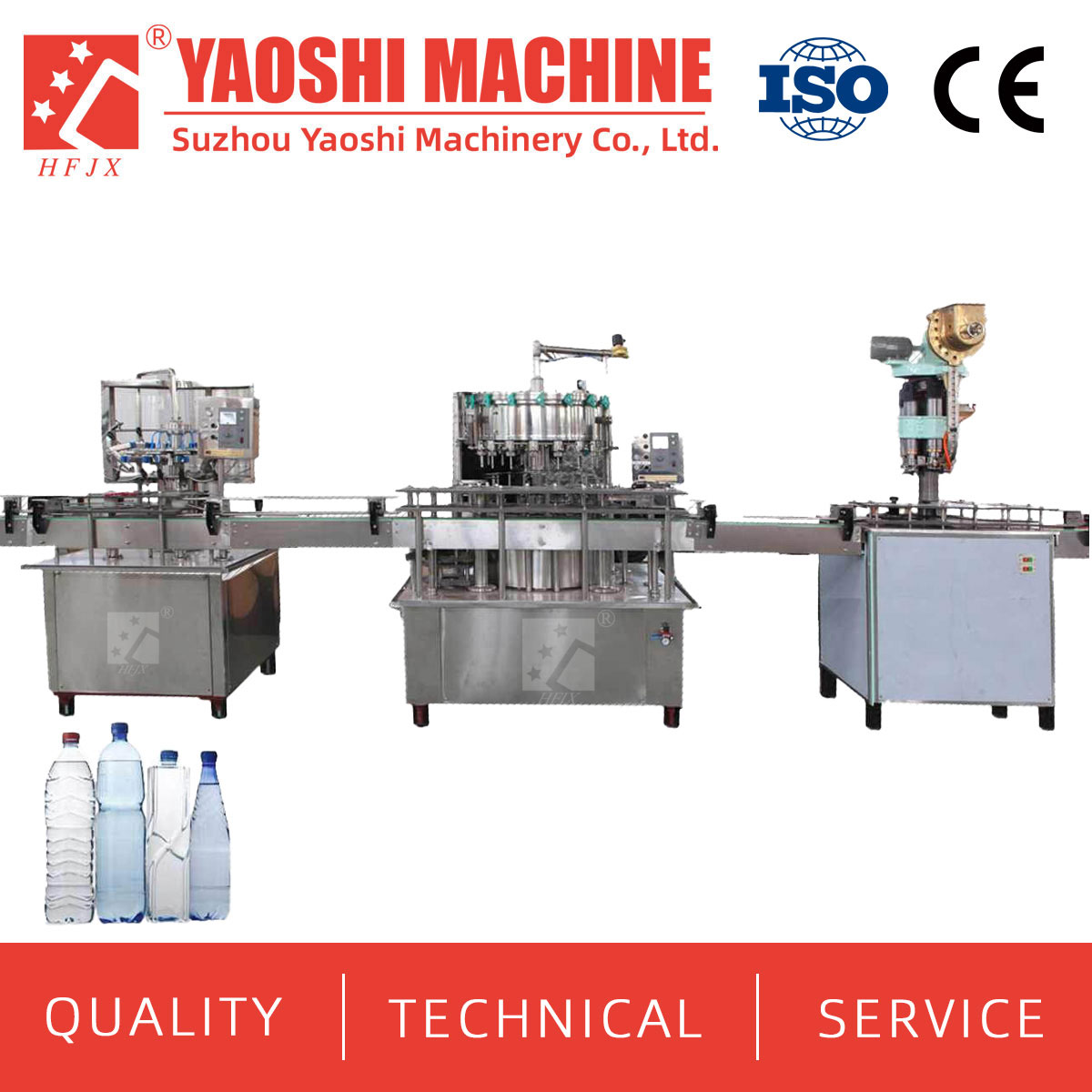
The Yaos Machinery water category describes integrated rinsing, filling and capping equipment for bottled-water applications. When requesting a drinking water filling machine, identify which operations and connections the quotation must include.
empty-bottle handover point and required infeed condition;
rinsing-medium source, quality and connection responsibility;
finished-water connection at the machine;
filling and capping scope for the approved bottle and cap;
discharge elevation and transfer to downstream equipment;
local control, line signals and emergency-stop interface;
guards, access, drainage and maintenance clearances;
change parts, tools and format documentation included in the offer.

For a replacement project, provide the current conveyor direction, elevations, available length, upstream delivery rate and downstream acceptance rate. Share control drawings or at least a signal list for machines that will remain. The supplier cannot define a reliable retrofit interface from photographs alone.
State whether the plant will purchase finished empty bottles, produce bottles in-house or connect to existing bottle-making equipment. This decision affects floor space, empty-bottle storage, infeed equipment, controls and the responsibility for stable bottle delivery.
If bottle production is included, provide the preform specification, neck finish, target bottle drawings and required output for each format. Ask the supplier to show how the proposed PET bottle blowing machine and bottle-transfer section relate to the filler’s reference duty. Do not assume that two machines with matching catalogue speeds will deliver balanced production.

Provide the label material and application method, bottle drawing, label dimensions, coding requirement and final pack pattern. State whether bottles will be shrink-wrapped, tray-packed, carton-packed or handed over as loose bottles. The pack specification should include bottle count, arrangement and material details.
Convert bottle rate into packs per minute for every required format. Ask the supplier to identify accumulation, grouping and material-replenishment assumptions. The selected bottled-water packaging equipment should be quoted against the actual bottle and pack format, not a generic downstream speed.
A usable layout needs more than a room length and width. Send a scaled drawing showing columns, doors, floor levels, drains, utility areas, operator routes and available maintenance space. Mark the intended flow of raw materials, empty containers, caps, labels, packaging materials and finished goods.
Provide available electrical supply and the known conditions for water, compressed air, drainage and any other utilities required by the requested equipment. Ask the supplier to return a utility schedule that states required quality, pressure, flow, connection point and assumptions. Utility values should apply to the quoted equipment list rather than an undefined standard line.
Give each file a number, revision and status. A short register keeps the supplier from designing around an obsolete bottle drawing or preliminary layout. The minimum package can be organized as follows:
| Attachment | Recommended content | Status to show |
|---|---|---|
| Project input sheet | Product, formats, output, scope and schedule | Issued for quotation |
| Raw-water report | Laboratory results, source and sampling date | Current or update required |
| Bottle schedule | Drawing references, volumes and required rates | Preliminary or approved |
| Cap schedule | Drawing references and sample availability | Preliminary or approved |
| Pack specification | Label, code and secondary-pack arrangement | Selected or open |
| Factory layout | Dimensions, restrictions, flow and retained equipment | Surveyed or concept |
| Interface register | Mechanical, product, utility and control connections | Confirmed or open by interface |
Ask the supplier to return a deviation and clarification list with the quotation. Each assumption should reference the affected equipment or interface. This is more useful than a proposal that silently fills missing fields with a standard configuration.
A quotation is ready for technical comparison when it answers the input package. Look for a selected model list, format-specific capacity table, equipment and responsibility matrix, preliminary layout, utility schedule, interface list, document list and proposed test basis. Unconfirmed facts should remain visible.
For a PET bottled-water project, confirm these points before contract award:
the reference water product, bottle and cap used for selection;
the output promised for each required format and where it is counted;
the exact upstream and downstream scope boundaries;
which drawings and samples still require approval or testing;
the required factory utilities and buyer connections;
which tests will be completed before shipment and at the site;
which project documents, change parts and spare items are included;
the commercial effect of every option and exclusion.
Yaos Machinery can use the submitted water, bottle, capacity and factory information to identify relevant equipment categories and prepare a project-specific response. Final model selection and scope should follow the current technical proposal rather than a general website description.
No. Provide a dimensioned PET bottle drawing, neck finish, intended fill volume, bottle weight and sample status. The machine and transfer system must be reviewed against the actual format.
Yes, when water treatment is part of the project. Identify the source, sampling date and required finished-water specification so the treatment proposal is based on project data.
State the required rate for each bottle size, the fill volume and the point where accepted output will be counted. Add shift demand and planned operating time.
Possible format coverage must be checked from drawings and samples. Ask the supplier to list compatible formats, change parts, adjustments and any required trials.
Mark it as preliminary and set an approval deadline. Ask the supplier to identify which machine, layout, price and delivery assumptions depend on the final bottle.
No. The plant may purchase empty bottles or produce them in-house. State the selected bottle-supply method and define the handover point in the equipment matrix.
Provide a scaled layout with dimensions, columns, doors, drains, flow direction, retained equipment and utility locations. Mark uncertain site data for later survey.
Compare the selected duty, equipment scope, interfaces, utilities, format coverage, included documents, test basis, options and exclusions. Normalize these items before comparing totals.
For a new drinking water filling machine or line review, send Yaos Machinery the raw-water report and finished-water requirement, PET bottle and cap drawings or samples, required output for each format, pack specification, factory layout, available utilities and existing-line interfaces.
Ask for a format-specific model and capacity table, equipment list, scope boundary, preliminary layout, utility schedule and clarification register. Email tony@yaos.ltd or call/WhatsApp +86 18915689808.


+86-512-58530618

Wukesong Road, Sanxing Town, Zhangjiagang City, Jiangsu Province, China