



A filler that runs a clear apple drink may need a different product path to handle a juice with fibers or visible fruit pieces. The buyer needs to check whether the complete route can deliver the right amount of liquid and pulp to every bottle, then be cleaned for the next product.
Compare a fruit juice filling machine using two separate acceptance questions: can it fill the approved recipe consistently, and can the supplied system be cleaned to the plant's requirements? Particle dimensions, concentration, settling behavior, viscosity and filling temperature belong in that assessment. A nominal BPH figure cannot answer either question.
“Clear” describes appearance, not viscosity, foaming or cleaning difficulty. A clear juice drink can still leave sugar, color or flavor residues. Likewise, “pulp” can mean fine fibers, soft sacs, dispersed puree or visible pieces. These materials should not be treated as one equipment duty.
Provide a representative product specification and samples. State recipe family, pH, Brix, density, viscosity with measurement temperature, inlet temperature and any handling limits. For particles, record size distribution, maximum dimensions, concentration, shape, hardness and settling behavior. Include the acceptable texture and distribution in the finished bottle so trials assess the product the buyer intends to sell.
Yaoshi's fruit juice filling equipment can be reviewed against that specification. Ask the supplier to identify the accepted recipe and bottle combinations, rather than approving a machine from the word “juice.”
| Decision Area | Clear Drinks | Pulp-Containing Products | Buyer Check |
|---|---|---|---|
| Product definition | Viscosity, foam, temperature and other liquid properties still matter | Particle size, concentration, texture and settling add selection inputs | Submit measured properties and representative samples |
| Holding and transfer | Deliver the agreed liquid condition to the filler | Review distribution, passage restrictions and particle integrity throughout transfer | Test from the preparation outlet through the filling point |
| Filling consistency | Check total fill quantity, repeatability and foam | Check total fill quantity plus pulp content and distribution | Define separate liquid and pulp acceptance measurements |
| Dosing configuration | Review the proposed filling method against actual flow behavior | Evaluate mixed-product filling or separate dosing through trials | Require an explanation of the selected route and its limits |
| Cleaning | Check sugar, color, flavor and other residues | Add retained pulp or fibers and any additional dosing path to the review | Obtain a circuit list and agreed residue checks |
| Changeover | Cleaning can still determine downtime | A pulp-to-clear change may expose residual-particle carryover | Include the demanding product sequence in acceptance testing |
This comparison establishes questions for the technical proposal. It does not assign a universal particle limit, valve type or cleaning time.
Start upstream of the filling valve. Ask how the proposed holding and transfer arrangement will maintain the specified pulp distribution without unacceptable texture damage, air pickup or residence time. Mixing intensity and circulation should be evaluated with the actual product; stronger agitation is not automatically the right answer.
Review the route through pumps, filters or strainers, valves, pipes and the filler. Identify any stage that could remove desired solids, restrict passage or alter their distribution. Request drawings of the proposed product route and a trial method that checks what reaches the bottle. Do not approve a particle-compatible nozzle while leaving upstream components unreviewed.
The juice preparation equipment should be included in that discussion when it is supplied with the filler. If preparation is retained from an existing plant, provide its specifications and assign the transfer interface to a named party.

Official website image of preparation equipment. For a pulp project, the transfer route should be tested as part of the product duty.
For a clear drink, define the target fill quantity, permitted variation, test method, foam condition and closure checks. For a pulpy recipe, add an agreed measure of solids distribution or pulp quantity. Two bottles can have similar total weight while containing different proportions of pulp and liquid.
Sampling should cover the agreed production run and operating events. Include startup, steady operation and restart after a representative stop. Ask whether results differ by filling position and how the supplier will investigate that difference. Use a common measurement method so buyer and supplier interpret the trial consistently.
A mixed-product route fills juice and solids together. A separate-dosing route places pulp and liquid through defined stages. Selection should follow the formula, consistency requirement, package opening and trial result. Neither route should be imposed on every product containing pulp.
Yaoshi's hot-fill product page describes a four-function option combining rinsing, pulp filling, juice filling and capping. It does not publish a universal particle-size or concentration limit for that option. Request the proposed structure, dosing method, handling limits, cleaning boundary and supporting test before confirming it for the recipe.
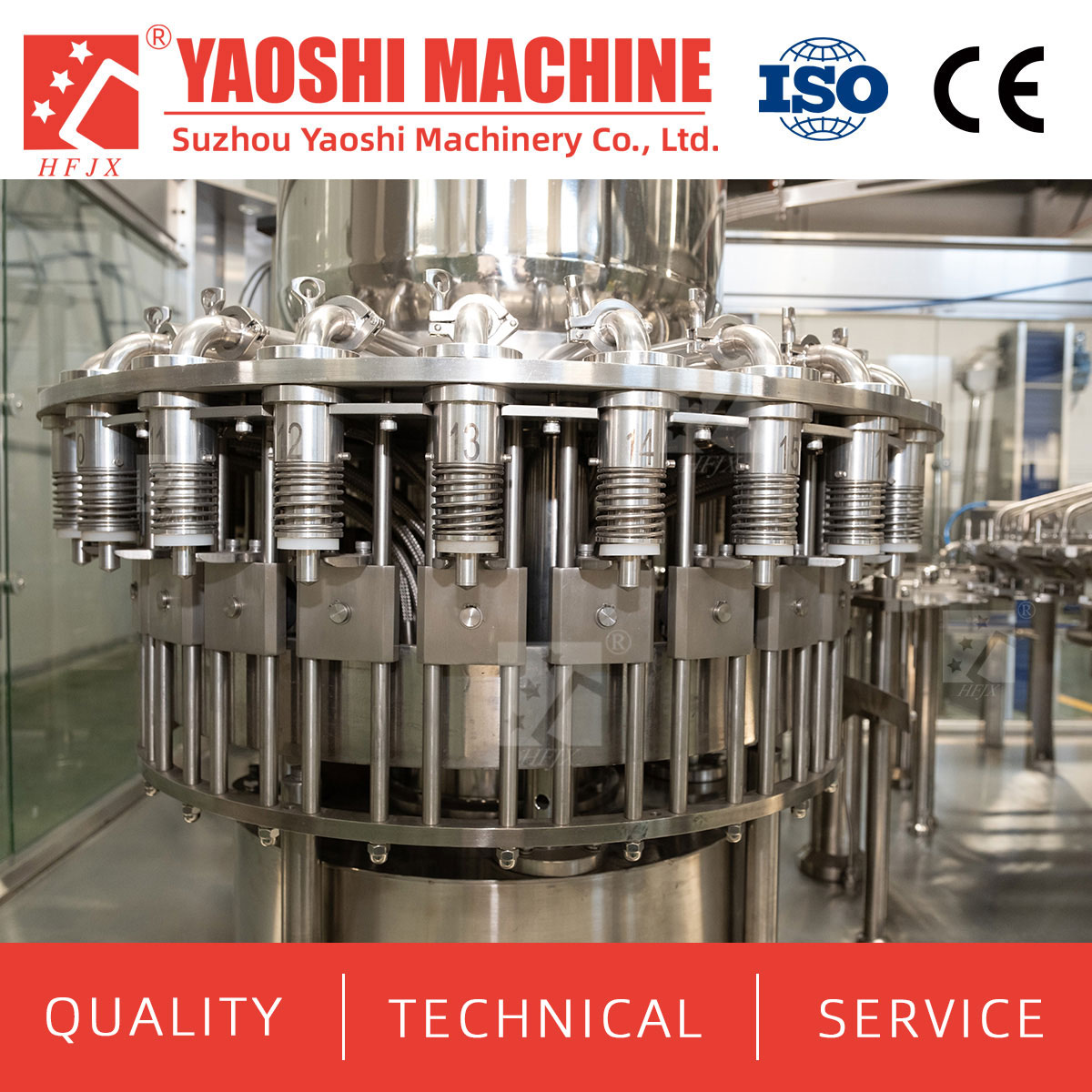
Official hot-filling equipment illustration. The photograph does not establish a pulp limit or identify the final configuration for a new project.
A machine's ability to pass pulp does not establish the correct thermal or preservation process. The approved process must account for the actual formulation and package, including particles where present. Provide that basis to the equipment supplier rather than selecting treatment from appearance alone.
Yaoshi lists hot-fill, ultra-clean and aseptic routes in its juice filling solutions. For the selected route, specify product inlet conditions, package and closure requirements, treatment boundary, cleaning or sterilization and validation responsibility. Ordinary hot-fill model data should remain references for those named machines.
Clear drinks and pulp products both need a cleaning plan based on their residues and the next SKU. List supplied tanks, transfer pipes, pumps, valves, filler circuits and return paths. If separate pulp dosing is proposed, include its hopper, feed path and dosing components in the same review.
Ask which areas are covered by CIP, which need disassembly or manual work, and how the procedures will be verified. A general “CIP included” statement does not demonstrate coverage of every supplied or buyer-owned connection. Request the circuit diagram, cycle monitoring, drain and return arrangement, inspection points and tasks requiring an operator.
For a pulp-to-clear change, agree what constitutes acceptable particle carryover, color or flavor residue and other relevant cleaning outcomes. Name the test methods and approval owner. Use these requirements to establish changeover time through testing; do not invent a fixed cleaning duration from the machine type.
These selected values come from Yaoshi's “Juice beverage hot filling machine” product table. They are catalogue references for the named RCGF models. The table does not establish pulp compatibility, particle dimensions, cleaning duration or capacity with a particular recipe.
| Published Model | Listed Capacity | Listed Power | Dimensions (mm) | Listed Weight |
|---|---|---|---|---|
| RCGF18-18-6 | 8,000 BPH | 4.4 kW | 2800 × 2150 × 2500 | 4,000 kg |
| RCGF40-40-12 | 24,000 BPH | 7.8 kW | 4500 × 3300 × 2600 | 8,000 kg |
Request the reference bottle and product conditions behind the stated rate. Confirm net output separately for clear and pulpy SKUs. Some other public model ratings and volume limits differ across website tables, so obtain a reconciled datasheet for the offered build before ordering.
A shared line is a candidate when the supplier confirms both families in an application matrix and can demonstrate acceptable filling, cleaning and changeover. The review should identify any different product-contact components, format parts, settings or dosing modules.
Evaluate the production schedule as well as instantaneous speed. Small batches alternating between pulp and clear drinks may spend a substantial part of the available shift in cleaning and changeover. Ask for a daily-output calculation using the agreed batch plan and measured transition times. Compare that with a dedicated pulp path or another configuration if the shared arrangement fails the production requirement.
Keep future recipes visible as options. A successful trial with one orange-pulp sample should not be generalized to different fibers, larger pieces or a more viscous nectar.
| Trial Case | Checks to Agree | Evidence to Retain |
|---|---|---|
| Clear reference drink | Fill quantity, repeatability, foam, closure and accepted rate | Run conditions, samples and measurement records |
| Representative pulp recipe | Total fill, pulp distribution, particle integrity and interruptions | Product specification, position-based samples and results |
| Stop and restart | Holding or return response, settling and first accepted bottles | Stop duration, recovery sequence and rejected-product record |
| Pulp-to-clear change | Cleaning coverage, residual particles and agreed carryover checks | Cycle records, inspection results and approval |
State sample quantities, conditioning, duration, instruments, acceptance limits and owners before factory acceptance testing. Define which checks will be repeated at site and which process-validation work is handled separately.
It removes a particle-handling variable, but viscosity, foam, temperature and package conditions still affect the duty. Clear products can also have demanding cleaning requirements.
Provide maximum dimensions and size distribution, concentration, shape, texture and settling behavior. Include samples representing normal variation.
No. Evaluate mixed filling and separate dosing against the actual product and acceptance requirements. Ask the supplier to justify the proposed configuration with trials.
Water may support some mechanical checks, but it cannot demonstrate pulp distribution, particle handling or cleaning after the real recipe.
The complete tank-to-bottle route needs review, including pumps, valves, piping and any filtration. Nozzle size alone cannot establish compatibility.
Cleaning coverage and results require verification. Include additional dosing paths and identify manual tasks or disassembly where needed.
Only if confirmed under defined test conditions. Require a separate performance basis for each approved recipe and package combination.
Send formula properties, pulp characteristics, process requirements, bottle and cap drawings, output by SKU and the intended product-change sequence.
For a new juice project or a product extension, send Yaoshi Machinery your formula characteristics, approved or proposed process, bottle and cap drawings, and target output. Add particle data, representative samples and the cleaning/changeover sequence. Request an application matrix, proposed dosing route, cleaning scope and sample-test plan. Contact tony@yaos.ltd or +86 18915689808.


+86-512-58530618

Wukesong Road, Sanxing Town, Zhangjiagang City, Jiangsu Province, China


