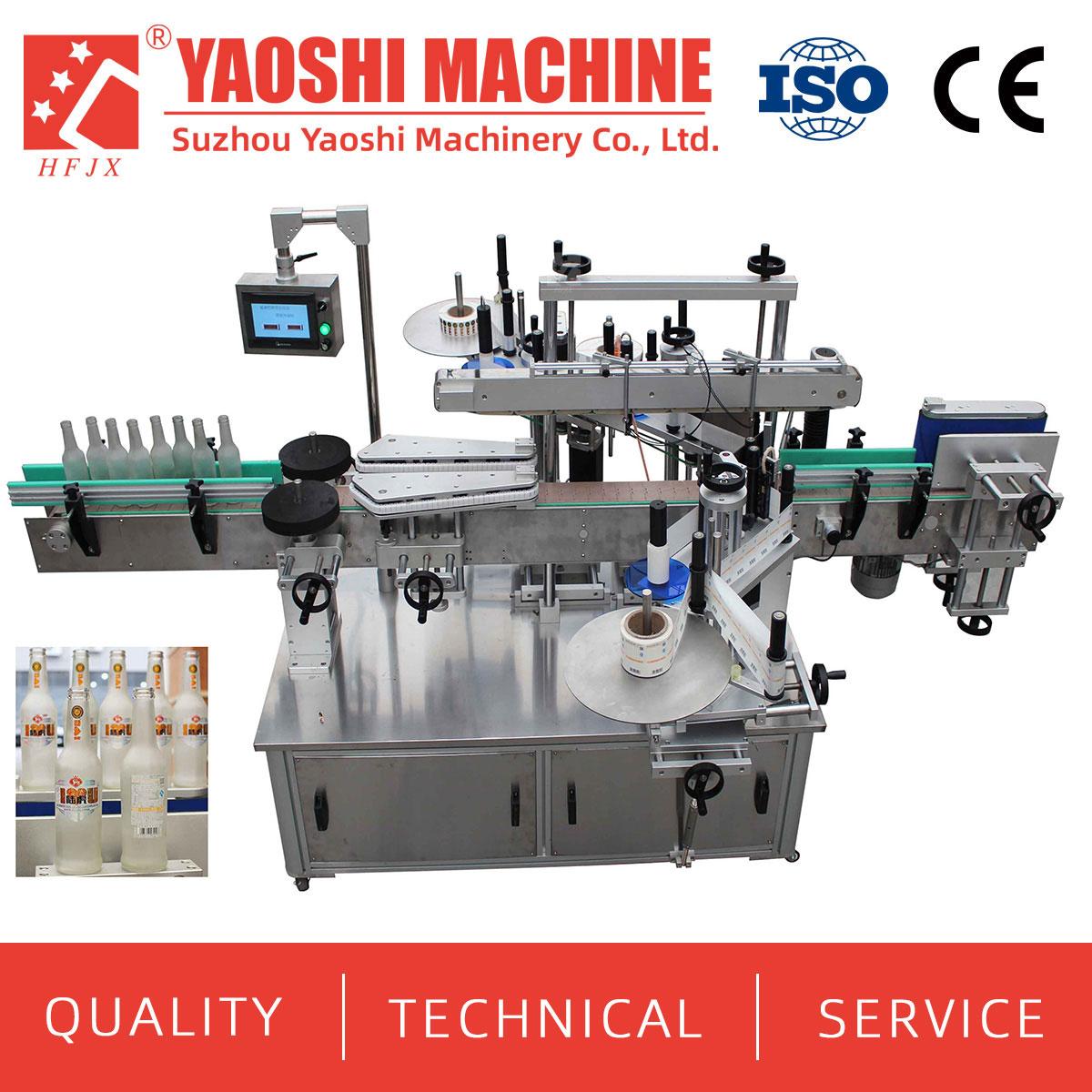
Hot melt wrap around labeling is a route to evaluate when a beverage bottle needs a wrap label on a compatible body panel and the production team can manage film feeding, adhesive application and bottle handling as one process. A cylindrical label panel is a useful starting point; an irregular bottle, several separate label positions or an untested adhesive combination needs further review.
The decision should follow the package design and operating conditions, not a headline machine speed. This article focuses on roll-fed OPP hot melt labeling for beverage bottles, how the application works and the conditions that make it a practical fit.
In this application, printed film is fed from a reel and cut into individual labels. Adhesive is applied at the required bonding areas. The bottle rotates as the label wraps around its body, and the trailing edge closes the overlap. The supplier must coordinate label feed, cutting, transfer, bottle rotation and bonding for the selected format.
This differs from applying a pre-coated pressure-sensitive label peeled from a liner. It also differs from shrink sleeving, where a sleeve is positioned and then shrunk to the container contour. Hot melt wrap-around labeling should not be specified as though it were a heat-shrink process.
Suzhou Yaoshi Machinery Co., Ltd. lists OPP hot melt equipment within its bottle labeling machine range. Its rotary OPP hot melt glue labeling machine page includes a parameter entry for leading- and trailing-edge hot melt gluing. Ask for the current technical proposal to confirm the exact application arrangement.
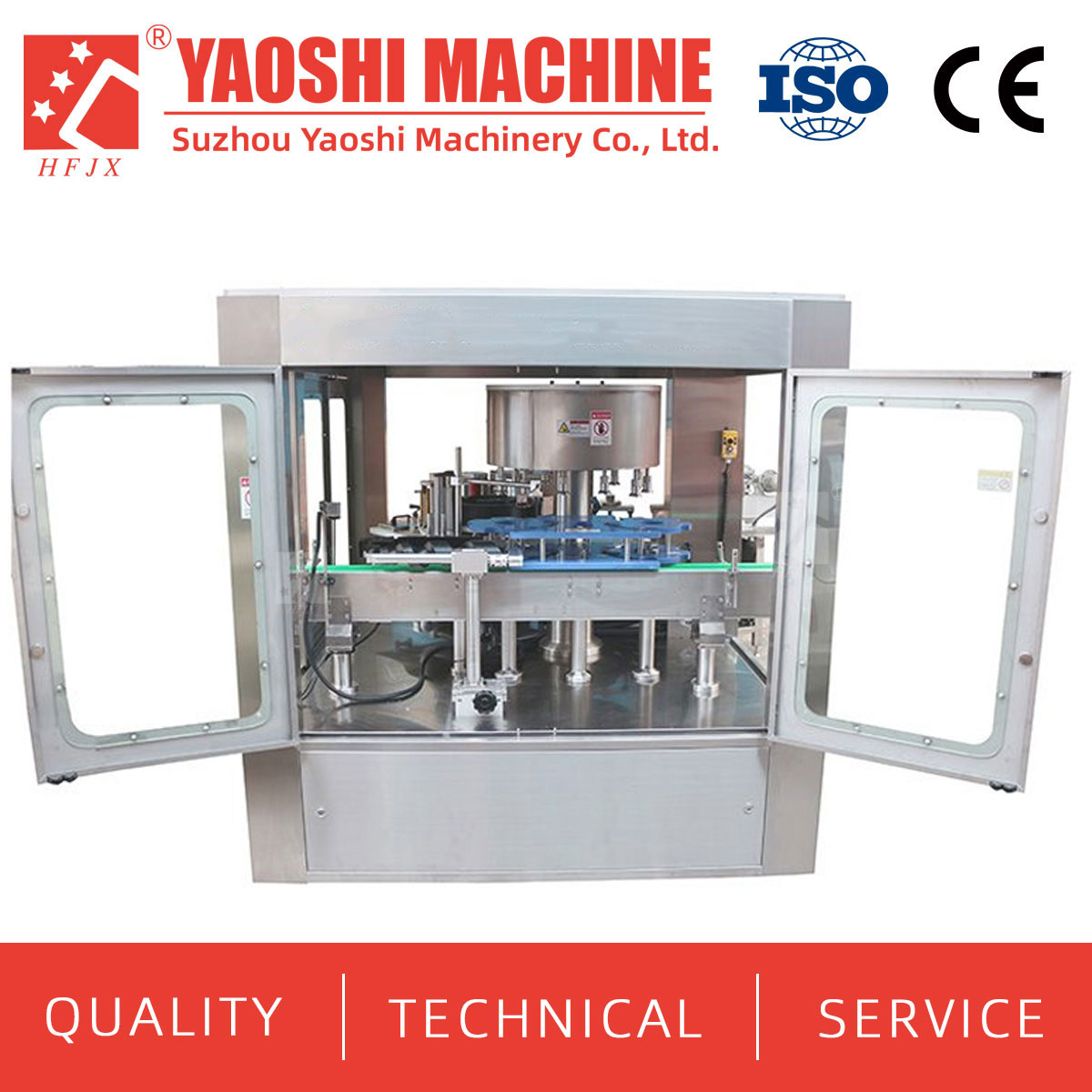
Official Yaoshi rotary labeling equipment imagery. The proposed bottle tooling and application system must be confirmed separately.
A wrap label needs a usable panel around the bottle body. Provide the panel diameter and height, along with any taper, ribs, recesses or molded features that affect label contact. A bottle can have a shaped shoulder while retaining a suitable cylindrical body panel, so assess the labeling area rather than rejecting or accepting the whole bottle by appearance.
| Project condition | Why it matters | Selection response |
|---|---|---|
| Continuous body wrap on a compatible panel | The label must follow the surface and close at the intended seam | Evaluate OPP hot melt with the actual bottle and label dimensions |
| Distinct front, back or neck labels | Separate positions require a different application arrangement | Review another labeling route or an explicitly confirmed combined configuration |
| Full decoration over complex contours | A body wrap does not automatically conform like a shrink sleeve | Review the decoration requirement before choosing equipment |
| Many bottle families and short batches | Tooling changes, material changes and start-up work affect usable production time | Compare the complete changeover duty, not speed alone |
| Cold or wet bottles at the labeler | The actual surface condition needs to be included in bonding assessment | Test the intended conditions and confirm whether surface preparation is required |
For a water or soft-drink bottle with an established OPP body label and repeated production runs, this route deserves evaluation. That does not establish a minimum batch size or guarantee lower cost. Compare the film, adhesive, change parts, start-up waste and maintenance requirements using your own production schedule.
If the label must extend across substantial contours, compare the intended result with a shrink sleeve labeling system. Do not select hot melt simply because both technologies appear in a beverage equipment catalogue.
“OPP label” is not a complete material specification. Submit the film construction, dimensions, print repeat, registration-mark details, roll core, roll diameter and unwind direction. Identify any material or print changes between SKUs. A trial with one approved roll does not prove compatibility with every label carrying the same general material name.
The adhesive also needs a defined specification and selection responsibility. Ask the supplier to identify the compatible adhesive or the process for approving a buyer-supplied grade. Review application conditions, bottle surface, label overlap and intended storage and handling conditions with the machine and material suppliers.
Use their approved operating guidance for temperature and application settings. A catalogue temperature range does not replace the adhesive data sheet or establish the correct setting for every film. Changing adhesive grade after approval should trigger a compatibility review.
Seam quality belongs in the acceptance discussion. Define the overlap, allowable appearance and how the bond will be checked after application and under relevant handling conditions. Do not approve the package from artwork alone.
The current Automatic Rotary OPP Hot Melt Glue Labeling Machine page lists the following entries. Use them for a preliminary review only; the quoted configuration and approved material combination must be confirmed before ordering.
| Product-page item | Published value | Confirmation needed |
|---|---|---|
| Maximum label width | 150 mm | Supported label range for your formats |
| Maximum label length | 500 mm | Cut length and seam allowance |
| Paper core diameter | 152 mm | Roll specification and winding |
| Power supply entry | Three-phase 380 V, 50 Hz, 8,000 W | Final electrical requirement and supply boundary |
| Gluing method | Leading- and trailing-edge hot melt gluing | Adhesive and application arrangement |
The product page currently contains mixed OPP and shrink-sleeve descriptions, and its introductory speed range differs from the speed in the parameter table. Those statements should not be combined into one machine specification. Request a corrected technical sheet identifying the offered machine, its actual process and the output supported for your approved bottles and labels.
The listed electrical entry is not a measured energy-consumption figure. Likewise, a maximum label dimension does not confirm successful feeding, wrapping or bonding for every material within that size.
The line must deliver bottles in a condition the proposed labeler can handle. State whether they arrive filled or empty, their surface condition and the available conveyor arrangement. Ask how bottles are spaced and supported, and how the machine responds to interrupted supply or a downstream stop.
Coordinate the handover to the bottle packaging equipment. The labeler, conveyor and packer should have agreed connection and control boundaries. Define the acceptable labeled-bottle output at that handover point rather than assuming that matching catalogue BPH values proves line compatibility.
For format changes, request the tooling list and adjustment procedure. Confirm which guides, bottle-handling parts and label-related components are included for each bottle family. A stored control recipe does not by itself eliminate physical change parts.
Also request the supplier's maintenance and cleaning instructions for the supplied equipment. Include access to the glue system, label path and cutting area in the layout review. Operating and maintenance procedures should follow the machine documentation, not a generic article.
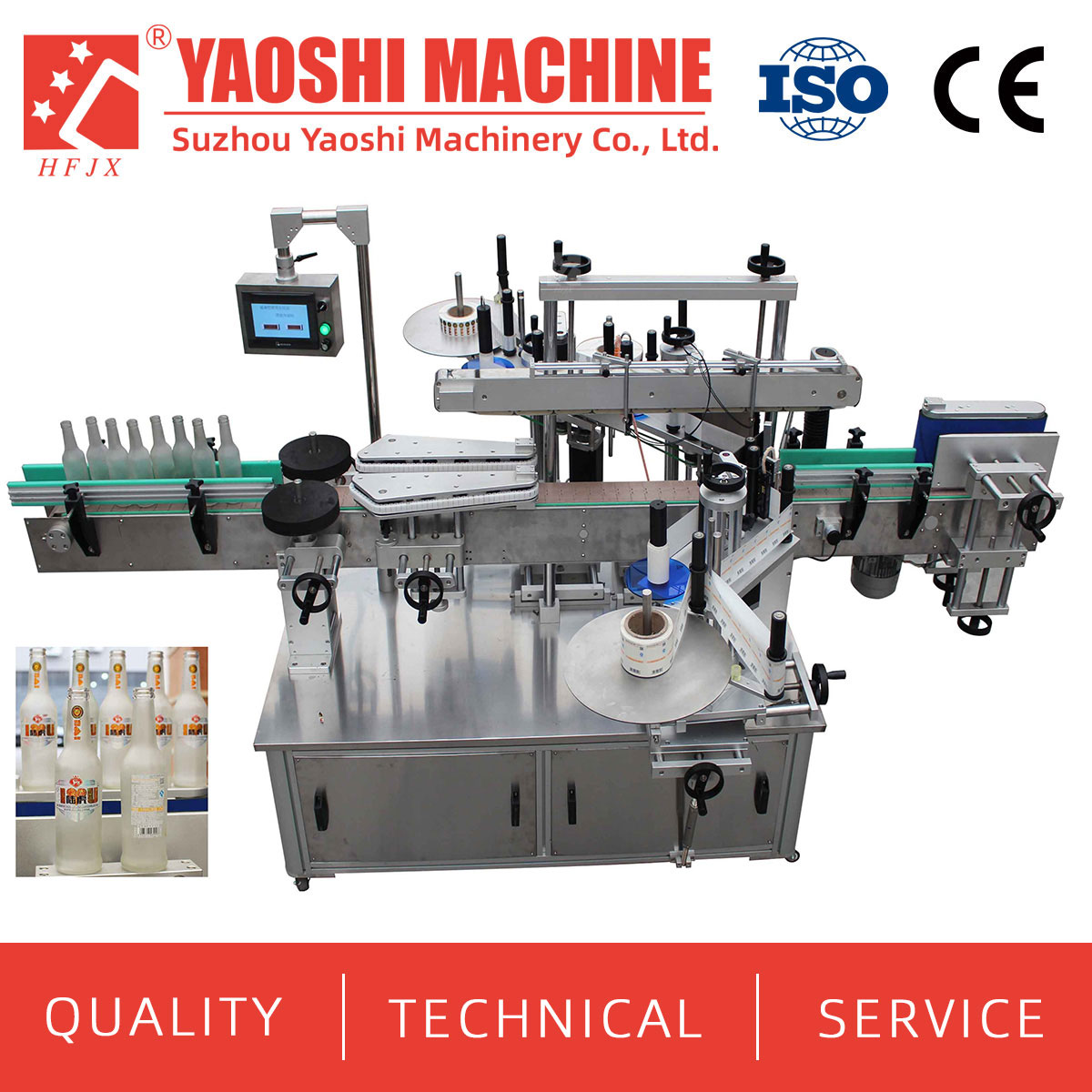
Alternative self-adhesive equipment shown for comparison. It uses a different label supply route and is not an illustration of the hot melt process.
Approve the representative bottle, label and adhesive combination before asking the supplier to demonstrate output. Include the most demanding format and any material variation that could change feeding or bonding behavior.
Agree the test rate, duration or quantity, and acceptable output counting method.
Check label position, overlap, wrinkles, visible glue and seam closure against agreed references.
Assess stop-and-restart behavior and a representative format change.
Define when and under which relevant conditions the finished label bond is assessed.
Record any untested stock or operating condition as an unresolved item.
The trial should answer whether this combination fits the project. It should not become a general claim that the machine accepts all bottles, films or hot melt adhesives.
The roll-fed hot melt process described here bonds a wrap label with adhesive; it is not shrink sleeving. Any additional tunnel or surface-conditioning equipment needs its own stated project purpose.
Possibly, if the intended body panel and handling arrangement are suitable. Submit the full drawing and samples; shoulder shape alone does not answer whether the label panel can accept a wrap.
No universal saving can be assumed. Compare the approved materials, equipment scope, change parts, waste and operating requirements for your actual batch schedule.
That requires material and operating-condition confirmation. The beverage name alone does not define bottle surface, application conditions or package-handling requirements.
No. Request output for the specified bottle, label and adhesive combination, with an agreed quality standard and test basis.
Obtain a consistent technical sheet, an approved format list, material requirements, output conditions and test obligations. Resolve the current product-page process and speed inconsistencies before using it as an order specification.
To evaluate hot melt wrap around labeling with Yaoshi Machinery, send container drawings or samples, label samples and material specifications, proposed adhesive information and required line speed by format. Include the conveyor layout and bottle condition at application. Email tony@yaos.ltd or call +86 18915689808 to request a configuration review and confirmation of the applicable equipment.


+86-512-58530618

Wukesong Road, Sanxing Town, Zhangjiagang City, Jiangsu Province, China