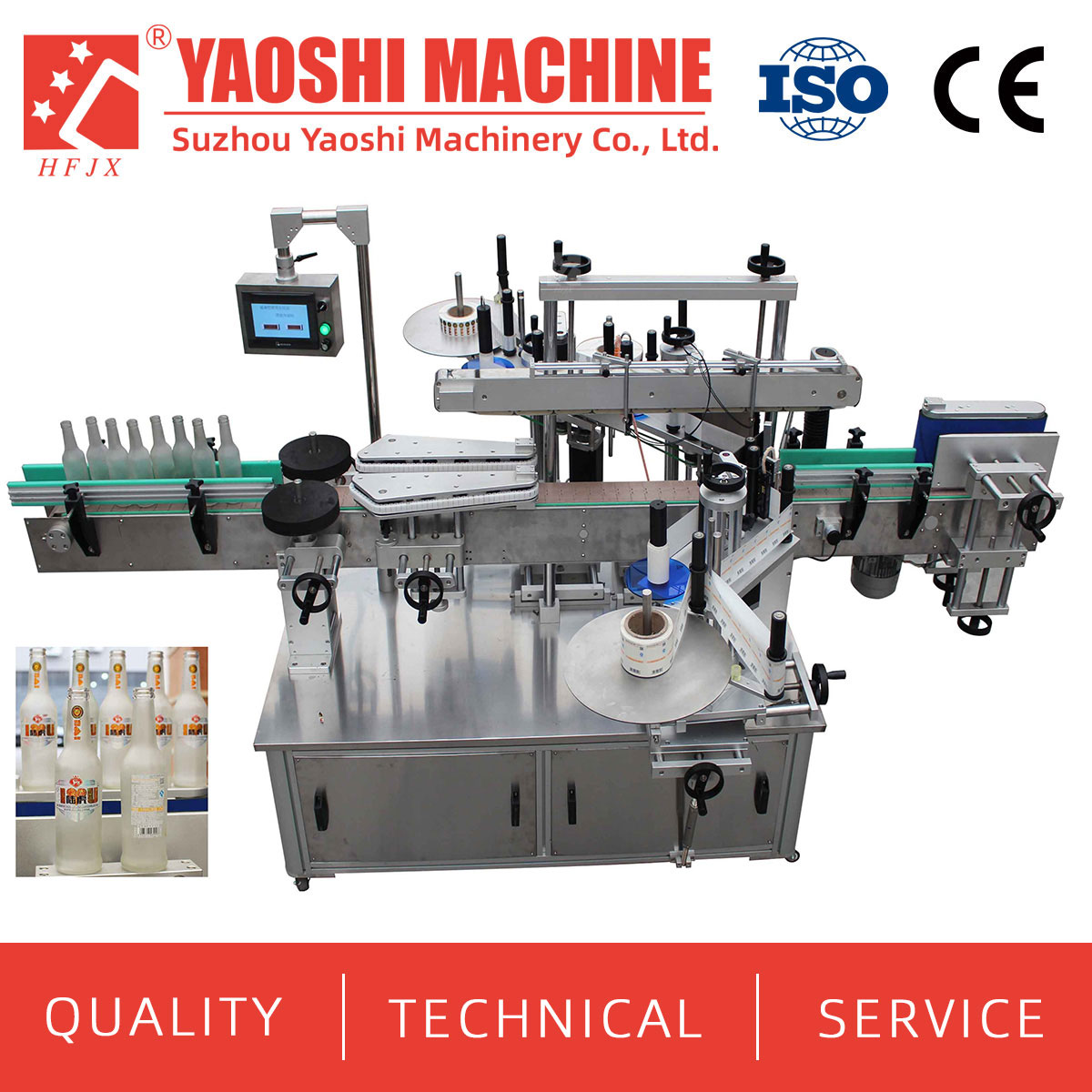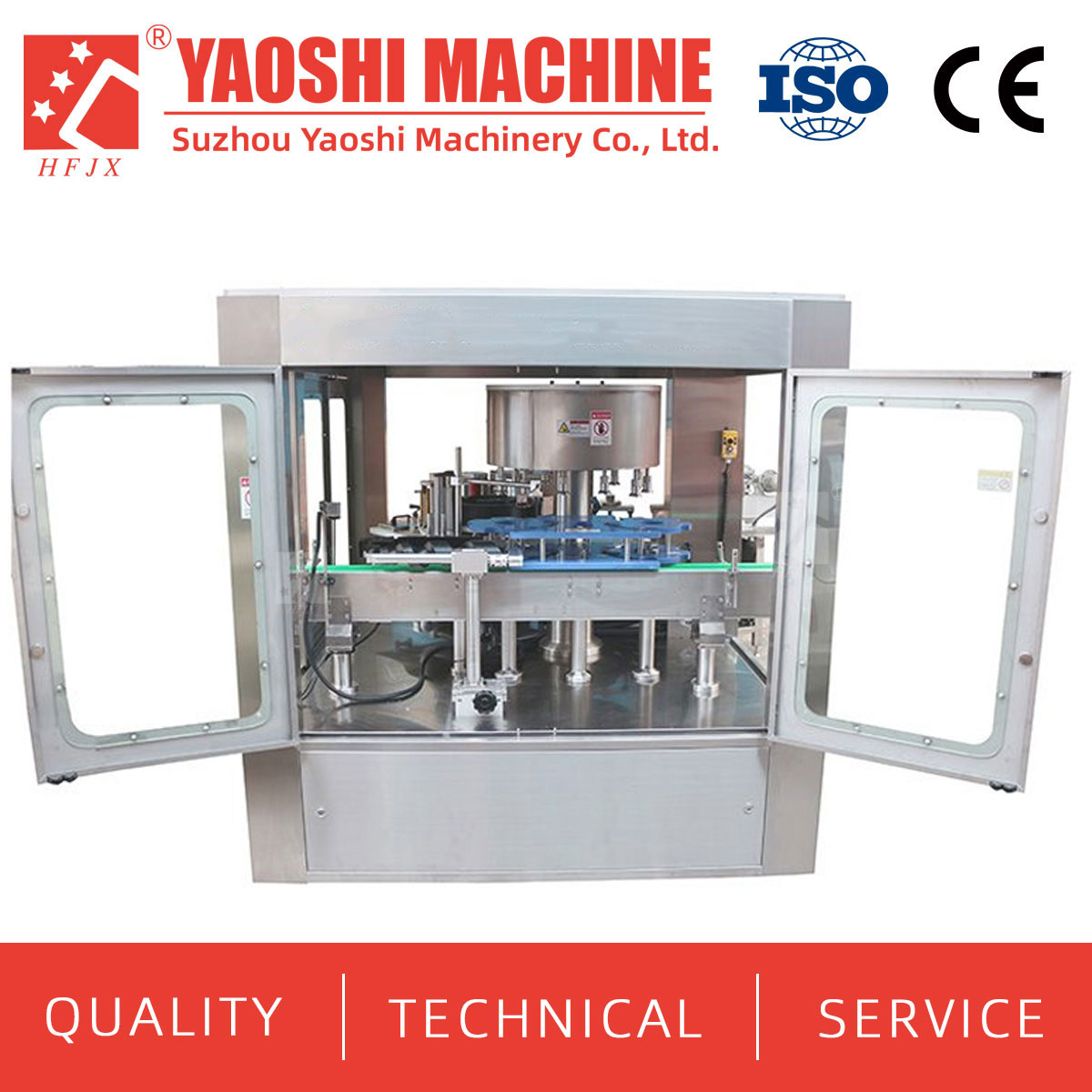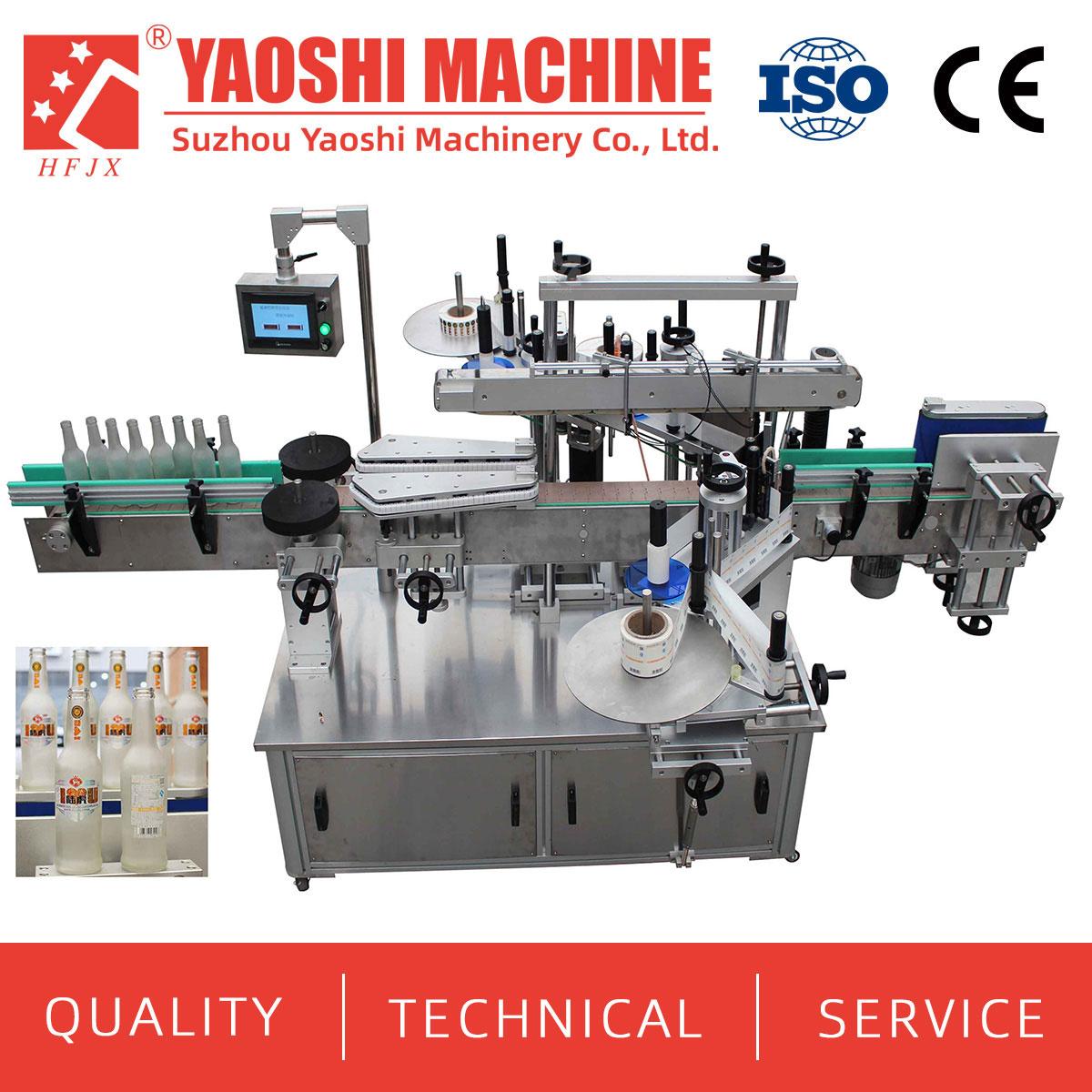
A glass bottle labeler must keep the container in a repeatable position while the label is applied. Matching bottle diameter and label dimensions is only the first check. The base, body profile, actual filled condition and any required alignment to an embossed feature also affect the handling arrangement.
For a glass-bottle beverage project, assess three things before approving a machine: stable transfer through the labeling zone, a measurable label-placement requirement, and a defined change-parts list for every format. This guide focuses on those compatibility questions rather than repeating a general comparison of label technologies.
Two glass bottles with the same nominal volume can have different bases, shoulders, label panels and weight distribution. Submit a dimensioned drawing and representative production samples. Identify whether the labeler receives empty bottles or filled, capped bottles, and whether the glass is clear, tinted, coated or decorated.
Mark molded seams, embossed logos, recessed panels and any other feature that may affect label contact or orientation. If several glass suppliers are approved, include the relevant dimensional tolerances and samples rather than assuming one nominal drawing represents every delivery.
Suzhou Yaoshi Machinery Co., Ltd. lists single-side, double-sided and three-sided self-adhesive systems in its bottle labeling equipment range. These provide starting configurations for discussion. The glass bottle and label combination still requires confirmation; a category listing does not establish glass compatibility for every model.
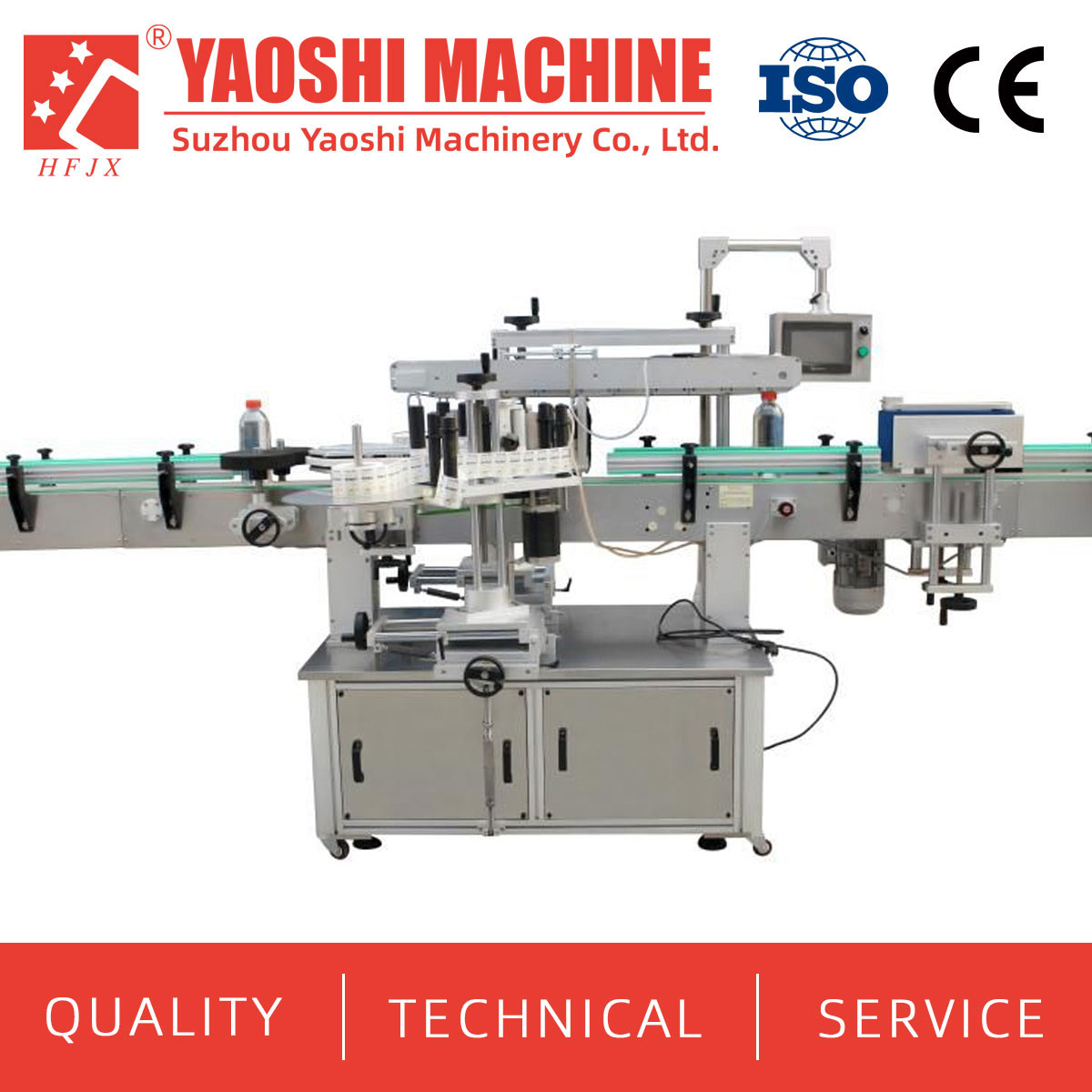
Official Yaoshi labeling equipment imagery illustrates the conveyor and application arrangement. It is not a trial record for the buyer's glass bottle.
Review the bottle's movement from the upstream conveyor into the application zone and out to the next machine. Ask the supplier how it will control spacing, support the container and prevent unwanted rotation. A steady bottle before the machine is not enough if it moves differently at the label-transfer point.
For glass, include contact with guides, transfers and other bottles in the trial review. Ask for evidence that the proposed handling arrangement avoids unacceptable scuffing, impact or damage at the agreed operating rate. Do not specify a generic guide clearance or holding pressure without the machine supplier's instructions.
| Glass-bottle condition | Compatibility question | Evidence to request |
|---|---|---|
| Tall body or narrow base | How is the bottle stabilized during transfer and label application? | Trial using the intended filled or empty condition |
| Molded seam, embossing or recessed panel | Does the label need clearance or a fixed rotational position? | Marked drawing and demonstrated positioning result |
| Variation between approved bottle supplies | Can the handling arrangement accommodate the agreed tolerances? | Representative samples and an approved container specification |
| Moisture or residue at labeling | Are the label and adhesive suitable for the actual surface condition? | Material review and application trial under representative conditions |
| Intermittent bottle supply | What happens when the line stops and restarts? | Observed transfer, spacing and label placement during restart |
If the bottle arrives from washing, cooling or a cold-fill process, describe its condition at the labeler rather than only the upstream process name. Surface preparation, if needed, should be an explicit equipment or buyer responsibility, not an unstated assumption.
A requirement such as “center the front label” is incomplete. Specify the reference: centered on a flat panel, aligned with an embossed logo, or positioned at a stated height above the base. A round glass bottle without an orientation requirement is a different task from one that must present a label beside a molded seam.
Show the intended label height and permitted deviation on a drawing. Define how skew will be measured and how bottle dimensional variation is treated. Agree whether the reference is the base, a panel edge or another identifiable feature.
If two labels must face opposite directions, define their relationship and whether their heights or sizes differ. Yaoshi's double-sided self-adhesive labeling machine page describes flat and square container applications. A round glass bottle needing front and back labels should therefore be submitted for configuration review rather than assigned to that machine by name alone.
Identify the actual feature that can be used as a reference, and ask how the proposed system detects or mechanically locates it. Ordinary bottle detection and orientation to an embossed logo are different functions. Do not assume that a standard presence sensor can establish rotational registration.
Yaoshi's single-side self-adhesive labeling machine page lists the following data for preliminary screening. The entries apply to that product and do not constitute a confirmed glass-bottle configuration.
| Published item | Listed value | Glass-project confirmation |
|---|---|---|
| Production capacity | 4,000–6,000 BPH | Output for each approved bottle, label and placement requirement |
| Bottle diameter | 30–90 mm | Actual profile, tolerances and handling suitability |
| Bottle height | 30–200 mm | Stability and available support locations |
| Label width / length | 10–110 mm / 20–360 mm | Panel fit, label construction and application result |
| Roll core / roll diameter | 76 mm / 350 mm | Required roll construction and winding direction |
| Voltage / power | 220 V, 50 Hz / 1,200 W | Final utility schedule for the offered configuration |
Being within a dimensional range does not prove that a particular glass bottle will remain stable or meet a registered placement requirement. Ask for the approved format list and trial basis. The electrical entry is not a measured energy-consumption guarantee.
The source page also mentions stored job settings. Treat recipe recall and mechanical format change as separate issues: stored values do not prove that guides, rollers or other handling parts need no adjustment.
Ask the supplier to distinguish adjustable components, format-specific parts and optional equipment. Depending on the machine design, the review may involve guides, spacing devices, wrap rollers or belts, support components, and orientation tooling. Not every machine uses every item.
For each glass bottle format, request the required parts, part identification and setup references. If a part is shared between formats, have that stated explicitly. Include the labels as well: a change in label height or length can require a different setup even when the glass bottle is unchanged.
Record bottle and label drawing revisions against each approved format.
Identify required mechanical parts separately from stored control settings.
Request the supplier's adjustment procedure and first-off approval checks.
Agree what a representative changeover demonstration must establish.
Review the outfeed connection to the bottle packaging equipment. Confirm conveyor direction, height, transfer details and the response to a downstream stop. The proposed labeler should be evaluated at the required line condition, not only with isolated bottles fed slowly by hand.
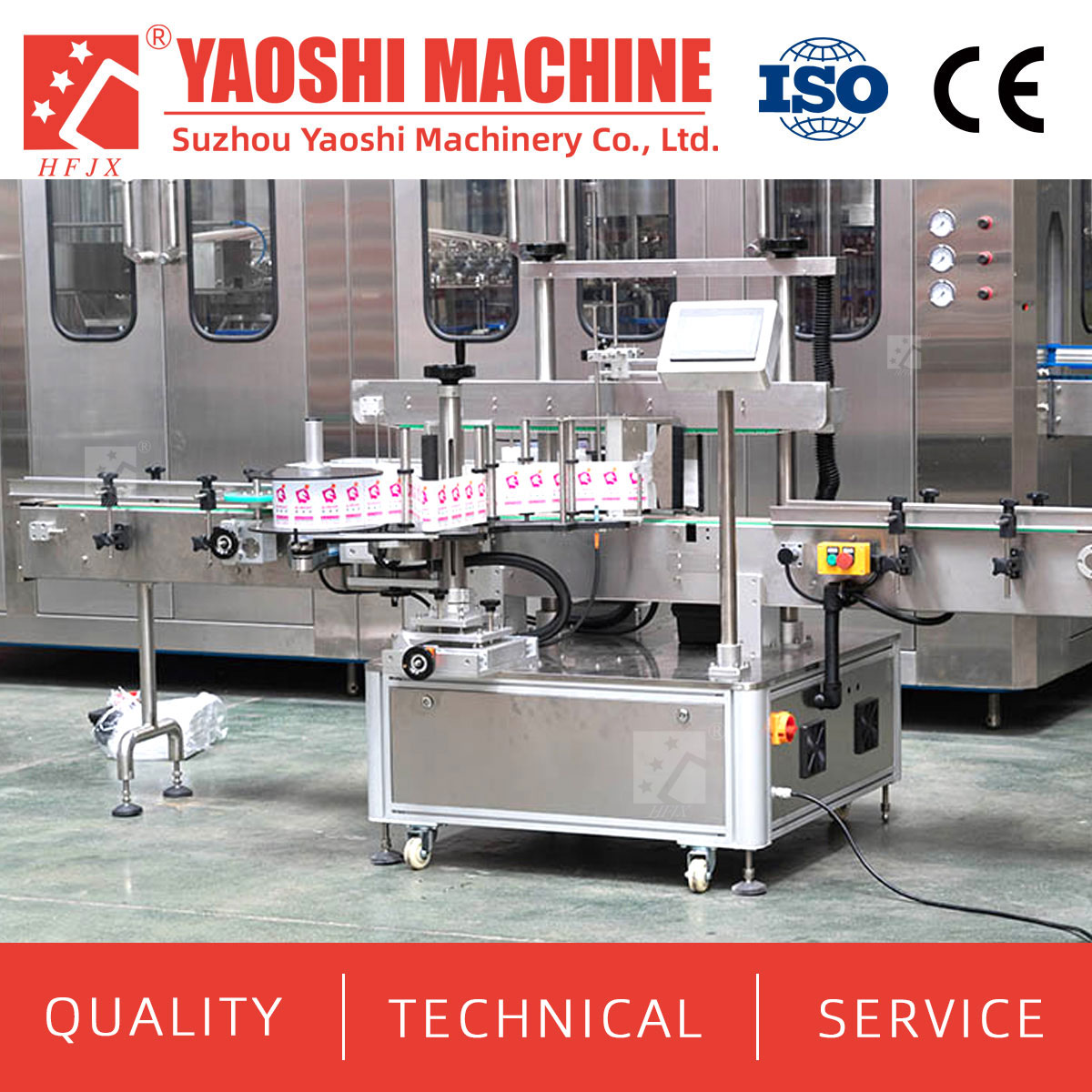
Official imagery shows an alternative application arrangement. Confirm the exact label positions, glass handling and change parts in the supplier's proposal.
Use representative production glass bottles and label stock, with the intended fill condition and relevant surface conditions. Agree the speed, test duration or quantity, and measurement method before the trial.
Inspect stable transfer, unwanted rotation, label height, skew and any alignment to embossing. For multiple labels, assess their relationship as well as each label independently. Define acceptable glass and label appearance instead of relying on “good quality” as an acceptance criterion.
Include stop-and-restart behavior and a representative format change. Record the approved settings, fitted parts and sample results. If some bottles or conditions have not been tested, leave them on an open confirmation list rather than extending approval to them automatically.
Only after reviewing the actual machine and glass formats. Matching dimensions alone does not confirm the contact arrangement, stability, sensing or acceptable surface appearance.
No. Assess its base, profile, filled condition and transfer path. Weight alone cannot establish repeatable positioning at the application point.
Ask for a confirmed orientation method using the actual reference feature. This requirement should be included in the technical proposal and demonstrated with production-equivalent samples.
Not necessarily. Compare diameter, height, body profile and label location. Request a format-specific parts review rather than grouping bottles by capacity.
Describe the actual condition and submit it for label, adhesive and equipment review. Do not assume a trial with clean dry samples validates a wet production surface.
Send glass bottle drawings or samples, label specifications and intended positions, output by format, and the conveyor layout. Identify any required alignment to a seam or embossed feature.
For a glass bottle labeler review with Yaoshi Machinery, submit container drawings or samples, label samples or drawings, placement references and target line speed for each format. Include the filled or empty condition, surface condition and required changeovers. Email tony@yaos.ltd or call +86 18915689808 to request the proposed handling arrangement, format-parts list and trial requirements.


+86-512-58530618

Wukesong Road, Sanxing Town, Zhangjiagang City, Jiangsu Province, China