Packaging equipment selection starts with the finished pack: what it contains, how it must travel and how many acceptable packs must leave the line. A filler capacity in bottles per hour does not identify the correct shrink wrapper or carton packer. The container, grouping pattern, packaging material and output endpoint must be defined together.
This guide covers secondary packaging after beverage filling, closing and labeling. It focuses on selecting the packing route and checking its interfaces, rather than choosing a filler or repeating a mineral-water-only comparison of film, trays and cartons.
Prepare a pack drawing before requesting a machine recommendation. State the container count, row arrangement, finished dimensions, approximate filled weight and the required film, tray or carton construction. Identify whether the pack is a consumer multipack, a distribution unit or an input to further packing.
Suzhou Yaoshi Machinery Co., Ltd. lists film-based and carton systems in its beverage packaging equipment range. Use the intended package to choose which system to evaluate. Do not assume that one model can switch between all packaging routes.
| Pack route | Evaluate when | Confirm before selection |
|---|---|---|
| Film-only shrink bundle | The approved container group and distribution duty can be met with a film bundle | Grouping stability, film specification, shrinking result and finished-pack handling |
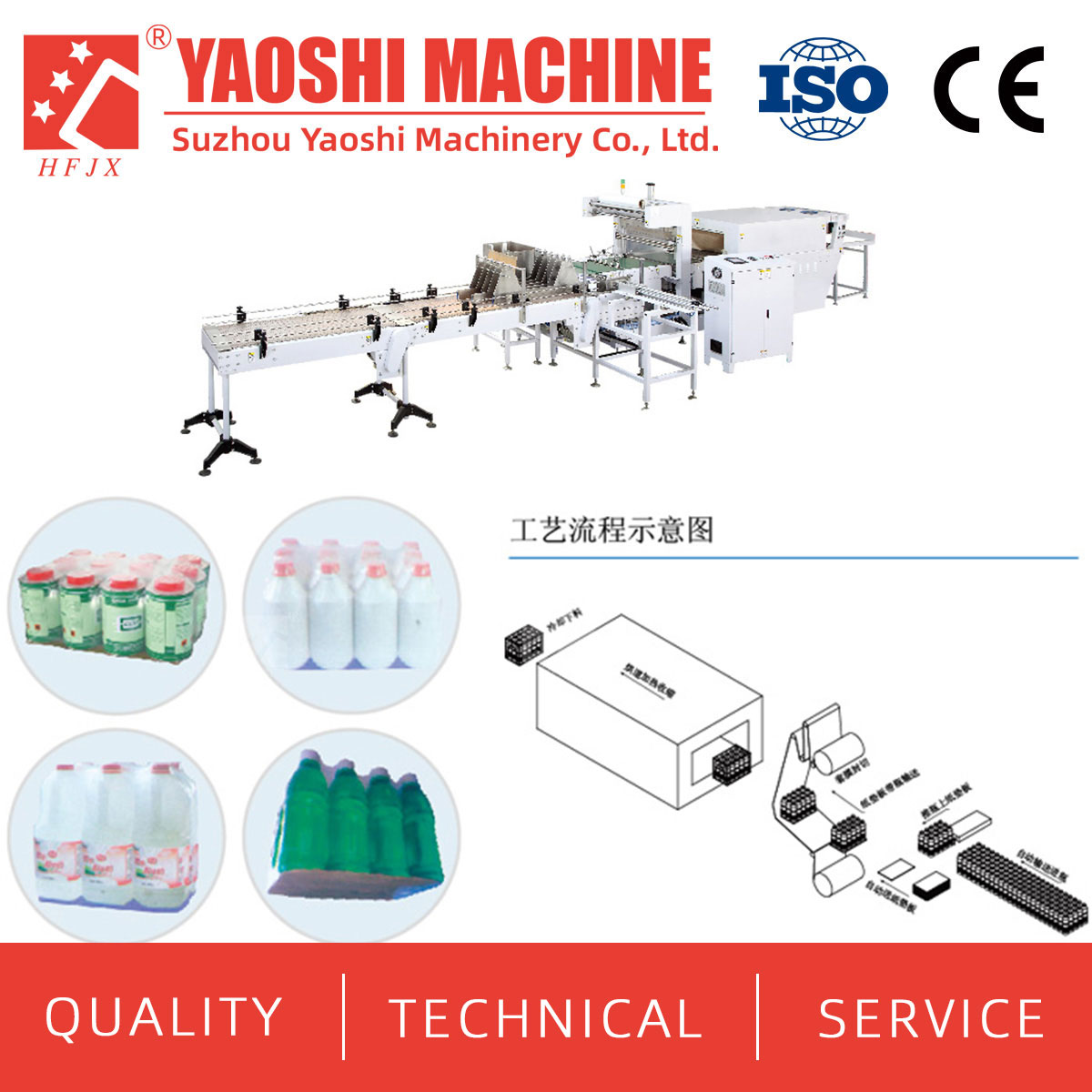
| Tray or pad with film | The package design requires bottom support with a film overwrap | Board drawing, feeding and forming scope, film specification and stack behavior |
| Carton or case packing | The distribution or retail specification calls for a defined corrugated package | Blank or case style, loading method, protection features and closure process |
A carton machine that forms a blank around a bottle group is not automatically the same scope as a case erector, top-loading packer and sealer. Ask the supplier to identify the carton construction and equipment sequence in the offer.
Send container drawings and production-equivalent filled samples. Dimensions determine the nominal envelope, but the infeed must also handle the container's stability, contact surfaces and arrival condition. Review the actual product range rather than grouping everything under “beverage bottles.”
Ask how the proposed system maintains the required group during accumulation and transfer. Provide the actual bottle profile and filled condition. Include the label and closure when assessing the finished pack, especially where they may contact film, guides or neighboring containers.
Include impact, scuffing and any separation requirement in the package review. If dividers or partitions are required, state whether their supply and insertion are included. Approval should cover the actual handling and distribution duty, not only whether bottles fit inside the carton.
Provide can diameter, height and finished condition at packing. For cold-filled products, identify moisture at the boundary. Ask for the approved grouping, transfer and material-handling arrangement rather than assuming the same setup as a bottle pack.
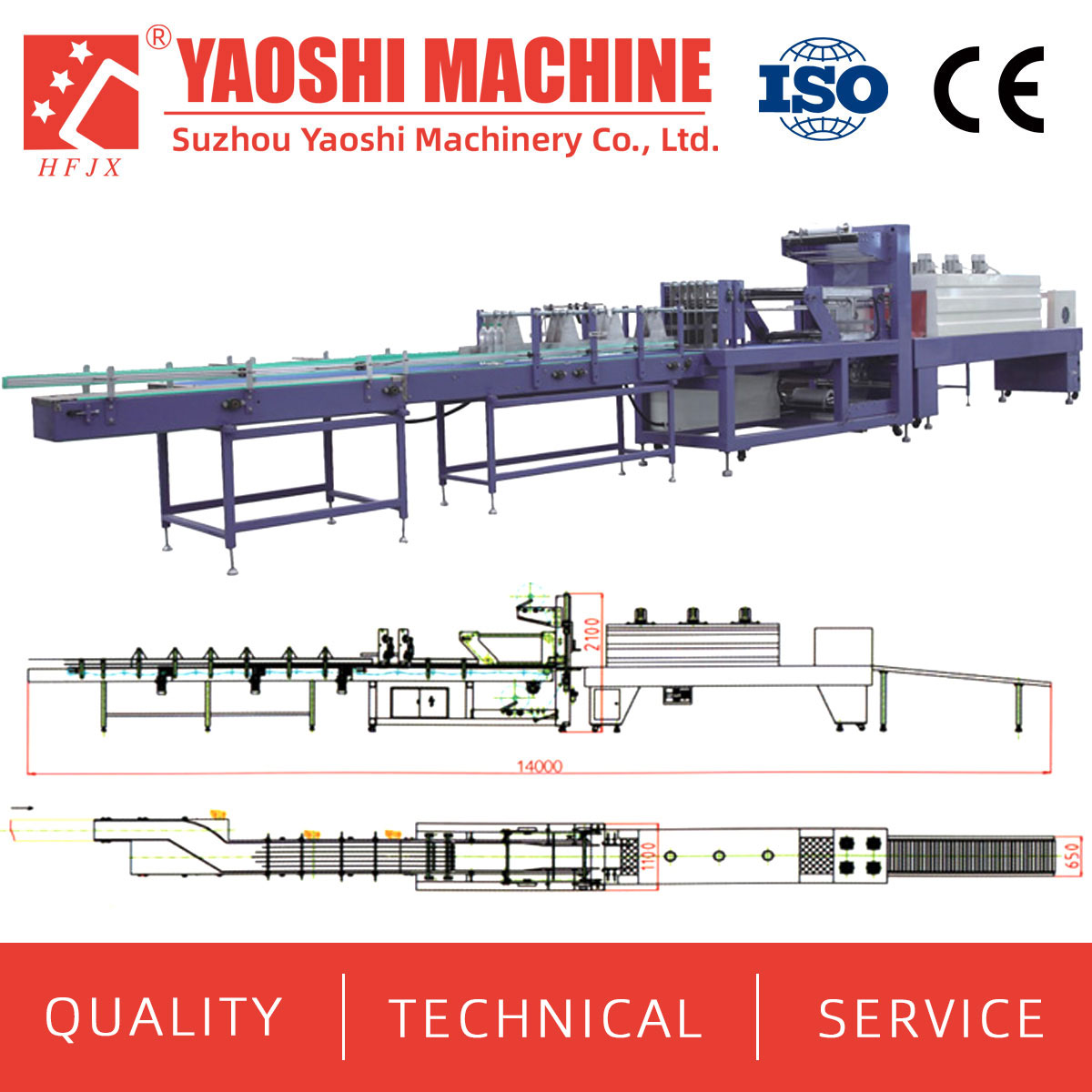
Yaoshi's half-tray film shrink wrapping machine page identifies cans and glass bottles among its intended applications. Confirm the tray or pad construction and material-feeding scope for the proposed project; generic film-only descriptions on that page should not define a tray system's scope.
Compare capacities in consistent units. The basic conversion is:
Required packs per minute = bottles per hour ÷ bottles per pack ÷ 60.
For illustration, 12,000 bottles per hour in a 12-bottle pack equals 16.7 packs per minute before allowances for interruptions or rejects. The same bottle flow in a 24-bottle pack equals 8.3 packs per minute. These are arithmetic examples, not Yaoshi machine ratings.
This conversion establishes the continuous-flow requirement, not the final machine specification. Ask the supplier to account for the actual infeed, grouping pattern, material replenishment, stops and recovery behavior. Do not add an arbitrary percentage and call the result guaranteed output.
Define the counting point: formed packs at the machine exit, acceptable packs after inspection, or packs delivered to palletizing. Record reject handling and any manual work needed between those points. For several SKUs, compare required output by pack format rather than using one maximum figure for the entire line.
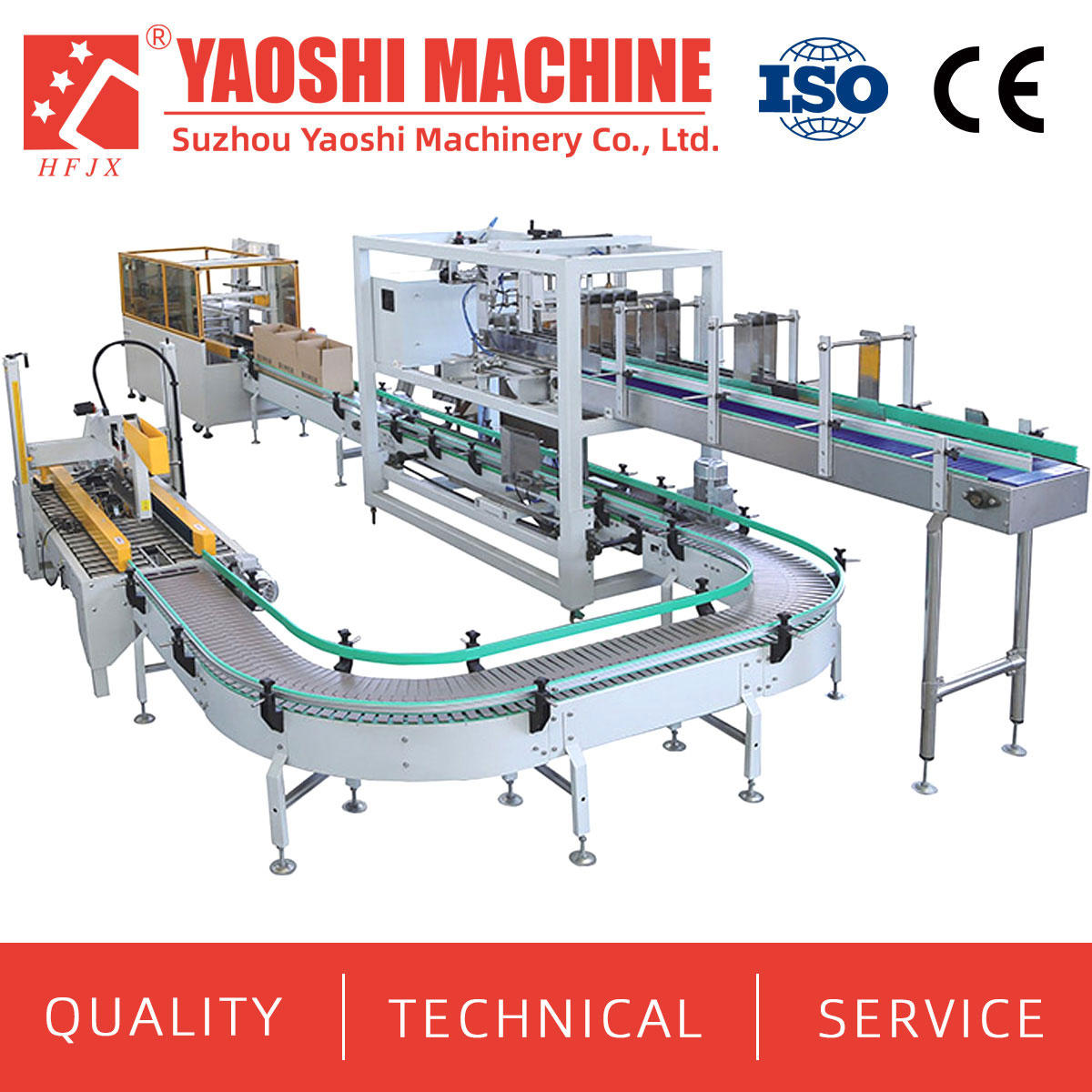
Yaoshi's automatic carton packaging machine page describes bottle grouping, cardboard feeding, forming, folding and glue bonding. Its published table includes the following entries.
| Published item | Listed value | Project check |
|---|---|---|
| Production capacity | 35–45 boxes/min | Accepted output for the named container and carton |
| Packaging arrangement | 3 × 4 / 4 × 6 | Required bottle count and grouping pattern |
| Applicable container dimensions | Diameter 60–90 mm; height 120–280 mm | Actual shape, filled weight and handling suitability |
| Machine dimensions | 10,400 × 1,800 × 2,600 mm | Installed layout, conveyors and service access |
| Total power | 20 kW | Final connected-load and utility schedule |
| Compressed air pressure | 0.4–0.6 MPa | Supply conditions at the agreed machine boundary |
These are product-page references, not guaranteed results for every container within the dimensional range. Confirm the exact offered configuration, carton material and test basis. The published power is not a measured consumption figure, and the machine envelope does not include all installation clearances.

Official carton-packaging equipment imagery illustrates the grouping and packing arrangement; use an approved layout for project dimensions.
Mark the quotation boundary on the line layout. Identify who supplies the accumulation conveyor, bottle grouping, material feeding, packing section, outfeed and connection to palletizing. Do not assume that a “complete packer” includes every conveyor or downstream module.
Discuss stops in both directions. What happens when the labeler cannot supply containers? What happens when the packer or downstream equipment stops? Ask the integrator to define buffer behavior, control signals and restart responsibilities for the actual space available.
Daily operation can change the preferred configuration. Give the supplier batch sizes, pack changes and material-replenishment expectations. Request the change-parts list and adjustment procedure for each format. Include access for loading board or film, clearing approved stoppages and maintenance in the layout review.
Compare materials on the same basis as equipment. A cheaper board or film specification is not a saving if it has not been approved for feeding and finished-pack duty. Validate the pack with the intended material before treating alternatives as equivalent.
| Buyer input | Expected supplier response |
|---|---|
| Container drawings and filled samples | Supported formats, grouping method and handling limitations |
| Pack drawing and material samples | Packing route, material requirements and required options |
| Target rate by SKU and units per pack | Acceptable pack output and stated operating conditions |
| Layout, utilities and adjacent equipment | Connection boundaries, installed footprint and utility requirements |
| Batch schedule and format changes | Change parts, adjustments and material-loading duties |
| Distribution and quality requirements | Agreed machine trial, package checks and any separate distribution validation |
Use the same RFQ revision for competing suppliers. Require included, optional and excluded items to be identified separately. An incomplete offer should remain visibly incomplete until its missing responsibilities and costs are clarified.
Agree a trial with the actual containers, pack format and materials. Assess grouping, closure or film result, visible damage, stop-and-restart behavior and acceptable output. A machine trial does not automatically establish transport performance; define any separate stacking, handling or distribution checks required for the project.
Use bottle flow as an input, then convert it to packs or boxes per minute for each format. Confirm the accepted output and operating conditions at the required endpoint.
No. The sequence depends on the carton construction and loading method. Ask whether the proposal forms a blank around the group or loads a separately erected case.
Only if the specific formats and handling arrangements are approved. A broad application statement does not establish interchangeable tooling or performance.
No. Choose the approved pack construction from container stability, handling and distribution requirements. Ask the supplier to confirm film-only, pad-supported or tray-supported operation explicitly.
Include it if the requested project boundary extends to pallet loads. Otherwise state the outfeed handover conditions and the buyer's downstream responsibilities.
Submit the container specification, proposed pack drawing and target output by SKU. Add material samples and the line layout so the supplier can review compatibility and interfaces.
For beverage packaging equipment selection with Yaoshi Machinery, send container drawings or samples, the packaging format and material specification, and target line speed. Include bottles per pack, output by SKU and the available layout. Email tony@yaos.ltd or call +86 18915689808 to request a packing-route recommendation and a quotation with clear module boundaries.


+86-512-58530618

Wukesong Road, Sanxing Town, Zhangjiagang City, Jiangsu Province, China