



Choosing PET or glass changes more than the bottle-contact parts inside a water bottling machine. The container source, empty-bottle preparation, transfer method, breakage or deformation risks, closure system, label process, secondary pack and warehouse flow all need to be reviewed.
The first project decision is not simply PET versus glass. It is whether PET bottles are blown inline or purchased, and whether glass bottles are new one-way containers or returnable bottles. Those four supply routes create different equipment scopes even when the water and target bottle count are the same.
Provide a dimensioned bottle drawing, approved sample, material, empty and filled weight, neck finish, closure and tolerances. State whether the container is single-use or returnable and describe any quality standard agreed with the bottle supplier.
| Package characteristic | PET planning question | Glass planning question |
|---|---|---|
| Container supply | Inline blowing, delivered bottles or another feed method? | New bottles on pallets, or returned bottles in crates? |
| Mechanical behavior | How stable is the empty and filled bottle at transfers? | What impact, breakage and chip controls are required? |
| Handling reference | Can empty bottles be handled by the neck finish? | Which base-supported transfers and guides suit the bottle? |
| Closure | Which cap and neck finish are approved? | Which screw, crown or other project-specific closure is used? |
| Secondary pack | Film, tray, carton or another market format? | Carton, divider, crate, tray or another protective format? |
Do not assume that two bottles with the same nominal volume can share the same change parts. Height, diameter, neck, base geometry and center of gravity can change guides, star wheels, screws, transfers and accumulation behavior.
| Container route | Typical modules to define | Buyer inputs |
|---|---|---|
| PET with inline blowing | Preform feed, heating and blowing, molds, cooling, compressed air, bottle transfer and buffer strategy | Preform and bottle drawings, bottle-quality criteria, output by format and available utilities |
| PET with purchased bottles | Empty-bottle storage, unpacking or unscrambling, feeding, rinsing as specified and transfer to filling | Delivery presentation, bottle condition, storage method and labor plan |
| New one-way glass | Depalletizing, bottle transfer, inspection, rinsing as specified, filling, closing and empty-pallet handling | Pallet pattern, bottle quality, inspection criteria and packaging route |
| Returnable glass | Crate and bottle handling, sorting, bottle washing, post-wash inspection, filling, closing and return-logistics flow | Return system, bottle population, soil conditions, rejection criteria and clean/dirty area plan |
The quotation should identify the first and last included points. “Complete line” may begin with preforms, approved empty bottles, washed bottles or bottles already presented at the filler infeed.
A PET bottle water filling machine can receive bottles from an inline blowing section or from a separate empty-bottle feed. Inline production connects filler capacity to the selected preform, mold, bottle design, compressed-air system, cooling equipment and bottle-transfer arrangement.
The PET blow molding machine rating should be confirmed for every bottle design. A capacity demonstrated with one small, stable bottle should not be applied automatically to a larger or more difficult bottle. Confirm which molds, preform handling, quality checks and utility equipment are included.

Inline PET bottle production adds molds, compressed air, cooling and bottle-transfer requirements.
When finished PET bottles are purchased, the plant avoids an inline blowing section but needs space and handling for bulky empty containers. Define whether bags, pallets, containers or another delivery method are used and how operators or automatic equipment feed bottles into production.
New glass bottles commonly arrive in a controlled pallet or crate pattern. The project should identify unloading, storage, depalletizing, layer handling and the transfer route to inspection and rinsing. Bottle weight and breakability affect equipment loading, manual tasks and the design of contact points.
Returnable glass adds an inbound used-package stream. The plant may need crate handling, bottle extraction, sorting, washing, inspection and rejection before the glass bottle water filling machine. Dirty returns should not move through the clean production area without a defined separation and hygiene plan.
Returnable-bottle population also affects capacity. Bottles can be rejected for damage, contamination or incorrect format, so the available return pool and replacement-bottle plan should be included in production planning.
A rinse prepares an approved bottle immediately before filling according to the agreed hygiene process. A returnable-bottle washer removes residues and contamination from bottles collected after market use. These are not interchangeable operations.
For new PET and one-way glass, confirm the approved bottle condition, rinsing medium, contact time, drainage and inspection requirement. The exact method depends on the package, water specification and project hygiene plan.
For returnable glass, define washer inlet condition, sorting, cleaning sequence, chemicals, temperatures, utilities, wastewater route and post-wash inspection. The buyer should provide representative returned bottles during design and testing instead of assuming all returns resemble clean factory samples.
Still water, sparkling water and other water products may require different filling conditions. Container material alone does not determine the filling principle. The supplier must review water type, temperature, carbonation where applicable, bottle strength, neck finish, target fill and closure.
Inside the filler, PET and glass may require different bottle support, centering, lifting and transfer arrangements. The machine pitch and bottle path should be confirmed against the approved drawings and samples. For a shared machine, list all common and format-specific parts.
Capacity should be stated for each bottle. Glass weight and breakage controls or PET stability and deformation risk can change the stable operating condition. A nominal BPH figure associated with one package should not be copied to the other.
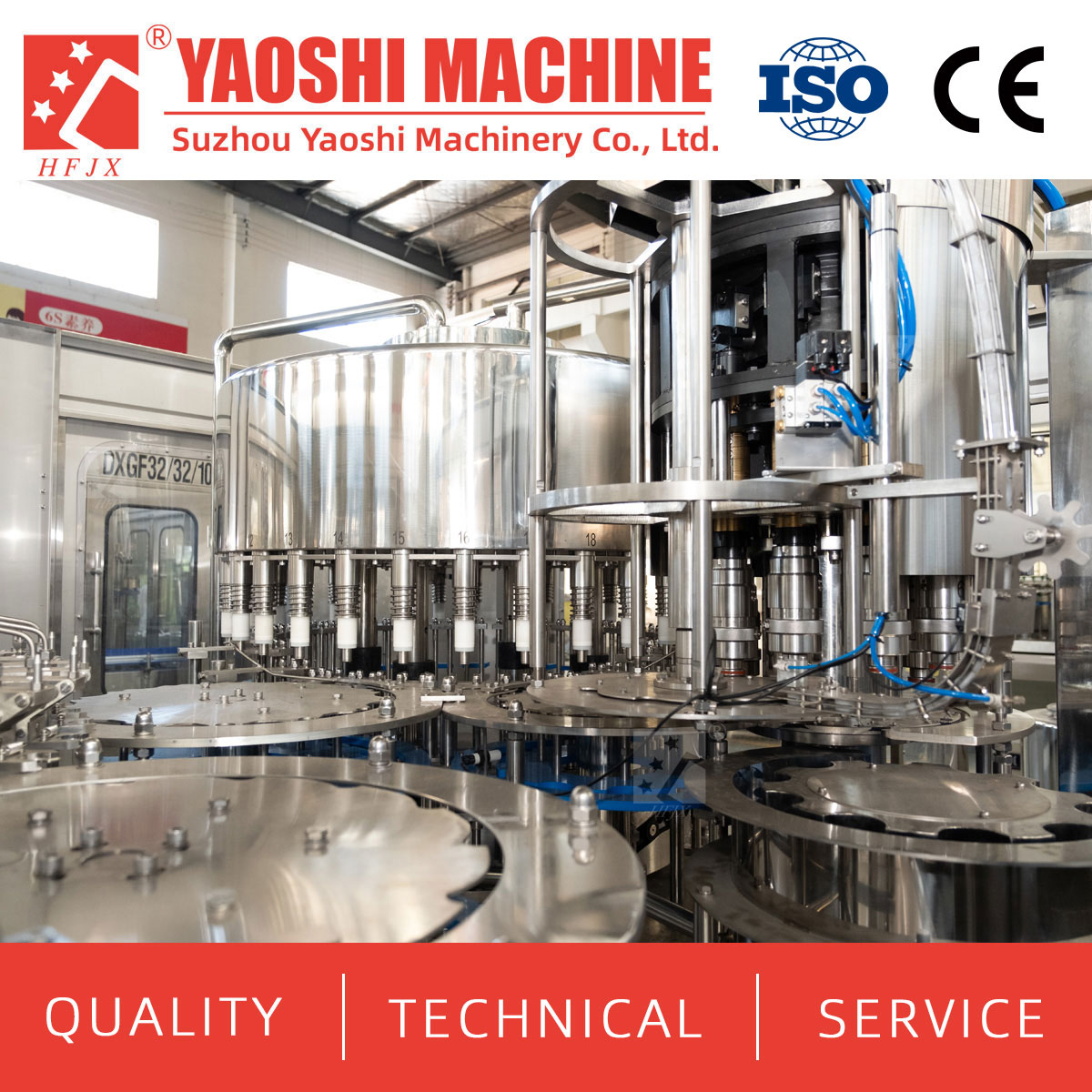
The filler configuration must be confirmed against the approved bottle, closure and water conditions.
Lightweight empty PET bottles can become unstable because of air movement, static, guide settings or abrupt transfers. Depending on the bottle and line arrangement, neck handling may be used before filling. After filling, the conveyor must account for the bottle’s increased weight and center of gravity.
Glass bottles require controlled base support and transfers that limit impact between containers. Accumulation should avoid excessive bottle pressure. The line also needs a defined response to broken glass, including stopping, isolation, removal, cleaning and inspection of the affected area.
| Conveyor issue | PET review | Glass review |
|---|---|---|
| Empty-container stability | Neck finish, body stiffness, static and air movement | Base geometry, weight, pallet discharge and contact pressure |
| Transfer gaps | Deformation, tipping and scuffing | Impact, chipping and breakage |
| Accumulation | Bottle pressure, deformation and unstable release | Bottle-to-bottle pressure and broken-glass containment |
| Line restart | Controlled release without surging or tipping | Controlled release without collision |
| Fault response | Remove malformed or unstable bottles | Isolate breakage and verify removal of fragments |
PET water projects often use a plastic screw closure, but this should not be treated as universal. Glass water bottles may use a screw cap, crown closure or another design selected for the package and market. The bottle and closure drawings must be reviewed together.
The quotation should identify closure storage, feeding, orientation, transfer, application, torque or seal checks where relevant and reject handling. If PET and glass share part of the line, separate closure systems or significant change parts may be required.
Do not specify the closer only by cap diameter. Neck finish tolerances, application method, bottle support and the required closure-quality check all affect the configuration.
Inspection should be based on the defects that can enter from the bottle source and the risks created during filling. For PET produced inline, the plan may include bottle formation, neck, base and transfer checks. Delivered PET also needs incoming-container controls.
New glass may require checks for damaged necks, cracks, chips or foreign material before filling. Returnable glass requires a broader post-wash inspection and rejection plan because bottle history and incoming condition vary.
After filling, both packages may require fill-level, closure-presence, closure-quality, label and code checks. Glass breakage and PET deformation should have separate line-stop and product-isolation procedures.
Confirm label material, application area, bottle dimensions, orientation and condition at the labeling machine. Bottle temperature and surface moisture can affect the selected label process. Glass tolerances and PET body flexibility can create different guide and application requirements.
If one labeler is expected to run both packages, ask the supplier to identify format parts, recipes, conveyor settings and changeover tasks. A labeler described as compatible by diameter alone may not account for bottle height, surface shape or stability.
PET water is commonly supplied in film, tray or carton formats, but the correct pack depends on the market and distribution route. Glass often needs packaging that controls bottle contact and protects against impact, such as cartons, dividers, crates or another approved arrangement. The selected packaging machine should be reviewed for the actual material, bottle weight and pack pattern.
Calculate packaging capacity from bottles per pack and target bottle output. Then verify the packer’s stable rate for the selected material and pattern. Heavier glass packs can change conveyor loading, manual handling, pallet pattern and warehouse equipment.
Returnable glass may require a two-way packaging flow: clean filled bottles leave in crates while empty bottles and crates return to the plant. Crate washing and inspection may therefore become part of the project.
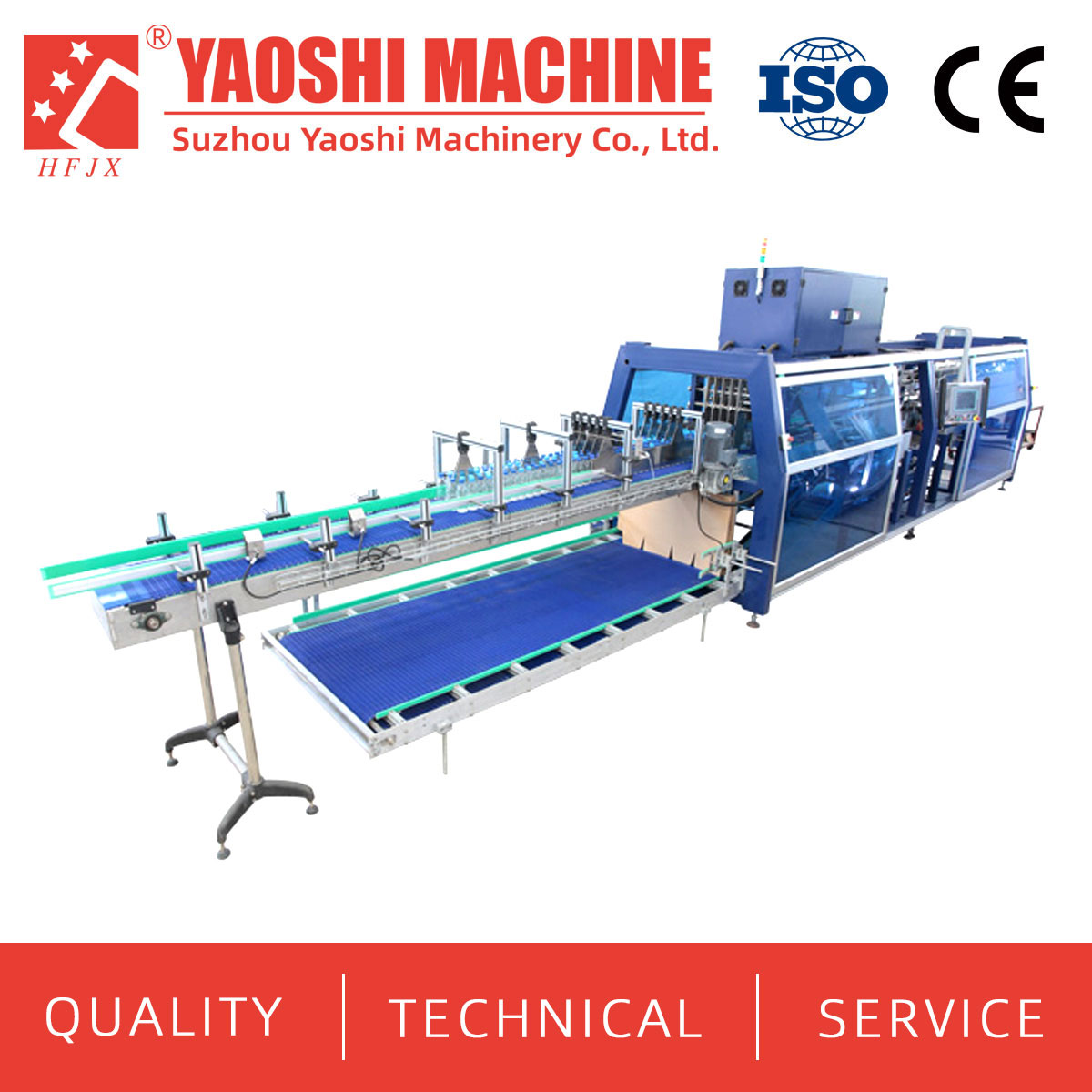
Carton and protective-pack requirements differ with bottle weight, contact risk and distribution conditions.
| Project area | PET with inline blowing | One-way glass | Returnable glass |
|---|---|---|---|
| Major auxiliary demand | Blowing air, cooling and preform handling as specified | Depalletizing, empty-pallet flow and gentle bottle handling | Bottle and crate washing, return sorting and wastewater handling |
| Warehouse input | Preforms and closures | Bulky and heavy empty-bottle pallets | Returned bottles, crates and replacement bottles |
| Layout concern | Blower-to-filler transfer and utility rooms | Glass receiving, storage and safe transfer | Dirty/clean separation and return-package flow |
| Waste route | Rejected preforms, bottles and packaging materials | Broken or rejected new glass | Rejected returns, washer discharge and broken glass |
The buyer should request a utility schedule and layout for the actual container route. Comparing only filler power or footprint hides major differences in bottle production, washing, storage and material handling.
Shared equipment may be technically possible for selected bottles, closures and output ranges, but compatibility must be confirmed module by module. Review bottle infeed, rinser, filler support, closer, conveyors, inspection, labeler and packer rather than asking only whether the filler can hold both bottles.
Create a changeover list that identifies:
Parts to replace or adjust
Tools and labor required
Cleaning and safety steps
Closure and label-system changes
Conveyor and inspection recipes
Time from the last good old-format bottle to stable new-format output
If the two package routes require different upstream preparation and secondary packaging, a shared filler does not make the whole line shared. Compare the cost and operating effect of common equipment with dedicated sections.
| Quotation field | Required supplier response |
|---|---|
| Bottle basis | Approved drawings, samples, tolerances and capacity for each format |
| Container preparation | Blowing, unpacking, depalletizing, washing, rinsing and inspection scope |
| Filling and closing | Support method, included functions, closures, change parts and output basis |
| Conveying | Transfer method, guides, accumulation, breakage or deformation response |
| Labeling and inspection | Materials, formats, checks, rejection and changeover requirements |
| Secondary packaging | Pack patterns, materials, rate and pallet or crate interface |
| Utilities and site work | Generation equipment, distribution, final connections and buyer work |
| Testing | Formats, materials, run conditions, quality checks and acceptance point |
Require every item to be marked included, optional, excluded or buyer-supplied. A lower machine price may reflect a different container-preparation or packaging boundary.
Factory and site tests should use approved commercial samples wherever practical. For PET, include the most difficult lightweight, unstable or unusually shaped bottle. For glass, include relevant dimensional variation and the format with the highest handling risk.
Test bottle transfer, rinsing or washing interfaces, filling, closing, inspection, labeling and packing. For a shared line, test the changeover and each package route. Acceptance should measure stable good output at an agreed boundary, not only short-term filler rotation.
Still, mineral or sparkling water specification
PET or glass bottle drawings and samples
New, one-way or returnable container status
Preform details or empty-bottle delivery method
Closure drawings and samples
Target good-output BPH for every bottle
Label and secondary-pack formats
Pallet, crate and warehouse requirements
Required washing, rinsing and inspection scope
Factory layout and available utilities
Shared-line or dedicated-line preference
Installation, testing and training requirements
This information allows the supplier to configure a PET bottle water filling machine, a glass bottle water filling machine or a project-specific shared solution around the actual package route.
Selected formats may share filling equipment when bottle support, transfers, closures and change parts are compatible. The complete upstream and downstream route still needs a separate review.
No. New one-way glass and returnable glass have different preparation requirements. A returnable-bottle washer is a separate process from final rinsing of approved new bottles.
No. PET bottles may be produced inline or purchased ready-made. The quotation should state the container-supply boundary.
The inspection scope follows the bottle source and project risk. Returnable glass normally creates additional incoming-condition and post-wash checks, while PET inspection should address the selected production and supply route.
It depends on bottle stability, pack material, pack pattern, weight and changeover capability. Confirm each commercial pack rather than assuming compatibility from bottle count alone.
Yaos Machinery supplies water filling and related equipment for a bottled water production line. For a project review, prepare the bottle, closure, output, container-supply route, inspection plan, label, secondary package, factory layout and utility information. Ask the proposal to distinguish common equipment, PET-specific modules, glass-specific modules and buyer responsibilities.


+86-512-58530618

Wukesong Road, Sanxing Town, Zhangjiagang City, Jiangsu Province, China


