Two suppliers may quote a mineral water filling machine with the same stated capacity and return very different totals. One offer may cover only the rinsing, filling and capping monoblock. Another may include cap handling, conveyors, change parts, inspection, testing, spare parts and site support. The headline figures cannot be compared until those boundaries are visible.
This guide does not publish price ranges. It explains what changes a filling-machine quotation, which items are often unclear and how to put competing offers onto the same technical and commercial basis.
The phrase “mineral water filling machine price” may refer to several different supply levels. Define the requested level in the RFQ and ask every supplier to mark additions and exclusions.
| Quotation level | Possible scope | Questions that must be answered |
|---|---|---|
| Filling monoblock only | Integrated rinsing, filling and capping machine | Are cap handling, controls, guards, machine-mounted piping and change parts included? |
| Monoblock with bottle handling | Main machine plus infeed, discharge and selected conveyors | Where are the mechanical and control connection points? |
| Filling section | Monoblock, cap supply, inspection, drying, coding and conveyors | Which functions, speeds and rejected-bottle arrangements are covered? |
| Filling and packing line | Filling section plus labeling and secondary packaging | Is output balanced using the same bottle, label and pack pattern? |
| Installed project scope | Selected equipment plus engineering, installation or commissioning services | Which local work, utilities, travel and site materials remain with the buyer? |
A complete factory can also require water treatment, bottle production, utility generation and finished-product handling. These modules should be quoted separately or listed clearly in the scope matrix so their cost is not mistaken for the filling machine itself.
A supplier cannot select an exact machine from BPH alone. Submit one reference configuration containing the water type, bottle material, bottle volume, dimensions, neck finish, cap drawing and required output. If several SKUs will run on one machine, list each SKU and its production share.
The capacity request should state the bottle size, bottles per hour, operating hours, expected changeovers and required daily accepted output. Also provide the destination voltage and frequency, compressed-air conditions, factory layout and the machines that the filler must connect to.
Water and filling condition
Bottle drawing, neck finish, weight and sample
Cap drawing, material and sample
Required BPH for every main bottle size
Existing upstream and downstream equipment
Electrical standard, air supply and available space
Use the same reference package for every supplier. Otherwise, one bidder may assume a single standard bottle while another includes several bottle formats and all associated change parts.
Higher capacity can change the number of rinsing, filling and capping stations, machine footprint, weight, connected load and required bottle flow. It can also require a different cap-feeding arrangement, longer conveyors and different upstream or downstream rates.
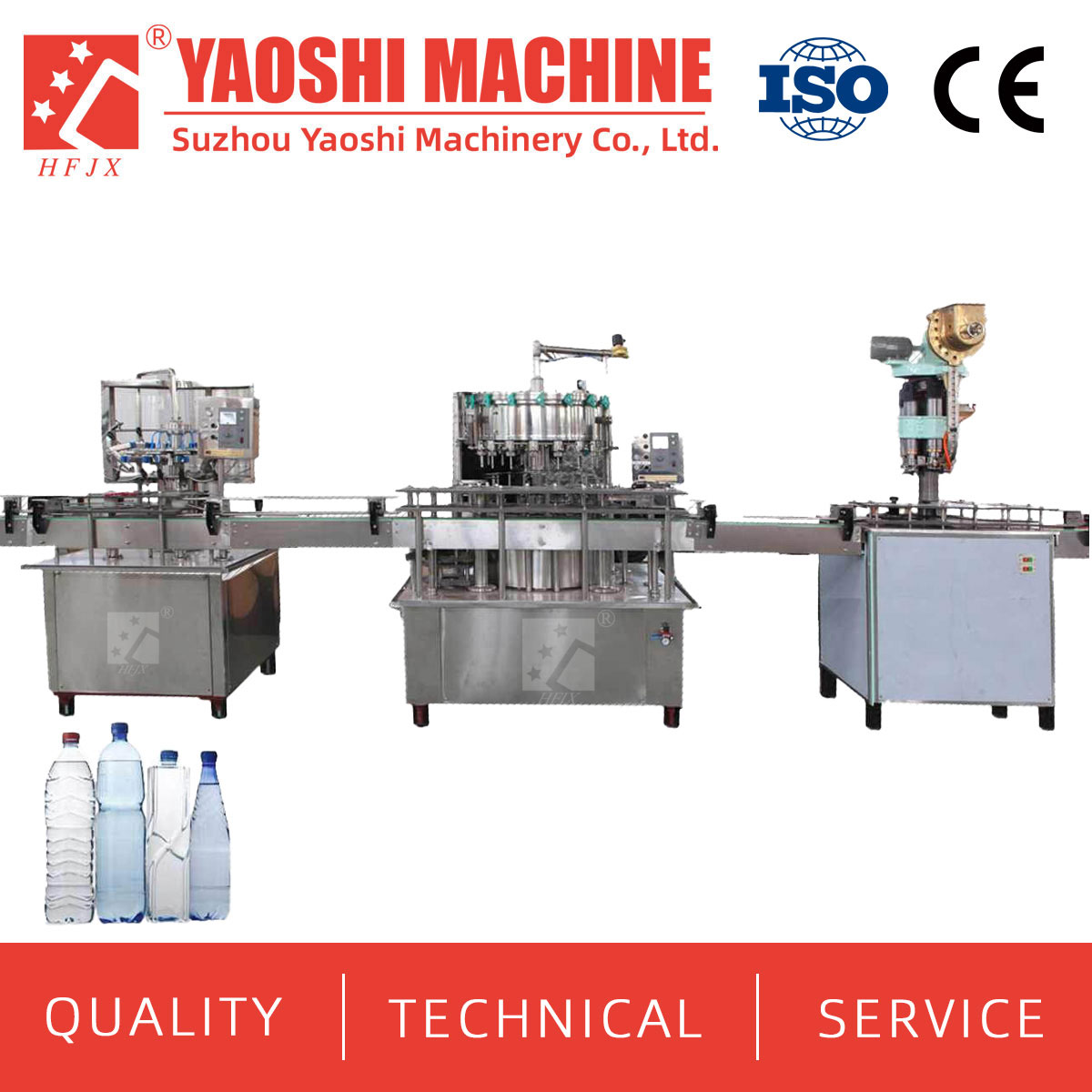
Yaoshi Machinery’s water filling machine range includes equipment for bottled water projects. The specific CXGF rinsing, filling and capping machine page publishes the model data below. The table shows why two capacities are different technical packages; it does not establish a price formula.

| Model | Published capacity | Rinsing / filling / capping heads | Published power | Published size | Published weight |
|---|---|---|---|---|---|
| CXGF8-8-3 | 2,000 BPH | 8 / 8 / 3 | 3.8 kW | 2300 × 1500 × 2100 mm | 2,800 kg |
| CXGF18-18-6 | 6,000–8,000 BPH | 18 / 18 / 6 | 4.4 kW | 2800 × 2150 × 2300 mm | 4,500 kg |
| CXGF24-24-8 | 8,000–12,000 BPH | 24 / 24 / 8 | 5.2 kW | 3100 × 2450 × 2300 mm | 6,500 kg |
| CXGF40-40-10 | 18,000–24,000 BPH | 40 / 40 / 10 | 9.6 kW | 4550 × 2650 × 2300 mm | 8,500 kg |
| CXGF60-60-15 | 28,000–36,000 BPH | 60 / 60 / 15 | 12 kW | 5450 × 3210 × 2300 mm | 12,000 kg |
The same page publishes a bottle-diameter range of 50–115 mm, bottle height of 160–320 mm and compressed-air pressure of 0.3–0.7 MPa for the listed matrix. These ranges do not confirm every bottle shape. The quotation should identify the reference bottle, expected output and required change parts for the buyer’s actual SKUs.
The quotation should describe the functions inside the main machine and identify the supplied assemblies. Request a scope table for rinsing, filling, capping, bottle infeed, discharge, cap sorting and feeding, tanks, pumps, machine-mounted pipework, controls, guarding and operator interface. A brief line reading “automatic 3-in-1 machine” leaves too much room for different assumptions.
Ask for the exact model, station count, filling principle, bottle-transfer method and cap application method. Product-contact materials, component makes and control hardware should be recorded in the project datasheet or bill of materials where they matter to the purchase specification. Do not rely on a description copied from another model.

| Main-machine item | Quotation should state | Common comparison risk |
|---|---|---|
| Rinsing section | Number of stations, bottle handling, rinse-medium connection and drainage boundary | External pumps, tanks or drainage work are assumed but not listed |
| Filling section | Number of stations, filling method, product connection, tank and control basis | Capacity is quoted without a reference bottle or operating condition |
| Capping section | Cap type, capping heads, cap sorter, elevator or feeder and supply point | Cap handling stops before the point expected by the buyer |
| Controls | PLC, operator interface, drives, sensors, alarms and connection signals | Component descriptions differ between brochure and quotation |
| Machine services | Power, air, water, drainage and connection locations | Only one pressure value is shown without consumption or peak demand |
| Safety and access | Guards, access doors, interlocks and maintenance clearances | Site work or additional guarding appears after layout approval |
Bottle volume does not define compatibility. The supplier needs bottle height, diameter, neck finish, weight, base design and controlled drawings. Cap dimensions, material and application method must also be confirmed. Physical samples should be supplied when requested for design or testing.
Ask for a compatibility matrix showing every SKU, supported output and change parts. The list may include guides, star wheels, grippers, cap-handling parts and settings specific to a format. Record whether each item is included in the base quotation, optional or excluded.
A machine that supports several formats may still require manual adjustments, production change time and storage for format parts. Request the changeover procedure and the parts list instead of assuming that a published bottle range means tool-free operation.
The price of the monoblock may stop at its machine frame. The buyer still needs to know how empty bottles enter, how filled bottles leave and which supplier provides the connecting conveyors. Request a layout showing direction of flow, transfer heights, conveyor lengths, motor locations, control ownership and accumulation.
If bottles arrive from a blow molder, confirm the air-conveyor connection and response to a downstream stop. If purchased bottles are used, define the bottle unscrambler or manual infeed boundary. On the discharge side, identify inspection, drying, coding and the transfer to the labeler.
Include the required interface signals in the quotation. Ready, running, fault, blocked and starved states should have an agreed owner and response. Otherwise, the mechanical connection may be supplied without coordinated line control.
Component brands can affect availability, plant standards and spare-parts planning, but a brand name alone does not define the supplied configuration. Ask for a project component list tied to the model and electrical drawing. Record acceptable alternatives and the approval process for substitutions.
The document register should list the general arrangement, utility schedule, electrical drawings, signal list, operating manual, maintenance instructions, parts list and test records. Request language, file format, delivery stage and revision status. Where applicable, define program and recipe backup delivery and access arrangements.
Documents should be treated as quotation items. A statement such as “standard manuals included” does not show whether the buyer will receive information needed for installation, maintenance and parts identification.
Ask for a factory-acceptance test protocol before the order is finalized. It should name the machine, bottle and cap revision, test materials, duration, functions, measured output, inspection criteria and treatment of open items. The test basis should match the assumptions used in the quotation.
If the buyer’s bottle or cap is unavailable, the supplier should state which substitute will be used and which checks remain open. A dry mechanical run, a water test and a capacity test do not prove the same things. Record the agreed scope rather than referring only to “machine testing.”
Testing may also involve travel, samples, consumables, third-party inspection or video records. The quotation should assign these costs and responsibilities clearly without assuming a standard arrangement.
Request separate lists for commissioning spares, wear parts, recommended operating spares and optional critical parts. Each entry should identify the machine, description, quantity basis and part number where available. This allows two quotations to be compared without treating an unspecified “free spare parts” package as equivalent.
Installation supervision, hands-on installation, commissioning, operator training and production support should be separate line items. Define travel, visas, accommodation, local transport, lifting equipment, local labor, tools, translation, working hours and site utilities. State which services are included, optional or buyer supplied.

Raw-water treatment can be a major project section, but it is not automatically part of the filler quotation. If required, request a separate process basis and equipment list for the water treatment system. The proposal should state the treated-water connection point, flow, tank and pump boundary at the filler.
Labeling, coding, secondary packing and pallet handling are also separate unless explicitly listed. Review the available packaging machine options against the approved bottle and pack pattern. Ask the supplier to show how downstream rated speeds convert to the same bottle-per-hour basis.
Bottle blowing, compressors, cooling equipment, utility distribution, civil work, site drainage, freight, taxes and local installation materials should appear in the scope matrix even when excluded. Visible exclusions are easier to budget and assign than unmentioned work.
Place each supplier response into the same comparison sheet. Keep technical data beside commercial status so an included item with the wrong specification is not treated as compliant.
| Comparison field | Information to record | Risk controlled |
|---|---|---|
| Reference duty | Water, bottle, cap, BPH, operating basis and electrical standard | Suppliers quote different machines for different assumptions |
| Main machine | Model, heads, included assemblies, options and component list | Identical labels hide different configurations |
| Format scope | Supported SKUs, change parts, settings and samples required | Additional format costs appear after order |
| Interfaces | Infeed, discharge, conveyors, signals, utilities and connection points | Installation gaps remain between supplied machines |
| Tests and documents | FAT basis, records, drawings, manuals and backups | Capacity and handover expectations are not measurable |
| Services and spares | Spare-parts lists, site services, local inputs and travel boundary | Post-manufacturing work is absent from the headline amount |
| Commercial status | Included, optional, excluded or buyer supplied | Totals are compared without equal scope |
Request an assumptions list and quotation revision whenever the bottle, capacity, cap, factory conditions or required services change. This keeps the mineral water filling machine price tied to an identifiable configuration.
Suppliers may quote different capacities, station counts, bottle formats, components, interfaces, tests, documents and service boundaries. Compare the complete configuration before comparing totals.
No. BPH needs a reference bottle, cap, operating condition and scope. The supplier also needs the required bottle range, electrical standard and connection requirements.
Do not assume the boundary. Ask whether the cap sorter, elevator or feeder, connecting parts and required controls are included and where the buyer supplies caps.
They may be included, optional or excluded. Request lengths, elevations, widths, motors, controls and connection points on the layout and equipment list.
Submit drawings and samples for every SKU. Ask for a compatibility matrix, supported rate and itemized change-part list for each bottle and cap.
Agree on a project-specific FAT protocol covering the machine, approved samples or stated substitutes, test duration, functions, measured output, inspection points and open-item handling.
No. A new factory may also require water treatment, bottle supply, labeling, packing, utilities, site work, logistics and services. Keep those packages visible but separate from the monoblock comparison.
Send the raw-water and product basis, bottle and cap drawings, BPH by bottle size, existing line interfaces, factory layout, electrical standard, utilities and required testing and service scope.
Send Yaoshi Machinery your raw-water information, bottle and cap drawings, required BPH for each bottle size, factory layout, electrical standard and available utilities. State whether you need the monoblock alone, a connected filling section or selected upstream and downstream modules.
Email tony@yaos.ltd or call +86 18915689808. Ask for the exact model datasheet, included/optional/excluded scope matrix, change-part list, utility schedule, layout and FAT basis so the quotation can be compared on equal terms.


+86-512-58530618

Wukesong Road, Sanxing Town, Zhangjiagang City, Jiangsu Province, China