A request for a “600 BPH barrel line” is not enough to select equipment. The supplier still needs to know whether the plant will run 3-gallon barrels, 5-gallon barrels or both; whether the containers are new or returned; how they will be inspected and washed; and where the quoted equipment scope begins and ends.
These projects should also be separated from small PET bottled-water lines. Large barrels require their own handling, washing, filling, capping and discharge arrangement. This guide explains the information a buyer should prepare before requesting a barreled water filling machine quotation.
“3 gallon” and “5 gallon” describe nominal volume, not a complete mechanical specification. Two barrels with the same volume may differ in outside diameter, height, neck profile, handle position, wall stiffness and base shape. Those differences can affect guides, carriers, washing positions, filling alignment and cap placement.
Send dimensioned drawings and physical samples when possible. If one line must handle both sizes, ask the supplier to identify the required change parts, adjustments and operating procedure. Compatibility should be confirmed against the real barrel rather than a photograph.
| Project input | Information to provide | Why it affects the machine |
|---|---|---|
| Barrel volume | 3 gallon, 5 gallon or both | Defines the required operating range and changeover scope |
| Barrel drawing | Height, diameter, neck, mouth, handle and base dimensions | Affects transport, positioning, washing and filling interfaces |
| Barrel material | Material specification supplied by the buyer | Supports confirmation of handling and washing conditions |
| Barrel condition | New, returned or a controlled mix | Changes inspection and washing requirements |
| Cap | Drawing, sample, material and sealing form | Determines cap feeding, placement and pressing configuration |
| Format plan | Current sizes and future additions | Helps define change parts and expansion allowance |
A line using new containers does not have the same preparation requirement as a refill operation receiving returned barrels. For returned containers, the buyer should define collection conditions, typical dirt, label or sleeve residue, damaged-barrel rejection and the plant's approved washing procedure.
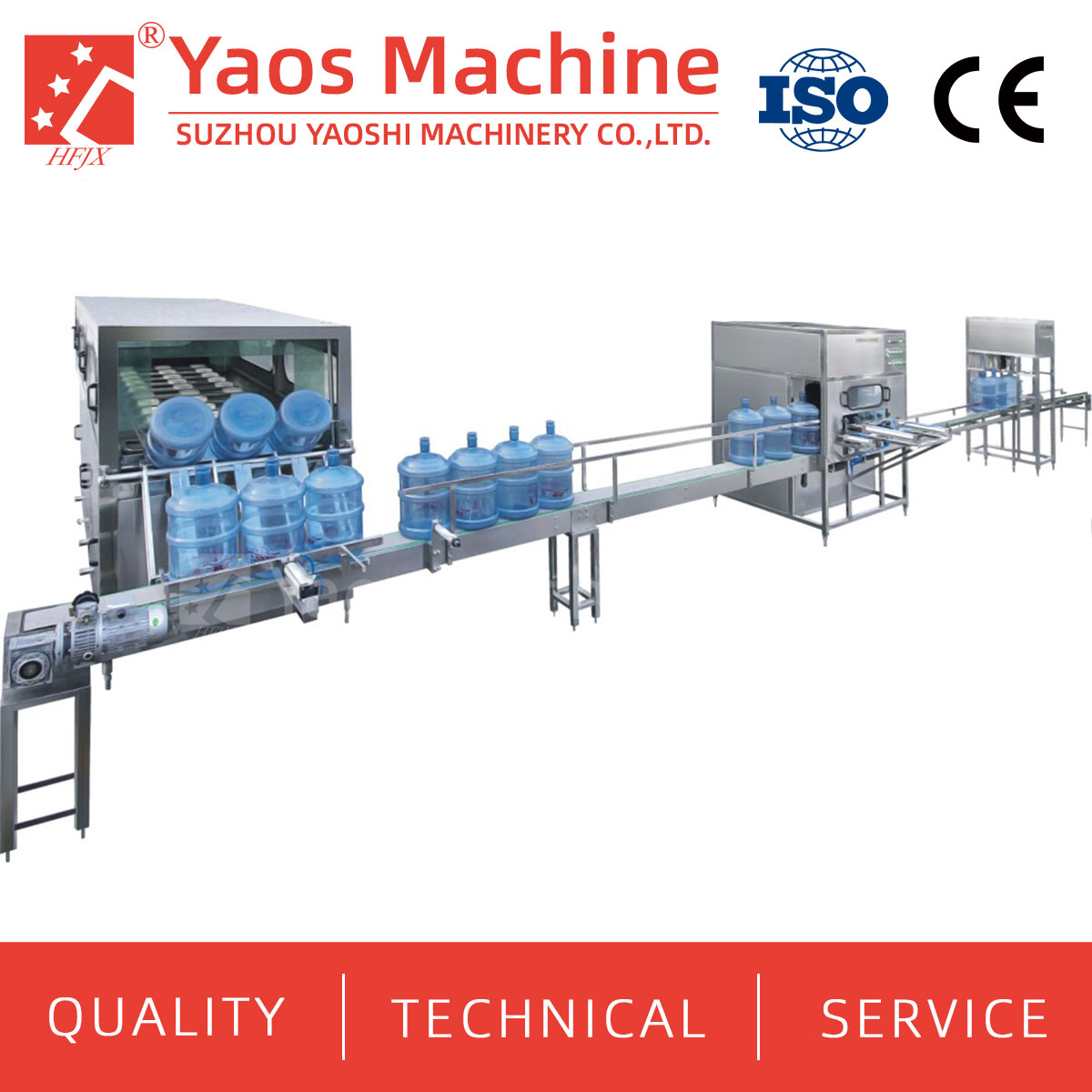
The relevant Yaoshi product page describes a QGF line that integrates washing, filling and capping for 3- and 5-gallon drinking-water barrels. Its detailed page also describes a 12-step washing sequence with pre-washing, alkali washing, recycled-water washing, disinfectant-water washing, finished-water washing and drain intervals. This is published product information, but the chemical concentration, contact conditions, water quality and final cleaning procedure still need project confirmation.

Ask the quotation to state whether external brushing, cap removal, leak inspection, manual inspection stations and rejected-barrel handling are included. Do not assume that every item described as a “barrel line” includes the same preparation equipment.
Yaoshi's published QGF description identifies three core functions: barrel washing, water filling and capping. The page also describes automatic barrel transfer, counting and product discharge. The filling section is listed as gravity filling with a no-bottle/no-fill function, while the capping section includes a cap unscrambler, cap rail and capper.
This core machine is only one part of the factory scope. Product-water supply, returned-barrel receiving, pre-inspection, external cleaning, finished-barrel inspection, date coding and downstream handling should each be marked as included, optional, excluded or buyer-supplied. The gallon-water production solution can be used as a starting point for discussing the wider line boundary.
BPH for this project means barrels per hour. Always attach the barrel volume to the number, because a 5-gallon barrel and a small bottle cannot be compared on bottle count alone.
Start with the required saleable barrels per day. Divide that number by planned production hours, then account for changeovers, sanitation, breaks, barrel rejection and expected operating interruptions. The result is the required net line output. A nominal machine rating should be compared only after the test barrel, cap, water supply and acceptance period are defined.
Capacity planning must include water demand. At the same barrel count, a 5-gallon format requires more filling water than a 3-gallon format. Washing water and line cleaning add further demand. The water treatment system, finished-water tank and transfer pumps therefore need to be checked against both production and cleaning consumption.
The official detailed QGF product page publishes data for QGF-450, QGF-600 and QGF-900. It lists 3–5 gallon application and a reference barrel dimension of φ276 × 496 mm. The figures below reproduce the readable model data for initial screening; final specifications must be confirmed in the technical quotation.
| Model | Published output | Rows | Published power | Published dimensions | Published weight |
|---|---|---|---|---|---|
| QGF-450 | 450 BPH | 3 | 7 kW | 4200 × 1600 × 3000 mm | 900 kg |
| QGF-600 | 600 BPH | 4 | 8 kW | 4200 × 1600 × 3600 mm | 1,000 kg |
| QGF-900 | 900 BPH | 5 | 10 kW | 4200 × 1600 × 4000 mm | 1,500 kg |
| QGF-1200 | 1,200 BPH indicated by the product title | Confirm | Confirm | Confirm | Confirm |
The same page publishes a shared compressed-air range of 0.45–0.6 MPa and 0.17–0.5 m³/hour. Buyers should request a model-specific utility sheet because the visible table does not separate air consumption by model. The separate “450BPH–1200BPH” product page currently contains an unrelated specification block, so it should not be used as a technical data sheet.
Cap samples should be tested with the intended barrel neck. The RFQ should identify whether cap preparation, cap washing or another treatment step is required and who supplies it. The acceptance test should check cap placement, sealing condition and barrel stability at the discharge.

Downstream scope varies by distribution method. Some projects need only inspection and manual removal. Others may require neck-film treatment, coding, bagging, conveyors, racks or pallet handling. List these modules individually instead of grouping them under “packing.”
Provide the available electrical supply, compressed-air pressure and capacity, product-water connection, washing-water arrangement and drainage points. If hot water or chemical solution is part of the approved washing process, identify how it will be prepared, controlled and returned.
The layout should show barrel receiving, dirty and clean zones, machine footprint, operator positions, maintenance access, chemical handling, finished-product discharge and utility routes. Floor loading, drainage direction, door size and equipment access also need review before shipment.

Two suppliers can quote the same BPH while offering different equipment and services. Request a scope matrix showing the core QGF machine, pre-washing modules, cap handling, conveyors, inspection, coding, finished-barrel handling, utility equipment, pipes, cables, installation materials, commissioning and training.
Factory acceptance should use confirmed barrel and cap samples. Record the test duration, counting point, acceptable stops, filling checks, cap checks and washing sequence to be demonstrated. If both 3- and 5-gallon formats are required, include both in the approved test plan and identify who supplies the samples and change parts.
| RFQ field | Required buyer information |
|---|---|
| Water | Raw-water analysis, finished-water target and approved treatment route |
| Barrels | 3 gallon, 5 gallon or both; drawing, material, samples and return condition |
| Caps | Drawing, samples, sealing method and preparation requirement |
| Capacity | Required net BPH for each barrel size, shifts per day and daily demand |
| Washing | New or returned barrels, expected contamination and required washing procedure |
| Line scope | Loading, decapping, brushing, wash-fill-cap, inspection, coding and discharge modules |
| Utilities | Electricity, compressed air, water, drainage and any heating requirements |
| Factory | Dimensioned layout, available space, access, zoning and planned expansion |
| Acceptance | Test barrels, caps, duration, counting point and quality checks |
Using “5 gallon” without supplying the barrel and neck dimensions.
Comparing BPH without defining the barrel volume and net output point.
Assuming returned barrels need the same preparation as new barrels.
Buying the wash-fill-cap block before confirming treatment-water capacity.
Leaving cap feeding, inspection and finished-barrel handling outside the scope review.
Expecting one format test to prove both 3- and 5-gallon operation.
The official QGF product description states that the line is intended for 3- and 5-gallon drinking-water barrels. The buyer should still submit actual barrel drawings and samples so compatibility and change parts can be confirmed.
The published description identifies washing, filling and capping as the core functions. Additional preparation, inspection and finished-barrel handling modules should be listed separately in the quotation.
Do not assume this. Ask the supplier to state the guaranteed or accepted output for each approved barrel and cap combination.
That depends on their condition and the approved cleaning process. Inspection, cap removal, external brushing or rejection may be required before the integrated washing section.
It should cover filling demand, washing demand, cleaning and operating allowances. The treatment process itself should be based on the raw-water analysis and finished-water target.
Use approved barrel and cap samples to test transfer, washing sequence, filling, capping, discharge and the agreed output measurement. Include both sizes when both are part of the order.
The official product title identifies a 1,200 BPH option, but the readable model table does not provide a complete QGF-1200 data row. Power, dimensions, weight and utilities therefore need written confirmation.
Send Yaoshi Machinery your raw-water report, 3- or 5-gallon barrel drawing and samples, cap specification, required net BPH and factory layout. State whether the barrels are new or returned and identify the upstream and downstream modules you expect in the quotation.
Request the model-specific equipment list, utility schedule, layout and scope boundary through the contact page, by email at tony@yaos.ltd, or by phone/WhatsApp at +86 18915689808.


+86-512-58530618

Wukesong Road, Sanxing Town, Zhangjiagang City, Jiangsu Province, China