Choosing a China filling machine manufacturer for a bottled-water project should not begin with the lowest price or the highest brochure speed. A useful comparison starts with one project brief and asks every supplier to support its proposal with the same types of drawings, calculations, test records and scope statements.
The purpose of supplier evaluation is not to collect more claims. It is to determine whether a manufacturer can translate your raw-water conditions, bottle format, required net output and factory constraints into a complete and testable equipment scope. The following 12 criteria help bottled-water plant owners and procurement teams compare quotations on that basis.
Before comparing suppliers, give each company the same input package. It should identify the raw-water source and analysis, finished-water requirement, bottle and cap drawings, bottle sizes, required net BPH, bottle supply method, label and secondary-pack formats, available floor space and utilities. If some information is not yet available, mark it as pending instead of allowing each supplier to make a different assumption.
A consistent brief makes differences visible. One quotation may include treatment, bottle blowing, filling and packing, while another may cover only a filling monoblock. Those prices are not comparable until the boundaries are aligned.
Request the company name that will sign the contract, the manufacturing address and a clear explanation of which machines are designed, assembled and tested in-house. If third-party equipment is included, the quotation should identify it. A factory video or visit is useful only when it can be connected to the legal entity and the equipment being quoted.
Ask for a process flow covering raw-water treatment, treated-water storage, bottle handling, rinsing, filling, capping and downstream packaging. The supplier should explain the design basis for each module. A standard reverse-osmosis list is not a substitute for reviewing the buyer's water report. The required treatment sequence may include multimedia filtration, activated carbon, softening, precision filtration, RO, UV or ozone, but the final selection must follow the actual project conditions.
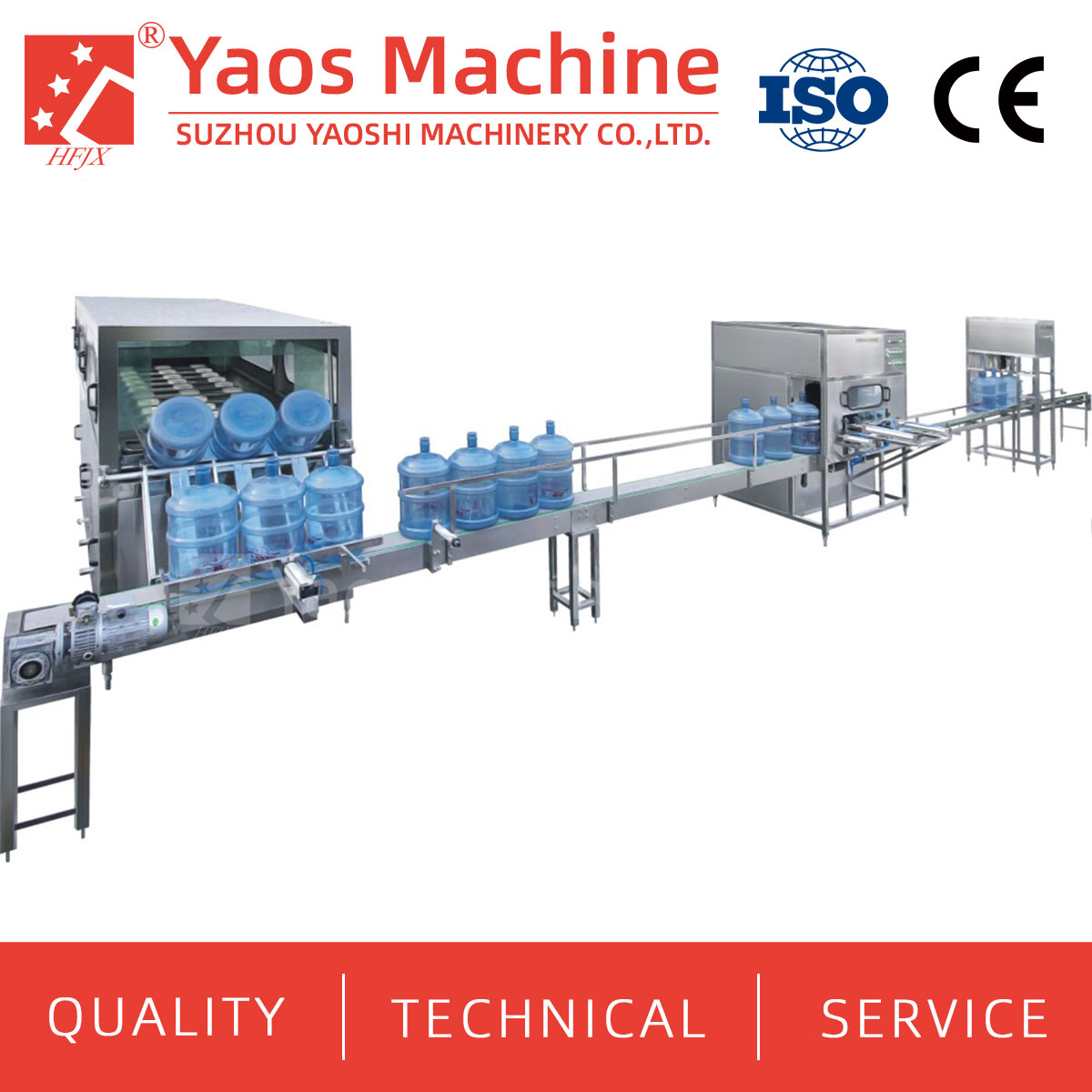
Yaoshi's published water treatment system page shows the types of modules that may be configured for purified or mineral-water projects.

Provide dimensioned bottle and cap drawings, neck-finish data and representative samples. Ask the supplier to return an approved compatibility matrix showing bottle diameter, height, volume, cap type and required change parts. The proposal should also state whether empty bottles arrive from an external supplier or from an in-line PET blow molding machine.
Do not compare BPH without the bottle size and test conditions. Request the rated output, expected net line output, product used for testing, test duration, counting point and permitted stoppages. Ask how the filler speed is coordinated with the blower, labeler and packer. This separates a nameplate number from output that the complete line can sustain.
The model name, number of rinsing, filling and capping heads, bottle range, utilities, footprint and weight should agree across the quotation, layout and technical datasheet. Record every contradiction in a clarification log. A supplier should resolve discrepancies in writing before the purchase order is released.
Identify who is responsible for the connections among the bottle blower or unscrambler, air conveyor, filling monoblock, cap supply, conveyors, labeler and packing equipment. The interface list should cover machine elevations, conveyor speeds, sensor locations, signal exchange, accumulation and emergency-stop logic. A water filling machine range is only one part of a reliable bottled-water line.

Request the raw-water analysis used for selection, target treated-water flow, recovery assumptions, tank capacities, sanitation method, instrument list and utility demand. The supplier should identify which values are calculated and which still require confirmation. Avoid accepting a treatment package selected only from the filler BPH.
Ask for material and purchased-component lists, inspection checkpoints and records tied to the actual machine serial number or project number. Evidence can include incoming-component checks, fabrication inspection, assembly records and electrical test sheets. Certificates and brand lists should match the offered configuration rather than a generic marketing file.
The factory acceptance test should state the bottles, caps and labels used, production duration, speed target, reject criteria, fill-level checks, cap checks, alarms and safety tests. Define whether the buyer will witness the FAT in person or remotely. The output should include a signed test report, recorded issues and closure evidence, not only a short running video.
Before ordering, list the required general arrangement drawing, process flow or P&ID, electrical drawings, utility schedule, foundation requirements, manuals, spare-parts list, lubrication schedule, PLC or HMI backup and recommended maintenance records. State the document language, format and delivery milestone in the contract.
The quotation should distinguish remote guidance, on-site supervision, mechanical installation, electrical connection, commissioning, operator training and trial production. Clarify who provides technicians, local labor, lifting equipment, travel, accommodation, test materials, utilities and production consumables. Acceptance conditions should be written before shipment.
Ask every supplier to label items as included, optional or excluded. Tie payment milestones to measurable outputs such as approved drawings, completed FAT and shipment documents. Establish how bottle changes, component substitutions, layout revisions and additional services will be priced and approved. This prevents a low initial quotation from becoming an incomplete project.
Score each criterion from 0 to 2: 0 means no evidence, 1 means partial or generic evidence, and 2 means project-specific evidence. Record the document reference beside the score so the evaluation can be audited later.
| Criterion | Evidence to Request | Warning Sign | Score |
|---|---|---|---|
| Legal entity and role | Contract entity, factory address, make/buy list | Manufacturer role remains unclear | 0–2 |
| Water process competence | Project process flow and design basis | Generic equipment list only | 0–2 |
| Bottle and cap compatibility | Approved drawings, samples and change-part list | No written compatibility review | 0–2 |
| Capacity basis | Net BPH, bottle size and test method | Only maximum nameplate speed | 0–2 |
| Technical consistency | Matching datasheet, layout and utility schedule | Conflicting model data | 0–2 |
| Line integration | Interface matrix and controls responsibility | Unassigned interface gaps | 0–2 |
| Treatment design | Water analysis, flow balance and module basis | RO selected without water data | 0–2 |
| Inspection traceability | Project-linked inspection and component records | Generic certificates only | 0–2 |
| FAT | Protocol, samples, duration and signed report | Short video replaces test criteria | 0–2 |
| Documents | Drawing and manual register with milestones | Handover package undefined | 0–2 |
| Site service | Task, cost and acceptance responsibility matrix | “Installation included” without boundaries | 0–2 |
| Commercial control | Included, optional and excluded schedule | Scope changes lack approval rules | 0–2 |
The following figures are selected from Yaoshi Machinery's published CXGF rinsing-filling-capping machine page. They illustrate the level of model-specific data buyers should normalize before comparison. They are catalogue references, not a performance commitment for a new project. Final selection still depends on the approved bottle, cap, water process, layout and acceptance conditions.
| Model | Published Capacity | Rinsing/Filling/Capping Heads | Power | Dimensions |
|---|---|---|---|---|
| CXGF8-8-3 | 2,000 BPH | 8/8/3 | 3.8 kW | 2300 × 1500 × 2100 mm |
| CXGF16-16-6 | 4,000–6,000 BPH | 16/16/6 | 4.4 kW | 2600 × 1900 × 2300 mm |
| CXGF24-24-8 | 8,000–12,000 BPH | 24/24/8 | 5.2 kW | 3100 × 2450 × 2300 mm |
| CXGF40-40-10 | 18,000–24,000 BPH | 40/40/10 | 9.6 kW | 4550 × 2650 × 2300 mm |
| CXGF60-60-15 | 28,000–36,000 BPH | 60/60/15 | 12 kW | 5450 × 3210 × 2300 mm |
The published series lists a bottle-diameter range of 50–115 mm, a bottle-height range of 160–320 mm and compressed-air pressure of 0.3–0.7 MPa. Buyers should still request written confirmation for their bottle drawings and the complete project utility balance.
The quotation gives one BPH figure without a bottle size or test definition.
The layout, technical table and commercial offer refer to different models.
The treatment system is proposed before the raw-water analysis is reviewed.
The supplier cannot identify who owns each upstream and downstream interface.
The FAT is described only as “machine running before shipment.”
Installation, local labor, travel and trial-production materials are not allocated.
Major component substitutions can be made without the buyer's written approval.
A qualified comparison should follow the material flow, not just the filler. Review treatment and storage first, then bottle supply, rinsing, filling, capping, labeling, coding and final packing. Yaoshi publishes separate pages for water treatment, PET bottle blowing, water filling and packaging machines; these pages can help define an initial equipment boundary. The final quotation should convert that boundary into project-specific drawings, interfaces, tests and exclusions.

No. First align the bottle, cap, water process, net capacity and included modules. Price comparison becomes meaningful only after the technical and commercial scopes are equivalent.
Match the contracting entity to the production address, request a make/buy list and review project-linked manufacturing and inspection records. A factory visit should include the relevant assembly and testing activities.
Rated BPH may describe one machine under stated conditions. Net line output reflects the coordinated result of bottle supply, filling, capping, conveying, labeling and packing after planned losses and stoppages are defined.
No. Treatment selection should follow the raw-water analysis and the required finished-water specification. The supplier should explain why each treatment module is included.
Send dimensioned bottle and cap drawings and, when possible, physical samples. Also provide label and secondary-pack information if the supplier is responsible for the complete line.
It should use agreed materials and define test duration, output, fill level, cap quality, rejects, alarms and safety checks. Open issues and their closure should be recorded.
The contract should specify the approved layout, process information, electrical drawings, utility schedule, manuals, spare-parts list, software backup and FAT record required before shipment.
A small shortlist is usually easier to evaluate than a large collection of unmatched offers. Apply the same evidence checklist and retain suppliers that resolve technical and scope questions clearly.
Send Yaoshi Machinery your raw-water analysis, bottle and cap drawings, required net capacity, bottle supply method, packing format, factory layout and available utilities. The project team can use these inputs to define the treatment, filling and line-interface scope for review. Contact tony@yaos.ltd or +86 18915689808.


+86-512-58530618

Wukesong Road, Sanxing Town, Zhangjiagang City, Jiangsu Province, China